


Page 489 - Demo
P. 489
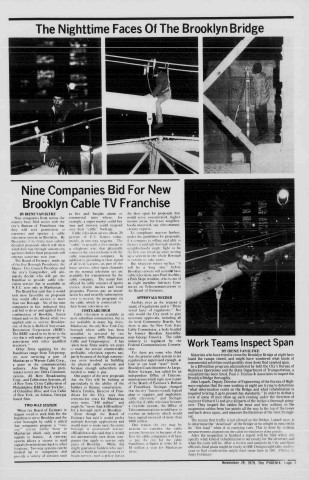
The Nighttime Faces Of The Brooklyn BridgeNine Companies Bid For NewBrooklyn Cable TV FranchiseBY IRENE VAN SLYKENine companies from across ilie country have filed notice with the city%u2019s Bureau of Franchises that they will seek permission to construct and operate a cable television system in Brooklyn. By December 3 the firms must submit detailed proposals which will then wind their way through various city agencies before final proposals will emerge sometime next year.The Board of Estimate, made up of the five Borough Presidents, the Mayor. City Council President and the city%u2019s Comptroller, will ultimately decide who will get the franchise to provide cable television service that is available in N.Y.C. now only in Manhattan.The Board has said that it would look most favorably on proposals that would offer service to more than one Borough. Six of the nine companies in fact indicated they will bid to do so and applied for a combination of Brooklyn, Staten Island and/or the Bronx while two applied only to service Brooklyn: one of them is Bedford Stuyvesant Restoration Corporation (BSRC). The BSRC stated in its letter to the city that it will make a proposal %u201c in association with other qualified investors.\Other firms applying for the franchises range from Tclcprompter, now servicing a part of Manhattan to Warner Cable Corp., a giant in the communications industry. Also filing the preliminary notice are: Delta Communications, All Boro Broadcasting Corp., and Cablevision Systems, all of New York; Cities Cablevision of Philadelphia; KBLE New York Inc., of Columbus Ohio; and Cox Cable of New York, an Atlanta, Georgia based firm.TWO-WAY SYSTEMWhen tne Board of Estimate in August voted to seek bids for the franchise to serve Brooklyn and the other boroughs by cable it asked that companies propose a %u201c two-<%u00ab-/%u00ab%u00ab>\cu ciom lin lilrr inManhattan which only send out signals to homes. A two-way system allows a viewer to send signals from his home back to other locations. Two-way systems can be hooked up to computers and provide a variety of services suchas fire and burglar alarm or commercial uses where, for example, a super market could buy lime and viewers could respond over their %u201c cable%u201d hook-up.Cable television serves about 20 percent of U.S. homes today, mostly in one-way systems. The %u201c cable\a telephone wire that physically connects the viewers home with the cable transmission company. In addition to providing a clear signal of all local stations, as part of the basic service, other open channels on the normal television set arc available for transmission by the cable company. The usual fare offered by cable consists of sports events, recent movies and local programs. Patrons pay an installation fee and monthly subscription costs to receive the programs via the cable which is connected to their home television set.COSTS ARE HIGHCable television is available in most suburban communities, but is not available in many big cities. Manhattan, the only New York City borough where cable has been installed, is serviced by two companies since 1970, Manhattan Cable and Tclcpromptcr. It has taken these firms nearly ten years to make the service commercially profitable, television experts say, partly because of the high construction costs involved in building the physical cable network and because enough subscribers are needed to make it pay.One aspect of the new proposals that the City will be looking at particularly is the ability of the bidders to finance construction. Morris Tarshis, Director of Franchises for the City, says that construction costs for Manhattan were some %u201c $40 million%u201d and might be %u201c more than $100 million%u201d for a borough such as Brooklyn.Even though the Board of Estimate has said it would prefer multiple borough applications and would want to make sure the entire hnrniiuh is u iia n in lo r d se r v ic e ,officials have also said that it would not automatically turn down companies that apply to service only parts of Brooklyn. While this might guarantee bidders who can%u2019t afford to build an entire network to begin service, such a policy leavesthe door open for proposals that would serve concentrated, higher income areas, but leave neighborhoods unserved, say telecommunications experts.To complicate matters further, under the guidelines for proposals, if a company is willing and able to finance a multiple borough system, neighborhoods might fight to be the first one wired up since setting up a system in the whole Borough is certain to take years.But whatever issues surface \will be a long time%u201d before Brooklyn viewers will actually have cable television, says Paul Asofsky, a Park Slope resident, who is one of an eight member Advisory Committee on Telecommunications to the Board of Estimate.APPROVALS NEEDEDAsofsky cites as the reasons a tangle of regulations and a %u201cThree tiered layer of regulators.%u201d Not only would the City need to give necessary approvals, including all the local Community Boards, but there is also the New York State Cable Commission, a body headed by former Brooklyn Assemblyman George Cincotta. The cable industry is regulated by the Federal Communications Commission.Yet there arc some who think that the present cable system is not regulated or supervised enough, at least at our local %u201c user%u201d level. Brooklyn Councilmcmbcr At Large, Robert Stcingut, has called for an independent Office of Telecommunications which right now is part of the Board of Estimate's Bureau of Franchises. Stcingut charged that the city %u201c has no overall, logical plan to regulate and implement cable television,%u201d and Stcingut adds that if cable television became a city wide system, the Office of Telecommunications would have to oversee an industry which would have capital invested of more than $400 million.One reason the city may be anxious to expedite the cable system, however, is because of the fees the cable companies will have to pay the city for the cable franchises, a figure at some $3 to $4 million a year for Manhattan alone.Work Team s inspect SpanBY IRENE VAN SLYKEMotorists who have tried to cross the Brooklyn Bridge at night havefound the ramps closed, and might have wondered what kinds ofmonumental activities could possibly close down that vaunted span.In a $20 million program administered by both the City%u2019s Bureau ofHighways Operations and the State Department of Transportation, aconsultant has been hired, Paul J. Emilius & Associates to inspect theBrooklyn Bridge thoroughly.John Lopuch, Deputy Director of Engineering of the Bureau of Highways explains that the men working at night are trying to determine%u201cwhat deterioration exists on the Bridge and what rehabilitation isrequired to bring it up to present day standards.\crew of some 10 men show up each evening under the direction ofengineer Richard Li and give all parts of the bridge a thorough goingover. They inspect the cables for wear and tear walking on thesuspension cables from low points all the way to the top of the towerand back down again, and measure the thickness of the steel throughout.The reason that traffic is not allowed on the Bridge, Lopuch says, isto determine the \its \measurements at points on the cable in relation io oilier points.After the inspection is finished a report will be filed which willspecify what kind of rehabilitation is necessary for the structure andwhat the costs will be. After a review and analysis by City and Stateofficials, final plans might be ready in 1980. Design might take anotheryear so that construction might start some time in 1981. (Photos b\\Andy Feldman 1November 29, 1979, The PHOENIX, rage 3


