


Page 541 - Demo
P. 541
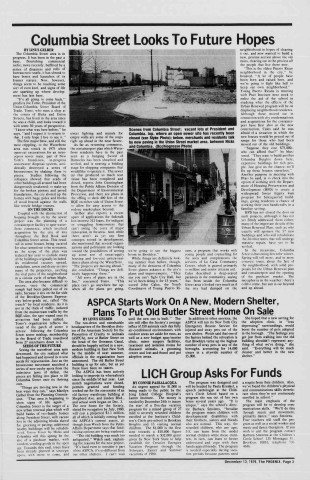
C o l u m b i a S t r e e t L o o k s T o F u t u r e H o p e sBY LINUS GELBERprogress. It has been in the past a busy, flourishing commercial niche; more recently, buffeted by a series of disasters and rolls of bureaucratic snafu, it has shrunk to bare bones and haunches of its former stature. Now, however, things seem to be reaching some sort of even keel, and signs of life are sparking up where development has lain bare.%u201c It%u2019s all going to come back,%u201d predicts Joe Tomo, President of the Union-Columbia Street Board of Trade. Tomo, who runs a shop at the corner of Hicks and Union Streets, has lived in the area since he was a child, and looks toward it with some 50 years of perspective.%u201c I know what was here before,%u201d he says, %u201c and I expect it to return to that. I only hope I live to see it.%u201d The first major blow, and still the most crippling, to the Waterfront area was struck in 1975 when open-cut excavations for an interceptor sewer main, part of New York%u2019s brand-new, in-progress wastewater disposal system, accidentally destroyed a series of brownstones by shaking them to pieces. Studies following the collapses showed that scads of other buildings all around had been dangerously weakened; to make up for the broken pinions and jarred foundations, the city shored up the homes with huge poles and blocks of wood braced against the walls like trestle bridge trusses.ON THE DOCKS Coupled with the destruction of housing brought on by the sewer project was the planning of a containerport facility to spur waterfront commerce, which involved acquisition by the city of lots throughout the Red Hook and Columbia Street areas. This resulted in some houses being vacated for what turned out to be no reason, as the scope of the plan was reduced last year to exclude many of the buildings originally included. As residential vacancy spread, vandalism, arson and decay set into many of the properties, catching the vital parts of the neighborhood in a vicious cycle of urban blight.The area also became difficult to restore, once the commercial oomph had been pulled out of its sails, because it sits on the far side of the Brooklyn-Queens Expressway below-grade cut, called %u201c the trench%u201d by local residents. As it is not in the thick of traffic, isolated from the mainstream traffic by the BQE slice, the spot waned once its attractons had been sullied. Tomo%u2019s organization reflects the trend of the patch of street it serves: following the ColumbiaStreet sewer mishap, membership in the Board of Trade nosedived from 27 merchants down to 6.SEEDS OF THE FUTURESeeing the waterfront area spin downward, the city realized what had happened and moved in to sow seeds for rejuvenation. Just as the brownstone movement snatched a series of now-cushy spots from the indecisive jaws of defeat, the pieces are falling into place to lift Columbia Street onto its thriving own.%u201cThings are moving now in the best ways they can,%u201d says Marilyn Gelber from the Planning Commission. %u201cThat area is beginning to show signs of life again.%u201d Columbia Street is the target of a new urban renewal plan which will build banks of two-family homes along President Street, with vacant lots in the adjoining blocks slated for greening or paving; additional nearby buildings will be rehabili- !a!cd Tjnion ^irppt hv Hicks andColumbia will this spring be the site of a pushcart market, with vendors vending goods in the open air. Towards this end, trees have been already planted in strategic spots, with more to come, andstreet lighting and murals for empty walls are some of the steps right up ahead in the near future.As far as returning commerce, the containerport plan which Waterfront residents have in the past seen as a hanging Sword of Damocles has been sheathed and settled, and is nearing a bidding stage for shipping companies that would like to operate it. The sewer cut that produced so much scar tissue has been completed and closed, reports John Cunningham from the Public Affairs Division of the Department of Environmental Protection, and there are plans in the offing to deck 400 feet of the BQE on either side of Union Street to allow for easy access to the redone marketplace beyond.Gelber also reports a recent spurt of applications for fedcralk low-interest 312 loans, for indigent or struggling homeowners that can%u2019t swing the costs of major renovation, in the area. And, while there aren%u2019t as yet any firm concepts rooted in development, she mentioned that several organizations and politicians arc looking toward the possibilities of setting up some sort of sweat-equity housing and low-cost artists-residcnce plans along the Waterfront. %u201c The projects are moving ahead,%u201d she concluded. %u201cThings are definitely happening there.%u201d%u201c All sorts of plans are in the fire,%u201d concurred Tomo. %u201c This place can%u2019t go anywhere but up: when all the plans get going,Scenes from Columbia Street: vacant lots at President andColumbia, top, where an open sewer site has recently beenclosed (van Slyke Photo); below, merchants and residents talkby new paving in the Union Street market area, between Hicksand Columbia. (Occhiogrosso Photo)we%u2019re going to see the biggest boom in Brooklyn.%u201dWhile things are definitely looking sunnier than before, though, many of the denizens of Columbia Street glance askance at the city%u2019s plans and improvements. %u201cThey say you can't fight City Hall, but we%u2019ve been doing it for 15 years,%u201d stated John Cales, the Youth Coordinator of Young Puerto Ricans, a program that works with young people and counselling for the area and complements the services of La Casa Community Center, which is geared primarily to welfare and senior citizens aid. Calcs described a deep-seated paranoia in the community, saying that from inside the Columbia Street area it looked very much as if the city had dumped on theneighborhood in hopes of clearing it out, and now wanted to build a new, pristine section above tne old ruins, clearing out in the process all the people that live there now.%u201c This is the oldest Puerto Rican neighborhood in the city,%u201d he boasted. %u201c A lot of people have been born and raised here, and we%u2019re going to fight like hell to keep our own neighborhood.%u201d Young Puerto Ricans is meeting with Pratt Institute next week to enlist the aid of the school in studying what the effects of the Urban Renewal program will be on displacing neighborhood residents. Although those moved out in connection with city condemnations and acquisitions for the containerport have first shot at the new construction, Cales said he was afraid of a situation in which the new houses would be priced out of range for those who had been moved out of the old buildings.%u201c Suppose they cost $75,000- who can afford that?\tered. %u201cThey want to build another Columbia Heights down here, expensive buildings for rich people. Just give us the chancc-wc%u2019il fix up these houses ourselves.%u201d Another purpose in meeting with Pratt he said, is to check into the option of working with the Department of Housing Preservation and Development (HPD) to create a widespread Sweat Equity loan program for beleaguered buildings, giving residents a chance of working their own handicrafts in a familiar setting.HPD has not closed the door on such projects, although it has not vet firmly addressed them either; many of the important details of the Urban Renewal Plan, such as who exactly will sponsor the 57 new buildings and who will rehabilitate the 34 other units that will undergo massive repair, have vet to be settled.In the meantime, Columbia Street is battening down for winter. Spring will tell more, and in more concrete tones, about the fate of the neighborhood, with solid proposals for the Urban Renewal plan and containerport and the opening of the pushcart market. The metaphor is in the weather: there's cold to come, but sun is out beyond and up ahead.ASPCA Starts Work On A New, Modern Shelter,Plans To Put Old Butler Street Home On SaleBY LINUS GELBERThe run-down and ramshackle headquarters of the Brooklyn division of the American Society for the Prevention of Cruelty to Animals (ASPCA), now at Butler Street on the head of the Gowanus Canal, should be happily settled in a new, modem building in East New York by the middle of next summer, officials in the organization have announced. The old Butler Street building is up for sale, but as yet there have been no takers.The ASPCA has been actively looking to improyle its whereabouts since the middle of last year. Last month negotiations were closed, permits granted and funding worked out for the conversion of an old factory warehouse building at Shepherd Ave. and Linden Blvd., and actual work began on Dec. 3, The new home for the Society, slated for occupation by July, 1980, will cost a projected $1.1 million, all of which is initially coming from the ASPCA%u2019s current assets, although Joan Weich from the Public Affairs Department says that fundraising options are being explored.%u201cThe old building was much too antiquated,%u201d Wejich said, explaining the reasons for the new project.\of the ASPCA. it%u2019s so different from our other shelters. 1 can't waituntil the new one is built.%u201d The site will offer the Society%u2019s average influx of 350 animals each day fully air-conditioned environments with outdoor areas set aside for runs, as well as a new budget spay/neuter clinic, minor surgery facilities, treatment and isolation rooms for diseased animals, a grooming center and lost-and-found and pet adoption areas.In addition to other services, the ASPCA will run its New York City Emergency Rescue Service for injured and stray pets out of the new shelter. Weich said that one of the factors behind the relocation is that Brooklyn turns up the highest number of stray pets in any of the boroughs, accounting for 14,000 strays in a citywide number of 35,000.She hoped that a new setting for the adoption clinic, in %u201cless depressing%u201d surroundings, would boost the number of pets adopted in the borough. %u201cThe feelings you got just from walking into the old building shouldn%u2019t represent anything of what we%u2019re doing,%u201d she said. %u201c Everything will be much cleaner and better in the new shelter.%u201dLICH Group Asks For FundsBY CONNIE PA3SALACQUAAn urgent appeal for $1,000 is being made to the public by the Long Island College Hospital%u2019s Lamm Institute. The money is needed by December 24th to insure the start of a five-day vacation program for a mixed group of 27 mild to severely retarded children enrolled at the Institute%u2019s Children%u2019s Circle pre-school in Brooklyn Heights and 15 visiting normal children. The $1,000 is the first step towards a $10,000 figure needed to match a $32,000 grant given by New York State to help establish the Creative Energies Vacation Program through the February, Easter and Summer vacations of 1980.The program was designed and will be headed by Paula Krenkel, a speech pathologist at the Children%u2019s Circle School based on a program she ran out of her own home several years ago. %u201c It is unique,%u201d says the school%u2019s director Barbara Smoiens, %u201c because the program mixes children with developmental disabilities with their brothers, sisters and friends who are normal. This way, the retarded children, who are ages 3-5, can learn from the model normal children while these children, in turn, can learn to better understand and cope with their handicapped friends. The program is needed especially during vacation periods because parents needa respite from their children. Also, we%u2019ve found the children%u2019s physical and communications skills deteriorate when they%u2019re not continously enrolled in school.%u201dThe main emphasis of the program will be to develop communications skills. %u201c We%u2019ll do this through music and movement, primarily dance,%u201d says Smoiens. Four teachers will staff the program as well as a social worker and music and dance therapists. If you wish to aid the program contact Barbara Smoiens at me Children's Circle School 135 Montague St Brooklyn, 10010, telephone \4646. %u2019mDecember 13,1979, The PHOENIX, Page 3


