


Page 55 - Demo
P. 55
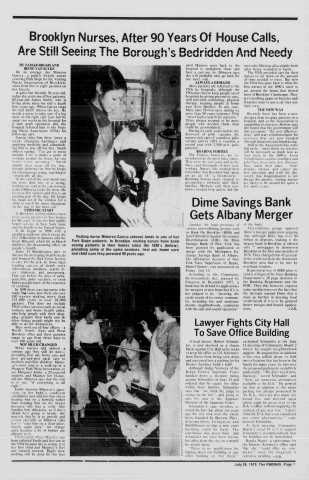
aBrooklyn Nurses, After 90 Years Of House Calls,A l^ P Q t iH Q p o i f i a T h p P m * A i iorS^ V D n f l^ iH r lA n A n r i M a a H u%u25a0 i i v w i u u r i i o i i v i v i v i i m ivj i 1 w u j %u00ab*%u25a0 * %u25a0BY TAMAR BIHARI AND IRENE VAN SLYKEOn an average day Minerva Garcia, a public health nurse covering Park Slope for the Visiting Nurse Association of Brooklyn, visits from five to eight patients on her bicvcle.A quiet but friendlv 30-ycar-old, today she visits one of her patients, 82-vear-old James Smith, who is living alone since his wife's death four years ago. When Garcia rings the bell Smith throws the key. He needs a nurse to take care of%u2019a leg ulcer on his right calf. Last fall he spent two weeks in the hospital for a skin graft operation and the hospital referred him to the Visitin e Nurse Association (VNA) for follow-up care.Garcia visits him three times a week, changing bandages and applying medicine and admonishing him to stay off his feet. Smith objects saying: %u201c I%u2019ve got to move around. 1 try to make a point of working around the house for two hours every m orning.%usually docs keep off his feet, though, pointing out that he keeps his television set going, watching it \At the end of the visit Smith ties his front door key to a string, holding one end so he can retrieve it after Minerva locks the door. He receives few visitors and this is an exciting part of the day. He keeps his head out of the window for a while to watch the nurse disappear on the wav to her next call. EPIDEMIC STARTIn Brooklyn visiting nurses have been seeing patients in their homes for 90 years. It was the first public health service in New York State and the fourth in the United States.It all began in 1888 with a smallpox epidemic which swept the City of Brooklyn in January and the Great Blizzard, which hit in March added to the devastating effect on people%u2019s health.Sonic 13 Brooklynites met to discuss the increasing health needs and formed the Red Cross Society to care for the sick. In those days leading causes of death were tuberculosis, smallpox, scarlet fever. diphteria, and pneumonia. That was before the days of sulfa, penicillin, polio vaccines, or even before people knew of the existence of vitamins.In 1890 there was one nurse who made 564 visits, now there are over 100 nurses making more than 125.000 visits to over 28,000 patients. This does not include VNA%u2019s other services such as social workers and home health aides, w'ho help people with their shopping. prepare their baths and do other things people might not be able to do for themselves.They work out of four offices - a North, South, East and West Brooklyn office and their patients range in age from three days to over 100 vears old.NOT MUCH CHANGEDWhat nurses did almost a century ago they still do now'%u2014 providing first aid, home care and give pre-and-post natal care to mothers and their children. Minerva%u2019s next stop is a walk-up in a Prospect Park West brown stone to sec Margaret Emile, a 20-vear-old student, and Maurice her 16-dayold son. Minerva says that the visit is to see %u201c if everything is all right.%u201cEmile answers Minerva%u2019s questions on the baby's condition confidently and tells her that she is feeding him on a formula rather than keeping him on the breast because she has a cold. She handles him delicately, as if she%u2019s afraid he%u2019s going to break, she marvels that he is so greedy and listens carefully as Minerva tells her to %u201c start him on a clear juice, maybe apple juice%u201d not orange juice because a lot of babies arethe VNA because she is young, it is her first child and Maurice's feet are turned inward. Right now nothing will be done for his feetVisiting nurse Minerva Garcia (above) tends to one of her Park Slope patients. In Brooklyn, visiting nurses have been seeing patients in their homes since the 1890's (below), providing some of the same services, first aid, home care and child care they provided 90 years ago.until Maurice goes back to the hospital to straighten them and have a cast put on. Minerva says she will probably only go back for one more visit.ALWAYS A DEMAND Most patients are referred to the VNA by hospitals, although the VNA also tries to keep people out of hospitals by giving preventive care, with nutrition counseling, phvsical therapy, keeping people at home near their families. In any case, Mary Jane Horton says, during its more than 90 years existence VNA %u201cnever had to search for patients.\There always seemed to be morea lie who needed them than d be accomodated.During its early years before the discovery of polio vaccines the nurses took care of countless polio victims and in 1931 it reached a record year with 2.500 new polio patients.ROARING FORTIESThe Forties, however, arc remembered as the most busy times. They were the w ar years and in the Naw yard thousands of men were working. Nurses who worked then remember that Brooklyn had taken on an air of %u201c a boomtown.%u201d Rooming houses were created to accomodate soldiers and their families. Mothers with their new babies needed help and so did themen who filled up all available beds after being wounded in battle.The VNA provided cars for their nurses to cut down on the amount of time needed to trave. But now the VNA has gone back to what the first nurses in the 1890%u2019s used to get around the farms that dotted most of Brooklyn's landscape. They arc travelling again on bicycles and if nurses w ant to use a car they use their own.THE NEW WAYRecently there has been a new cheaper than keeping patients in a hospital, and so the Association is expanding its services. Horton says she hopes that the government will also recognize %u201c the cost effectiveness\services that are now funded through donations and fundraising.And so the Association has come full circle - most likely its services w ill be necessary as much now as they were in the 1890%u2019s. Even though battles agains smallpox and polio have been won. new diseases nave taken their place - heart attacks, strokes, and cancer are now prevalent and with the discovery that hospitalization is not always the answer, visiting nurses arc likely to be around for quite a few more years.Dime Savings Bank Gets Albany MergerAmidst the loud protests of various anti-redlining groups such as Bank On Brooklyn (BOB) and South Brooklyn Against Investment Discrimination (AID), the Dime Savings Bank of New York has been granted its application to merge with the Mechanics Exchange Savings Bank of Albany. The affirmative decision of New York State Supervisor of Banks, Muriel Siebert. w'as announced on Friday, July 13.According to the Community Re-investment Act, passed by Congress in December 1977, a bank may be denied its applications for mergers or new branches if it is not judged to be %u201c meeting the credit needs of its entire community. including low and moderate income neighborhoods, consistent with the safe and sound operation%u201dof the bank.Anti-redlining groups opposed Dime's merger application arguing that although Dime has over S4 billion in deposits, making it the largest bank in Brooklyn, it offered only 7 mortgages in downtown Brooklyn in the first nine months of 1978. They charged that 65 percent of the credit needs in the downtown Brooklyn area had to be met by non-bank lenders.Representatives of BOB plan to send a critique of the State Banking Department's 28 page decision to the Banking Department and the FDIC. They did, however, express sonic satisfaction over the fact that the decision warned Dime that it must go further in meeting local credit needs if it is to be granted future merger and branch applications. %u2014J.S.Lawyer Fights City Hall To Save Office BuildingA local lawyer. Robert Schmukler, is now involved in a classic battle against City Hall as he seeks to keep his office at 121 Schermerhorn Street from being torn down and converted into a parking lot for District Attorney Gold%u2019s staff.Although Judge Ventiera of the Kings County Supreme Court handed down a decision ruling against Schmuklcr on June 22 and ordered that he vacate his office within three months. Schmuklcr says that %u201c we think the judge is wrong on the law\take the case to the Appelate Division of the Supreme Court.Schmukler's case revolves around the fact that about ten years ago the city took over the entire block bounded by Bocrum Place, Schcrincrhorn. Livingston, and Smith St reels so that a new court building could be built. The courthouse was never built, and Schmuklcr has since been Icasinu his office from the city on a month by month basis.%u201cThere is no justification for ripping down our building or any other building on that block,\exclaimed Schmuklcr at the June 13 meeting of Community Board 2 where he sought neighborhood support. He argued that in addition to his own selfish desire to hold onto a location that has been in the family for many years, he also secs the proposed parking lot as publicly undesirable. %u201c We don't need more blacktop,%u201d noted Schmuklcr, and %u201c there arc numerous alternatives available to the D.A.\out that m addition to the many parking lots already possessed by the D.A.. there arc also many city leased lots and metered spots which could be given over to the D.A.%u2019s office without requiring the creation of any new lots. %u201c 1 don't think the D.A. has even considered any other alternatives,%u2019%u2019 commented Schmuklcr.At their meeting. Community Board 2 voted 29 to 3 to support Schmukler%u2019s recommendation that ihe building not be demolished.Ronda Nagcr, a spokesman for the District Attorney%u2019s office said that she %u201c could offer no comm ents%u2019%u2019 since the litigation is currently pending. %u2014j.s.July 26 1979 The PHOENIX Page 7


