


Page 609 - Demo
P. 609
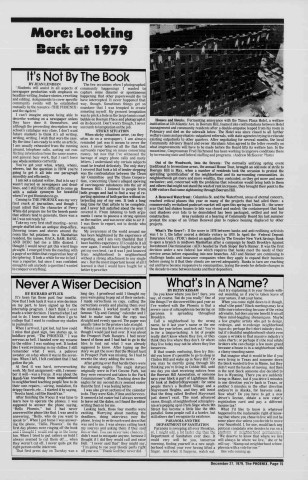
M o r e : L o o k i n gS o c k a t 19 7 9It%u2019s Not By The Book BY JEAN LENIHAN%u201cStudents will assist in all aspects of newspaper production with emphasis on headline writing, feature stories, rewriting and editing. Assignments to cover specific community events will be established mutually by the resource (THE PHOENIX) and the student.%u201dI can%u2019t imagine anyone being able to describe working on a newspaper unless they have done it themselves, and although the preceeding description in my school%u2019s catalogue was close, I don%u2019t want future students to think it%u2019s all writing, writing, writing. I wish that were the case. By the time I am ready to write an article, I am usually exhausted from the running around, telephone calls, sorting out conflicting information from the same source, and general busy work, that I can%u2019t force one whole sentence correctly.You%u2019ve got your whos, whats, whens, wheres, but the question is HOW you%u2019re going to get it all into one paragraph smoothly and efficiently.I am not a natural writer, that is to say I wasn%u2019t nursed on newspapers and deadlines, and I still find it difficult to come up with a suitale synonym for beautiful when I%u2019ve got 20 minutes to go.Coming to THE PHOENIX was my very first crack at journalism, and though I must admit that the character of Perry White did prepare me for the beserk panic that editors tend to generate, there was a lot I was not ready for.Take my very first staff meeting%u2014seven people stuffed into an antique shop-office, throwing issues and stories around the room like hot potatoes. As a Manhattan resident, the names, BACA, BAM, BANG, AND BCBC had me a little dizzied. I thought I would never get this wierd lingo straight. I emerged from the meeting with a page of scribbles that required an hour of deciphering. It took a while for me to feel I was a reporter, but once I was confident enough to ask anybody a question I wanted to conquer everything.The few occasions when I photographed community happenings I wanted to capture some disaster or spontaneous happening that other papers would die to have intercepted. It never happened that way, though, Sometimes things get so mundane that I was tempted to create someting myself. My grossest temptation was to prick a hole in the large tennis court bubble on Boerum Place and photograph it on its descent. Don%u2019t worry though, I never succumb to temptation on the job.STICKY SITUATIONWhen sticky situations arise, (as they often do on a newspaper), I am always reminded just was it means to cover the news. I never believed all the flak that surrounds reporting on issues concerning money, but now that I%u2019ve witnessed the barrage of angry phone calls and nasty letters, I understand why certain subjects must be treated delicately. The only story I covered that took a bit of tender stepping was the confrontation between the Clean Air Committee and The Ulano Corpora tion, (concerning Ulano%u2019s alleged spewing of carcinogenic substances into the air of Boerum Hill). I listened to people from I both groups and had to find a way of reporting opinions of both parties without interjecting any of my own. It took a long long time for that article to be complete, and I never felt satisfied about the way I covered it. From listening to both arguments I came to possess a strong opinion on the matter, and was never able to air it: I was there to report, not to decide who was right.My awareness of the world around me has been heightened by the experience of reporting, and I am very thankful that have had this experience. If I could do it all over again, I would have fought harder to get my own beat, (as it was I just bounced from neighborhood to neighborhood without a strong attachment to any single one). But the most important lesson of all I learned is that I would have fought for a better typewriter.Never A Wiser DecisionBY RICHARD AFFLICKIt%u2019s been fun these past four months.Now that I look back it was a wise decision on my part, to have signed up for the internship program. I don%u2019t think I ever made a wiser decision. I learned what I set out to do. I know now that when I go to college that I want to continue my studies in journalism.When I arrived, I got lost, but how could I miss that giant sign, two stories up, in boldface print, %u201cThe PHOENIX.%u201d I was nervous as hell. I handed over my resume to the editor. I was soaking wet. It looked like I went swimming in my clothes. I still remember what I wore, a pullover sweater, on a day when it was in the seventies. When I left, I felt confident that I had gotten the job.At first it was hard, nervewracking work. My first assignment%u2014ahh, I remember it well%u2014was a Focus. It was about the Handi-Van traveling from neighborhood to neighborhood teaching people Tiow to do their own repairs,%u2014wiring, insulation, fix drippy faucets, etc... I started it by saying,%u201cNeed a hand, call the HandiVan.%u201dAfter finishing the Focus it was time to learn how to operate the phones. I was supposed to answer the phone saying,%u201cHello Phoenix,%u201d but I had never answered the phone like that. I was used to answering, %u201cHello, who do you want to speak to%u201d . When I got home I was answering the phone, %u201cHello, Phoenix%u201d. On the first day phones were ringing off the hook-------- 1 T 4-1-------- T ------------- --------- 1 A %u00bb n 4 ; M 4 U - _ %u201e %u201e %u201eC U IU a W I V U 5 1 1 C a ** U U 1 U v ,iiv 4 u p * i%u00bb u i v , c m o \\j i w i a t . i i_ /u t a n l i e V c i c a K C t u a i i t u o , adidn%u2019t want to misquote anyone, because I thought if I did they would call and raise Hell. %u201cI never said that%u201d they might say, %u201cI%u2019m going to sue your bloody pants right off your ass.%u201d Thank God they never did.long day. I proofread until I thought my eyes were going to pop out of their sockets. I made corrections on copy, cutting the corrections evenly and placing them over the mistakes. I worked mostly with the famous %u201cUp and Coming%u201d calendar and I had to make sure that the copy was straight and evenly spaced. The paper was usually taken to the printers late at night.When I saw my first news story in print I though I would just keel over. It was about the Prospect Park Rangers. I had never heard of them and I had had to go to the files to find out what I was already supposed to know. After typing up the story we got the news that the Mozart bust in Prospect Park was missing. So I had to rewrite the story adding the news.After getting over that hurdle there were the missing eagles. The eagle statues originally were in Fort Greene Park, but they were removed and taken to the Park Commissioner%u2019s office. Tracking down the eagles for my second story seemed easier than the first. I was feeling better.I was also given sections of the calendar to do. They were Kids, Films and Services. It seemed a lot easier but I always seemed to leave out the dates, so I found the editor writing them in for me.Looking back, those four months were exciting. Worrying about meeting the deadlines, doing interviews over the phone, trying to write each word down that was said to me. I was always calling back my sources and asking them if they said, l . %u00ab - U ___________-----------------------------o --------- ----------- ------------ i %u2014 ------- -------------- vbin. When I tried to put callers on hold I always seemed to cut them off..., when they weren%u2019t cut off, I never quite got the right person on the intercom.That first press day on Tuesday was aHouses and Hotels: Fermenting annoyance with the Times Plaza Hotel, a welfare institution at 510 Atlantic Ave. in Boerum Hill, foamed into confrontations between Hotel management and community residents after a double-amputee leaped from his room in February and died on the sidewalk below. The Hotel was since closed to all further welfare cases and psychiatric outpatient referrals, with state agencies trying to relocate existing outpatients to other quarters. After negotiating for several months, the local Community Advisory Board and owner Abraham Ailon agreed to the letter recently on what improvements will have to be made before the Board lifts its welfare ban. In the meantime, Congressman Fred Richmond has been working to improve conditions there by increasing state and federal staffing and programs. (Andrew McKeever photo)Out of the Woodwork, Into the Streets: The normally unifying spring event traditional to brownstone areas, the annual House Tour, brought an odd note of strife to Boerum Hill in May, when a number of residents took the occasion to protest the spiralling %u2018gentrification%u2019 of the neighborhood and its surrounding communities. As neighborhoods get more and more wealthy, they contended, so they get more and more exclusive; and, concerned with the problems that relocation would bring both to them and others that might not stand the wash of rent increases, they brought their point to the 6,000 visitors that came sightseeing through Boerum Hill.A Renewed Waterfront: Columbia St. and the Waterfront, areas of eternal concern, reached critical phases this year on many of the projects that had ailed them: a commercially revitalized pushcart market will open this spring on Union St.; the sewer scar that had shaken houses to bits was closed and sealed; the containerport that had cast shadows over lots to be demolished has been packaged, settled and sent for construction. Area residents at a hearing of Community Board Six last summer protest the scope of an Urban Renewal plan to replace housing displaced by other projects.What%u2019s The Score?: If the score in 1978 between banks and anti-redlining activists was 1 to 1, the latter scored a definite victory in 1979. In April the Federal Deposit Insurance Corp. (FDIC) denied an application by The Greater New York Savings Bank to open a branch in midtown Manhattan after a campaign by South Brooklyn Against Investment Discrimination (AID) headed by Park Sloper Herb Steiner. It was the first decision under a new federal law which requires that banks meet the needs of their service areas before expanding into new branches. AID and Steiner are continuing to challenge banks and insurance companies when they apply to expand their business before seeing to it that their clients are served adequately. Banks in turn are reaching out and have become responsive to communities, laying the seeds for definite changes in the decade to come between banks and their depositors.What%u2019s In A Name?BY BETSY KISSAMDo you know where you live? Sure, you say, of course. But do you really? One of the things I%u2019ve discovered this past year as I%u2019ve worked with the Phoenix is that a severe case of schizophrenia bordering on paranoia is spreading throughout Brooklyn.Call a neighborhood by the wrong name, be it last year%u2019s name or the one from the year before, and look out! You%u2019re in for a tongue-lashing. A lot of people really don%u2019t know where they live, or they think they live where they don%u2019t. Or where they live today may not be where they live tomorrow.If that sounds confusing, then try this: did you know it%u2019s possible to go to sleep in Clinton Hill and wake up in Navy Hill? Or you may be merrily going through life thinking you%u2019re living in Cobble Hill, until one day you start receiving notices from the Boerum Hill Association, or someone says your block is part of Lighthouse Hill. Or look at Bedford-Stuyvesant: for some people there%u2019s a Bedford Village and a Stuyvesant Heights, and they will insist that the thing called Bedford Stuyvesant just doesn%u2019t exist. The most advanced cases, though, of neighborhood schizophrenia are popping up in Park Slope where 9th Street has become a little like the 49th parallel. Some people call it a border, but still others don%u2019t recognize its existence.PARANOIA AND THE DEPARTMENT OF SANITATIONParanoia is sweeping all over Brooklyn,1 -4 - f ----- 4-___ 41--------i U .a t , i u u g u t a u u , a i u o i u c l i p m a i l c u eDepartment of Sanitation ever does. It could very well be you, tomorrow morning, finding yourself in a new neighborhood without your ever having lifted a finger. And when it happens, watch out.Just try explaining it to your friends with out sounding as if you%u2019ve taken leave of your senses, if not your home.When you come right down to it though, what's the point? Block meetings may be a little more interesting because of the extra adrenalin, but does anyone benefit from all these mind-boggling shenanigans. Maybe a few graphic artists who get to design, redesign, and re-redesign neighborhood logos do; perhaps the t-shirt industry does, but it%u2019s doubtful neighborhood t-shirts even cause a wrinkle in that massive industry%u2019s sales charts: or perhaps it%u2019s the real estate brokers who can charge a few more grand because a house is in a neighborhood with a classy sounding name.But imagine what it would be like if you were living in Texas and someone down the block wanted to live in Maine, but they didn%u2019t want the hassle of moving. And then in the next block someone else decided to live in Wyoming. There you are suddenly living in Maine, but if you drive 5 minutes in one direction you%u2019re back in Texas, or another 5 minutes in the other direction andyou%u2019re in Alaska, for heavens sake. Now what? Do you have to get a new driver%u2019s license, obtain a new voter%u2019s registration card and pay a different income tax?What I%u2019d like to know is whatever happened to the inalienable right of knowing that where you chose to live will not be some place else unless you decide to move your household. I, for one, would back any political candidate who decides to run on a piuuv/i in ui neighborhood permanence. %u201cWe deserve to know that where we live will always be where we live,%u201d she or he will say. \phrenia with a vote for me.%u201dOne vote coming up.December 27,1979, The PHOENIX, Page 15


