


Page 135 - Demo
P. 135
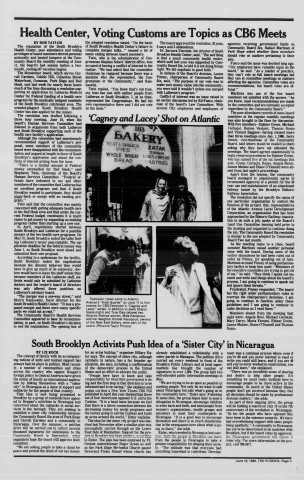
Health Center, Voting Customs are Topics as CB6 MeetsBY ROB TAYLORThe reputation of the South BrooklynHealth Center, poor attendance and votingprivileges of board members stirred personalanimosity and heated tempers at the Community Board Six monthly meeting of June11, the board%u2019s last session before a twomonth, cooling-off vacation begins.The 50-member board, which serves Carroll Gardens, Cobble Hill, Columbia StreetWaterfront, Gowanus, Park Slope and RedHook, met last week for nearly three hoursmuch of the time discussing a resolution supporting an application by Lutheran MedicalCenter for Federal funding of a health careprogram for the medically indigent residentsof the South Brooklyn catchment area. Thescandal-plagued South Brooklyn HealthCenter has also applied for the money.The resolution was drafted following athree hour meeting, June 10, when theboard%u2019s Human Services Committee hadlistened to arguments from both Lutheranand South Brooklyn supporting each of thehealth care facility%u2019s application.Although the committee had unanimouslyrecommended support of Lutheran%u2019s proposal, some members of the communityboard were disappointed with the recommendation and argued at length in favor of SouthBrooklyn%u2019s application and about the conflicts of interest arising from the issue.%u201cThere is a limited amount of Federalmoney earmarked for Red Hook,%u201d saidStephanie Twin, chairman of the Board%u2019sHuman Services Committee. %u201cFederal officials have indicated to me and othermembers of the committee that Lutheran hasan excellent program and that if SouthBrooklyn wanted to participate, they shouldpiggy-back or merge with an existing program .%u201dTwin said that the committee was mainlyconcerned with getting adequate health carein the Red Hook area and that under the current Federal budget constraints it is mucheasier to get money by expanding an existingprogram rather than starting up a new one.In April, negotiations started betweenSouth Brooklyn and Lutheran for a possiblemerger of the two health care programs. OnMay 15, South Brooklyn ended the talks finding Lutheran%u2019s term s unacceptable. The application deadline for the federal money wasJune 1, so South Brooklyn went ahead andsubmitted their own proposal.According to a spokesman for the facility,South Brooklyn ended the negotiationsbecause the director believed they wouldhave to give up much of its autonomy, doctors would have to leave the staff unless theybecame members of the Lutheran staff, patients would only be admitted by Lutherandoctors and the center%u2019s board of directorswas only offered three positions onLutheran%u2019s advisory board.%u201cThe merger was a one-way street,%u201d saidMorris Kantoowitz, fiscal director for theSouth Brooklyn Health Center. %u201cIt was a proposed merger and there were many specificparts we could not accept.%u201dThe Community Board%u2019s Health ServicesCommittee appeared to base its recommendation, in part, on South Brooklyn%u2019s decisionto end the negotiations. The opening line ofthe adopted resolution stated, %u201cOn the basisof South Brooklyn Health Center%u2019s failure tocomplete merger talks...%u201d caused a lot ofname calling between board members.Twin, who is the administrator of Congressman Stephan Solarz%u2019 district office, wasaccused of having a conflict of interest in thematter. %u201cWe had asked that the committeechairman be replaced because there was aquestion who she represented, the Congressman or the Community,%u201d said Kantoowitz.Twin replied, %u201cYou know that%u2019s not true,my boss has met with neither people fromLutheran or South Brooklyn. I, at no tim e,represented the Congressman. He had hisown representative there and I did not voteon the issue.%u201dThe board approved the resolution, 32 yeas,6 nays and 5 abstentions.Dr. Saccora Vincente, the director of SouthBrooklyn Health Center, said, %u201cThe sad thingis teat a small community health center,which until last year was supported by Community Board Six, is told it is not doing thingsright. We did negotiate in good faith.%u201dIn defense of the Board%u2019s decision, LouiseFinney, chairperson of Community BoardSix, said, %u201cThe purpose of our vote was tomake sure money came into the community;you were told it wouldn%u2019t unless you mergedwith Lutheran%u2019s program.%u201dConflict of interest was an issue raised inan earlier discussion led by Ed Fusco, chairman of the board%u2019s Law Committee. Withseveral City employees and employees of%u2018Cagney and Lacey%u2019Shot on AtlanticW H b r f a ^ * tb r e a d \\ $ r m mTelevision crews cam e to AtlanticAvenue%u2019s %u201cArab Quarter%u201d on June 11 to filmscenes for CBS-Television%u2019s \Lacey%u201d series. In addition to stars SharonGless (right) and Tyne Daly (above) twoAtlantic Avenue women, Mela Kanapousand her daughter Kismet Kanapous, ownersof the Near East Bakery, were part of thescene. (Phoenix/Taylor Photos)agencies receiving government funds onCommunity Board Six, Rafael Martinez ofPark Slone asked whether these membersshould vote on m atters pertaining to theirjobs.Fusco said the issue was decided long ago.%u201cCity employees have valuable input on theboard,%u201d he said. %u201cAs a matter of practice,they can%u2019t vote at full board meetings butthey can at committee meetings on mattersaffecting the agencies. Committee votes arerecommendations, but board votes are official.%u201dMartinez was one of the few boardmembers not satisfied with the answer. %u201cAsyou know, most recommendations are madeby the committee and are normally acceptedregardless by the Community Board.%u201dThe poor attendance records of some boardmembers at the regular monthly meetingswas also brought to the floor for discussion.With five members%u2014Ephner Green, MichaelCarbajol, Ramon Vasquez, Thomas Russoand Vincent Saggese%u2014having missed morethan three meetings since Jan. 1, 1986, Jen-yArmer, vice-chairman of the CommunityBoard, said letters would be mailed to themasking why they have not attended themeetings. The board agreed unanimously tobegin removal procedures for Ephner Green,who has missed five of the six m eetings thisyear. Green, Carbajol, Russo, Angela Benni,James Malone and Diane O%u2019Donnell were absent from last night%u2019s proceedings.Apart from the tension, the communityboard managed to unanimously agree torecommend approval of a permit for the 50year use and maintainance of an abandonedrailway tunnel by the Brooklyn HistoricRailway Association.The resolution did not specify the name ofany particular organization to control thefinances of the project. But, representativesof the Atlantic Avenue Local DevelopmentCorporation, an organization that has beenapproached by the Historic Railway Association to do such a job, spoke at the Board%u2019sLand Use Committee hearing held prior tothe meeting and requested to continue doingthe job. The Community Board Six resolutionis similar to the one adopted by CommunityBoard Two last month.As the meeting came to a close, boardmember Martinez raised another personalissue with the board. During some of theearlier discussions he had been ruled out oforder by Finney, for speaking out of turn.Martinez accused Finney of using parliamentary tactics to keep him quiet. %u201cMembers ofthe executive committee are trying to get ridof m e,%u201d he said. %u201cThey think I speak out toomuch and write bad things about the board%u2019sprocess. I am going to continue to speak outand ignore these threats.%u201dFrustrated, Finney responded, %u201cThe boardhas the right under parliamentary rules tooverrule the chairperson%u2019s decisions. I amgoing to continue to function under theseguidelines and I am going to continue tomake decisions as I read them .%u201dMembers absent from the meeting thatnight were: Angela Beni, Michael Carbajal,Mary Darcy. Maria Faruzzi, Ethner Green,James Malone, Diane O%u2019Donnell and ThomasRusso.South Brooklyn Activists Push Idea of a %u2018Sister City%u2019 in NicaraguaBY LIZ KOCHThe concept of fam ily with its accompanying notions of unity and mutual support hasalways had its place in politics. Most recently, a number of communities and citiesacross the country who oppose Reagan%u2019sforeign policy in Central America have giventhe notion of fam ily an international application by linking them selves with a %u201csistercity%u201d in Nicaragua as a show of support andsolidarity for the people of that country.That idea is now being presented inBrooklyn by a group of residents here opposed to Reagan%u2019s activities in Nicaragua andconcerned about the cutbacks in social services in the borough. They are seeking toestablish a sister city relationship betweenthe Community Board Six area of Park Slopeand Carroll Gardens and a community inNicaragua. Over the summer, a petitiondrive will be carried out to collect severalthousand signatures for submission to thePA m m unihr B nord in CanfAmhAc mV>AM ~ %u00ab%u2022%u00ab | f IUVIIorganizers hope the board will approve theirresolution.%u201cWe are asking people to take a stand forpeace and protest the drain of our tax moneyfor an arms buildup,%u201d organizer Hillary Exter says. The concept of sister city, althoughsymbolic in nature, has a far broader application, she says, including a reaffirmationof the democratic process in the UnitedStates and an effort to educate the public.%u201cPeople here have to know and takeresponsibility for what their government is doing and the first step in that direction is to beinformed and to be caring,%u201d she explains andpoints out that a New York Times/CBS Pollpublished in April this year showed that threeout of four Americans opposed U.S. aid to theContras. %u201cIt is a local issue because we feelthat there is a direct connection between thedecreasing money for social programs andthe money going to aid the Contras and buildup arms around the world,%u201d Exter explains.The idea for the sister city project was hatched last November after a sim ilar plan wassuccessfully carried through on the LowerEast Side of Manhattan. Support for the proIn DnAnlrltm Koo Knan nnatfUm n/tnnn/lmiito Exter. The plan has been endorsed by Ft.Greene Assemblyman Roger Green as wellas the Park Slope Me'hodist Church pastorReverend Finley Schaef whose church hasalready established a relationship with asister parish in Managua. The petition drivecarried out every weekend in front of theBrooklyn Public Library and at local supermarkets has brought the number ofsignatures to over 1,200. The group held twowell-attended public information meetings inMay.%u201cWe are trying to be as open as possible inmeeting people. Not only do we want to talkabout Nicaragua but also what%u2019s going on inthe community here,%u201d Exter says. Followingth same idea, the group hopes later to send adelegation to Nicaragua, encourage childrento write back and forth, and send people fromwomen%u2019s organizations, health groups andeducators to meet their counterparts inNicaragua. %u201cIt is a good way to encouragediscussion and there is so much disinformation in the newspapers here about what is going on there,%u201d she adds.Exter, who traveled to Nicaragua last sum(n n ln n /v n n ln In Dnn/\\lr1%u00abm n o n !%u00ab**%u00ab%u00bb%u00bb*y M m~0m WVIUJ 1| V^Ul I 1VU1 i %u2022from the people in Nicaragua to take agreater responsibility for shaping their society. %u201cThe attitude was that everyone hadsomething important to contribute. Development was a continual process where even ifyou%u2019re 60 and you never learned to read orwrite you could still learn, and if you are 40and you%u2019ve never worked in construction, youcan still learn,%u201d she explained.%u201cThere was an incredible sense of sharingand desire to help other people. It%u2019ssomething we could really institute here toencourage people to be more active in thecommunity. So much in the United Statespeople don%u2019t get involved because they feelall decisions should be made by professionaldecision makers,%u201d she adds.As part of their ongoing drive, the groupwill be holding a march on July 19 on the 7thanniversary of the revolution in Nicaragua.%u201cSo far the people who have opposed thishave been in the extreme minority. We havehad overwhelming support with some peoplebeing apathetic.%u201d A community in Nicaragualias yet to be determined to be matched withBrooklyn, but if the board votes its approval,4V*%u00ab KTmnwnrflinn m ail nLnnn>\\ n HIV lltV M l ^V/%u00ab VI IUUVUV 11 Ui VlU/VklV Usister city. For more information on the project, call 789-2477.June 19, 1986, THE PHOENIX, Page 3


