


Page 152 - Demo
P. 152
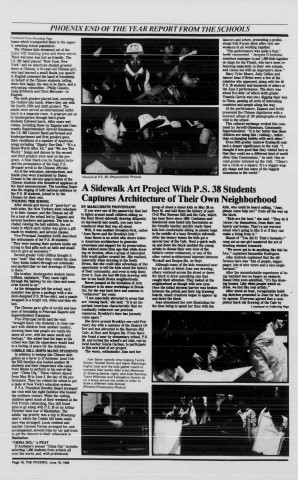
%u00ab* %u2022%u00bbPage 18, THE PHOENIX, June 18,1886PHOENIX END OF THE YEAR REPORT FROM THE SCHOOLS( ontinued hrom Preceding Pagebuses which transported them to the eagerly awaiting school population.The Chinese kids streamed out of theKttoAC nrifK VvAominn irw ine mnrl m ot*m ir n tr o r k'VW*.***.^ 6*\Their welcome was lust as friendly. TheI.S. 293 band played \York\them in Chinese, a 10-year-old Chinese girl,who had learned a small thank-you speechin English extended the hand of friendshipon behalf of the Chinese students, tellingthem how happy she was to be there, and awelcoming committee%u2014Philip Colazzo,Julia Schwartz and Chris Mercado%u2014inEnglish.The sixth graders played host, escortingthe visitors into lunch, where they ate withthe fourth, fifth and sixth graders. Theadults were served an international buffetlunch in a separate room. A program put onby kindergarten through third gradestudents followed lunch. After more welcomes, including those by Zagami and Community Superintendent Jerrold Glassman,the I.S. 293 Concert Band performed andkindergarteners and first graders gavetheir renditions of a number of Americansongs including %u201cZippity Doo-Dah,%u201d %u201cIt%u2019s aSmall World After All,%u201d and %u201cWe Are TheWorld.%u201d Songs and dances by the secondand third graders were next on the program. A final thank-you by Zagami included the presentation of the huge P.S.29-made scroll to the Chinese officials.All of the welcomes, introductions, andthank-yous were translated by DianaGranat to the obvious appreciation of theChinese students who thundered applause atthe least announcement. 11)6 touching finalewas the singing of both national anthems bythe P.S. 29 students, joined in by theChinese for their own.TOURING THE SCHOOLAfter shouts and waves of %u201cgood-bye%u201d onboth sides, the New Yorkers went reluctantly to their classes, and the Chinese set offfor a tour of the school led by Zagami andseveral teachers and parents. The tour included viewing the hall exhibits, the artroom in which each visitor was given a giftmade by students, and several classes.Vice-Principal Josephine Ierilli describedthe enthusiasm of the P.S. 29 students:%u201cThey were turning their pockets inside wittrying to find gifts such as balls and smalltoys to give as souvenirs.%u201dSecond grader Colin Gifkins thought itwas %u201cneat%u201d that when they visited his flags%u201cthey kinda looked through our notebooksand spotted that we had drawings of Chinain them .%u201dHis brother, kindergarten student JamieGifkins, explained, %u201cThey came rightthrough the hallway by my class and someeven waved to us!%u201dAs the delegation left the school, eachmember was given a package with a student-designed P.S. 29 tee-shirt, and a puzzlewrapped in a bright red, white and blue ribbon.The Chinese gave gifts of scrolls and banners of friendship to Principal Zagami andSuperintendent Glassman .Vice-Principal Ierilli said the visit%u201cbrought them (the students) in close contact with children from another country,showing them that people are really thesame all over, with the same needs andfeelings.%u201d She added that the hope at theschool was that the experience would leadto a feeling of peace for the children.COBBLE HILL HOSTS MAINE STUDENTSIn addition to hosting this Chinese delegation as a favor to D%u2019Amboise, local Cobble Hill fam ilies also hosted another 20students and their chaperones who camefrom Maine to perform in his end-of-theyear %u201cChina Dig.%u201d These visitors stayedfrom May 30 to June 2, the day of the performance. They too visited the school to geta taste of New York%u2019s education system.P.T.A. President Dorothy Siegel arrangedthe visit with the eight fam ilies who housedthe northern visitors. While the visitingchildren spent much of their weekend at theFelt Forum rehearsing, they still foundtime to go along with P.S. 29 on an ArthurFletcher boat tour of Manhattan. Theadults%u2019 top priority was a trip to Bloomingdale%u2019s, which tiie Cobble hill hosts madesure was arranged. Local resident andteacher Carmen Farina arranged for, andaccompanied, several trips by car and traintn get the dancers to their rehearsals inManhattan.%u201cCHINA DIG,%u201d A FEATD%u2019Amboise%u2019s annual %u201cChina Dig%u201d includesselecting 1,500 students from schools allover the world, and, with professionaldancers and actors, presenting a professional Felt Forum show after only oneweekend of all working together.%u201cThe performance was quite a feat,%u201dTarim onrnmantad %u201c.lurniiM TVAmhoisasomehow manages to put 1,500 kids togetheron stage for the Finale, who have been rehearsing separately in their own schools,and comes out with an impressive show.%u201dMary Tyler Moore, Judy Collins anddancer Sean O%u2019Brien were a few of thenotables who appeared, along with the 40P.S. 29 students and hundreds of others inthe June 2 performance. The story wasabout five kids (of which sixth graderYesenia Garcia was one) digging their wayto China, passing all sorts of interestingcountries and people along the way.At the performance, Zagami and Ierillipresented the Chinese dignitaries with asouvenir album of 155 photographs of theirvisit to the school.This cultural exchange evoked this comment by Jerrold Glassman, CommunitySuperintendent: %u201cIt is far better that thesechildren are doing this (visiting), ratherthan exchanging bullets with each other.%u201dEven fifth grader Andrew Kunhardt realized a deeper significance to the visit. %u201cIthought it was good that they visited here stthat they could see a different kind of worldother than Communism,%u201d he said. One second grader summed up the visit: %u201cChina%u2019snot a circle or a square. It%u2019s a wiggly-waggly shape and has some of the biggestmountains in the world.%u201dA Sidewalk Art Project With P.S. 38 StudentsCaptures Architecture of Their Own NeighborhoodBY MARGUERITE PROVENZANOIf you were one of the passers-by that hadto tiptoe around sm all children sitting onthe Hoyt Street sidewalk drawing diligentlyon lap-boards last month, you may havewondered what tin t was all about.Well, it was another Brooklyn-first, called%u201cJoan Baren and the Brooklyn kids.%u201dJoan Baren is an artist who draws historic American architecture to generateawareness and support for its preservation.She noticed some time ago that while drawing on location, often a group of interestedkids would gather around her. She realized,especially when drawing in the SmithBronx, that she could take advantage of thisopportunity to tell the kids about the historyof their community, and even to help themdraw it. Soon d ie had 400 kids drawing withher in ten South Bronx neighborhoods.Baren jumped at the invitation of ArtsExposure to do some workshops in Brooklyn, for she was bom here and anxious to%u201crediscover%u201d her rods.%u201cI am especially attracted to areas thatare %u2018waning back,%u2019 she said. %u201cIt is an important American characteristic that weconstantly rediscover our preciousresources. Brooklyn%u2019s tim e has joyouslycome again.%u201dShe drove around Brooklyn one cold February day with a member erf the District Office and was attracted to the Boerum HillCafe, at Hoyt and Bergen Sts. From thereshe found a near-by elementary school, PJS.38, and invited the school%u2019s art club, run bylocal teacher Gloria Carlson, to participatein this new kind of art project.The warm, enthusiastic Joan met hergroup of about a dozen kids on May 28 onHoyt St. and told them the history of postCivil War Boerum Hill and the Cafe, whichhas been there since 1850. Confusion anddisinterest soon faded into fascination asthe friendly teacher quickly made thesekids feel comfortable sitting on plastic bagsin the middle of a busy Brooklyn sidewalk.After the history lesson the kids got aspecial tour of the Cafe. Next a quick walkup and down the block enabled the youngartists to choose their own view of thehistoric corner restaurant, or any of theother varied architectural interests betweenWyckoff and Bergen Sts. on Hoyt.Although many of the kids remained nearthe art table at which Joan was drawing,others ventured across the street or downthe block to draw something else thatcaught their attention. They locked at theneighborhood as though with new eyes.Once the initial shyness barrier was brokenbetween the artists and their big drawingboards, sm all creations began to appear upand down the block.Joan abandoned her own illustration forthe tim e being to spend her time with thekids, who could be heard calling, %u201cJoan,please come help m e!%u201d from all the way upthe block.%u201cKids are the best,%u201d she said. %u201cThey do it(draw) for them selves, from their ownhearts and brains. They%u2019re not worriedabout who%u2019s going to like it or if they canmake a living from it.%u201dShouts erf %u201cYou did it! That%u2019s fantastic!%u201drang out as one gud mastered the art ofdrawing window ironwork.%u201cWe never got to do anything like tins before,%u201d explained Samantha Rodriguez.John Andrade explained that the difference here was %u201clots of people, biggerpaper, lots of nice views and a nice neighborhood.%u201dAfter the uncomfortable experience of being watched was no longer an obstacle,Raoul Ortiz even admitted, %u201cIt%u2019s fun drawing houses. Like ahen people watch usdraw, we feel like real artists.%u201dAfter about an hour, recognizable building sketches presented to Joan for her artistic opinion. Everyone agreed that a completed black ink drawing erf the Cafe byContinued on Following PageJoan Baren spends tim e helping TyishaBrown, Russell Smith and Gavin Rahmings(right); Joan and the kids gather round tocompare their works after a hot afternoonof drawing (below, right), and Jose Santana,Travis W illoman and Evangelino Gom ez siton a stoop across the street in order todraw a different view (below).(Phoenix/Provenzano Photos)


