


Page 285 - Demo
P. 285
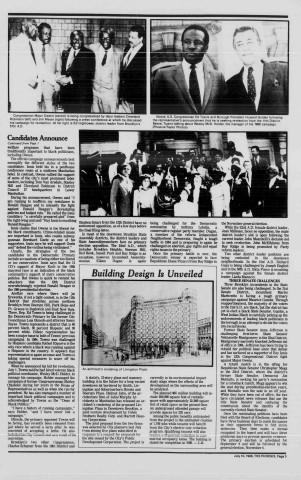
Congressman Major Owens (center) is being congratulated by labor leaders ClevelandRobinson (left) and Jim M eyer (right) following a press conference at which he discussedhis campaign for re-election. At far right is Ed Hightower, district leader from Brooklyn%u2019s57th A.D.Above, U.S. Congressman Ed Towns and Borough President Howard Golden followingthe representative's announcement that he is seeking re-election from the 11th District.Below, Towns talking about Wesley McD. Holder, the manager of his 1986 campaign.(Phoenix/Taylor Photos)Candidates AnnounceC ontinued fro m Page Iwelfare programs that have been traditionally important to black politicians, including Owens.The official campaign announcements best exemplify the different styles of the two candidates. Innis held his in a penthouse conference room at a midtown Manhattan hotel. In contrast, Owens rallied the support of some of the city%u2019s most prominent labor leaders, including Tom Van Arsdale, Stanley Hill and Cleveland Robinson to District Council 37 headquarters in Lower Manhattan.During his announcement, Owens said %u201cI am running to reaffirm my resistance to Ronald Reagan and to intensify the fight against Ronald Reagan%u2019s devastating policies and budget cuts.%u201d He called the Innis candidacy %u201ca carefully prepared plot%u201d from the right-wing and said %u201cRoy Innis is mouthing Ronald Reagan.%u201dInnis claims that Owens is too liberal for his black constituents. Crime-related issues are important to Innis, who counts subway gunman Bernhard Goetz as one of his supporters. Innis says he will support Goetz and %u201cdefend the victims being victimized.%u201dClearly, the strategies of the two candidates in the Democratic Primary include accusations of being either too liberal or too conservative. Innis says that the 12 CD%u2019s support of Mayor Koch in the 1985 mayoral race is an indication of the black community%u2019s support of more conservative policies. But Owens is quick to remind his attackers that the 12th District overwhelmingly rejected Ronald Reagan in the 1984 presidential election.Another race where there will be fireworks, if not a tight contest, is in the lith District that stretches across northern Brooklyn from Boerum Hill, Park Slope and Ft. Greene to Bushwick and East New York. There, Rep. Ed Towns is being challenged in the Democratic Primary by the former City Councilman Luis Olmedo and attorney Sonny Zayas. Towns represents a district that is 40 percent black, 30 percent Hispanic and 30 percent white. Ethnic representation has been a major issue in both of Towns%u2019 previous campaigns In 1984, Towns was challenged by Hispanic candidate Rafael Esparra in the only race where a black was running against a Hispanic in the country. It appears that representation is agam an issue and Towns is taking special measures to scare off his challengers.When he announced his bid for re-election, July 1, Towns said he had hired veteran black political coordinator, Wesley McD. Holder, to manage his campaign. Holder managed the campaign of former Congresswoman Shirley Chisholm during her years in the House of Representatives as well as when she ran for president. He has also managed a number of important black political campaigns and is acknowledged by Towns as the %u201cDean of Black Politics.%u201d%u201cI have a history of running campaigns,%u201d says Holder, %u201cand I have never lost a campaign.%u201dOlmeda, the primary opponent Towns will be facing, has recently been released from jail where he served a term after he was convicted of accepting a bribe. He alsoe%u2014 j nu. . n %u2014%u2014 --------------u. %u201e r ai__ iW i iv it> v u m o v / i i j V>UUJ%u00bbV/U o tu t> u o u a C O U H u i U1V.conviction.Brooklyn%u2019s two other Congressmen, Charles Schumer from the 10th District andStephen Solarz from the 13th District have no announced opposition, as of a few days before the final filing dates.In most of the downtown Brooklyn State Assembly districts, the district leaders and State Assemblymembers face no primary election opposition. The 52nd A.D., which includes Brooklyn Heights, Boerum Hill, Red Hook, Sunset Park and Bay Ridge is an exception, however. Incumbent Assemblywoman Eileen Dugan is againbeing challenged for the Democratic nomination by Anthony Lobelia, a conservative regular party member. Dugan, a member of the reform Independent Neighborhood Democrats, fought a tough battle in 1984 and is preparing to again be challenged on abortion, gay rights and equal rights issues in the primary.Once the primary battle is over, the Democratic winner is expected to face Republican Diane Picucci from Bay Ridge inBuilding Design Is UnveiledAn architect%u2019s rendering of Livingston Plaza.A stately, 12-story glass and masonry building is in the future for a long vacant downtown lot bordered by Smith, Livingston and Schermerhom Streets and Boerum Place. Helmut Jahn, of the architecture firm of Jahn/Murphy Architects in Manhattan has released an architect%u2019s rendering of the proposed Livingston Plaza in Downtown Brooklyn, a joint venture development by Cohen Brothers Realty Corp. and Starrett Housing Corporation.The joint proposal from the two firms was selected by City planners last July from among five plans submitted inr r t o n n n p o f n n r n o u n c f f r \\ r n r n r v n c o lc f n r* %u2014 r %u2014 %u201c w * v - - * w * ---------------- -----the site issued by the City%u2019s Public Development Corporation. The project iscurrently in its environmental impact study stage where the effects of the development on the surrounding area will be analyzed.The planned $65 million building will include 500,000 square feet of rentable space with approximately 25,000 square feet of retail space on the ground floor.An underground attended garage will provide spaces for 225 cars.Among the public benefits anticipated from the project is the estimated creation of 1.700 jobs while tenants will benefit from the City%u2019s electric rate reduction program. Qualifying tenants will also%u00ab on __________ak i/CV/i V V u uu i t u u c u u n u i l u iu *mercial occupancy taxes. The building is slated for completion in 1988. %u2014 L.K.the November general election.While the 52nd A.D. female district leader, Joan Millman, faces no opposition, the male district leader%u2019s slot is open following the current leader John Mazzitelli%u2019s decision not to seek re-election. John McElhinney from Bay Ridge is being promoted by Party reform leaders.Two other district leader positions are being contested in the downtown neighborhoods. In the 51st A.D. Richard Guay is being challenged by Joseph English and in the 50th A.D. Sixta Ponce is mounting a campaign against the female district leader, Linda Manucci.THREE SENATE CHALLENGESThree Brooklyn incumbents in the State Senate are also being challenged. In the 21st Senate District, incumbent Martin Markowitz is facing a tough primary campaign against Maurice Gumbs. Through reapportionment, the majority of the voters in the 21st S.D. are black, but the district has yet to elect a black State Senator. Gumbs, a West Indian Black is carefully picking up the endorsements of leading black politicians in the borough in an attempt to divide the voters into racial blocks.Former State Senator Anna Jefferson is challenging first-term State Senator Velmanette Montgomery in the 22nd District. Montgomery narrowly knocked Jefferson out of office in 1984. Jefferson has been trying to rebuild her political base since that defeat and has surfaced as a supporter of Roy Innis in the 12th Congressional District fight against Major Owens.A return match is in the offing for Republican State Senator Christopher Mega in the 23rd District, where the district%u2019s former State Senator, Democrat Joe Montalto, is seeking his party%u2019s nomination for a comeback match. Mega appears to win the seat during presidential-election years, and Montalto won the seat in an off year. While they have been out of office, the two have circulated news releases that use the title State Senator and confusing the constituents about the identity of the currently-elected State Senator.Once the nominating petitions have been filed with the Board of Elections, candidates have three business days to comb the names on their opponents forms to find inconsistencies. They then make a formal complaint to the board and will have three additional aays to provide speeme evidence. The primary election is scheduled for September 9 and will be followed by the general election, November 4.July 10,1986, THE PHOENIX, Page 3


