


Page 279 - Demo
P. 279
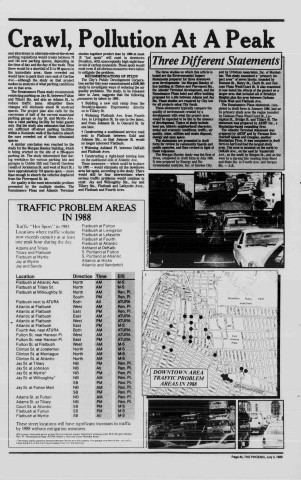
Crawl, Pollution At A Peakand alterations in altemate-side-of-the-street parking regulations would create between 76 and 124 new parking spaces, depending on the time of day and the day of the week. Thus there would be a shortfall of 51 to 99 spaces in the immediate area; those crowded out would have to park their cars east of Carlton Ave.%u2014although the study on that project makes no analysis of what parking conditions are in that area.The Renaissance Plaza study recommends restricting parking on Jay St. between Fulton and Tillary Sts. and also on Adams St., to reduce traffic jams. Altogether these changes will eliminate about 50 on-street spaces. The project plan also calls for the conversion of half of the current municipal parking garage on Jay St. and Myrtle Ave. into a valet parking facility for hotel guests only. But the study also estimates that there are sufficient off-street parking facilities within a 15-minute walk of the hotel to absorb the cars crowded out of these eliminated spaces.A similar conclusion was reached by the study for the Morgan Stanley building, which is being erected on the site of a 235-space parking lot. The study determined that during weekdays the various parking lots and garages in Cobble Hill and Carroll Gardens (south of Joralemon St. and west of Hoyt St.) have approximately 710 spaces open %u2014 more tl\\an enough to absorb the vehicles displaced from the Pierrepont St. lot.Air quality is the most intractable problem presented by the multiple studies. The Renaissance Plaza and Atlantic Terminalstudies together predict that by lusts at least 18 %u201chot spots%u201d will exist in downtown Brooklyn, with unacceptably high eight-hour levels of carbon monoxide. These spots would exist even if all obvious measures were taken to mitigate the problem.RECOMMENDATIONS OF STUDYThe City%u2019s Public Development Corporation earlier this year commissioned a $100,000 study to investigate ways of reducing the air quality problems. The study, to be released later in June, suggests that the following ^measures by taken by 1992:1 Building a new exit ramp from the Brooklyn-Queens Expressway directly on to TOlary St.1 Widening Flatbush Ave. from Fourth Ave. to Livingston St. by one to two lanes, and from Johnson St. to Concord St. by one lane.1 Constructing a southbound service road next to Flatbush between Gold and Johnson Sts., so that Johnson St. would no longer intersect Flatbush.1 Widening Ashland PI. between DeKalb and Flatbush Aves.1 Constructing a right-hand turning lane on the eastbound side of Atlantic Ave. These measures %u2014 which could be in place by 1992 %u2014 would eliminate all the downtown area hot spots, according to the study. There would still be four intersections where serious traffic problems would continue to exist: Jay and Willoughby Sts., Jay and Tillary Sts., Flatbush and Lafayette Aves., and Flatbush and Fourth Aves.T he th re e studies on w hich th is A rticle is based are the EnvirofisaentAl Impactfice lwfl-%u00bb j . if t i r t f i f 11111111$ iilft Ulj1ll_il


