


Page 278 - Demo
P. 278
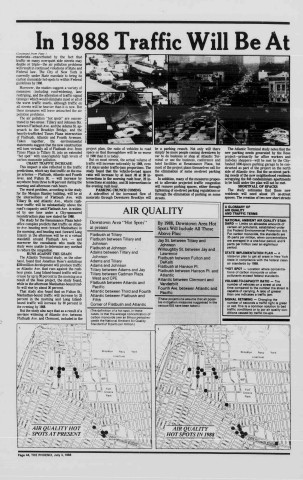
In 1988 Traffic Will Be AtContinued from Hage 1motorists%u2014exacerbated by the fact that traffic on many now-quiet side streets may double or triple%u2014the air pollution problems will result in continued violations of State and Federal law. The City of New York is currently under State mandate to bring its carbon monoxide hot-spots to within Federal guidelines by 1988.Moreover, the studies suggest a variety of measures (including road-widening, lane restriping, and the alteration of traffic signal timings) which would eliminate most or all of the worst traffic snarls, although traffic on all streets will be heavier than it is now. But these measures will leave untouched the air pollution problems.The air pollution %u201chot spots%u201d are concentrated in two areas: Tillary and Johnson Sts. between Flatbush Ave. and the Adams St. approach to the Brooklyn Bridge, and the heavily-trafficked Times Plaza intersection of Flatbush, Atlantic and Fourth Avenues. Taken together, the environmental statements suggest that the new construction will turn virtually all of Flatbush Ave. from Times Plaza to Tillary St. into an extended %u201chot spot\carbon monoxide pollution.CHART TRAFFIC INCREASEThis impact is also reflected in the traffic predictions, which say that traffic on the major arteries %u2014 Flatbush, Atlantic and Fourth Aves. and Fulton St. %u2014 will increase by anywhere from three to 30 percent during the morning and afternoon rush hours.The worst problem, according to the study for the Morgan Stanley building, will be at the intersections of Flatbush Ave. with Tillary St. and Atlantic Ave., where rushhour traffic will be substantially above the road%u2019s capacity until Flatbush Ave. is widened by one lane under a City-sponsored reconstruction plan now slated for 1988.The study for the Renaissance Plaza hoteloffice complex predicts that traffic on Atlantic Ave heading west (toward Manhattan) in the morning, and heading east (toward Long Island) in the afternoon will be at a virtual standstill around Flatbush Ave. %u2014 and moreover the consultants who made the study were unable to determine any method to reduce the congestion.RUNS AGAINST THE GRAINThe Atlantic Terminal study, on the other hand, found that Jonathan Rose%u2019s ambitious $230-million development will produce traffic on Atlantic Ave. that runs against the rushhour grain. Long Island-bound traffic will increase by up to 30 percent in the morning as a result of the Rose project, the study found, while in the afternoon Manhattan-bound traffic will rise by about 20 percent.That study also found that on Fulton St., Manhattan-bound traffic will increase by 25 percent in the morning and Long Islandbound traffic will increase by 30 percent in the evening by 1988.But the study also says that as a result of a one-lane widening of Atlantic Ave. between Flatbush Ave. and Clermont, included in theproject plan, the ratio of vehicles to road space on that thoroughfare will be no worse in 1988 than it is today.But on most streets, the actual volume of traffic will increase noticeably by 1988, even if it stays under traffic-jam proportions. The study found that the vehicle-to-road space ratio will increase by at least .05 at 30 intersections in the morning rush hour, 22 intersections at midday, and 35 intersections in the evening rush hour.PARKING CRUNCH COMING A side-effect of the increased flow of motorists through Downtown Brooklyn willbe a parking crunch. Not only will there simply be more people coming downtown by car to do business or shop at Atlantic Terminal or use the business, conference and hotel facilities at Renaissance Plaza, but most of the project plans themselves call for the elimination of some on-street parking space.In addition, many of the measures proposed to alleviate projected traffic congestion will remove parking spaces, either through tightening of on-street parking regulations or through the elimination of parking on some streets.The Atlantic Terminal study notes that the new parking needs generated by the Rose project%u2014primarily for office workers and mid-day shoppers%u2014will be met by the Cityfunded 1009-space parking garage to be constructed as part of the project on the north side of Atlantic Ave. But the on-street parking needs of the new neighborhood residents occupying the 643 condominium apartments to be built under the plan will not be met.SHORTFALL OF SPACES The study estimates that these new residents will need about 175 on-street spaces. The creation of two new short streetsDowntown Area %u201c Hot Spots%u201d at presentF la tb u s h a t T ilta ry F la tb u s h b e tw e e n T illa ry a n d J o h n s o nF la tb u s h a t J o h n s o n A d a m s b e tw e e n T illa ry a n d J o h n s o nA d a m s a n d T illa ry A d a m s a n d J o h n s o n T illa ry b e tw e e n A d a m s a n d J a y T illa ry b e tw e e n C a d m a n P laza W e s t a n d C P EF la tb u s h b e tw e e n A tla n tic a n d P a c ificA tla n tic b e tw e e n T h ird a n d F o u rth A tla n tic b e tw e e n F la tb u s h a n d F ifthC o rn e r o f F la tb u s h a n d A tla n ticBy 1988, Downtown Area Hot Spots Will Include All Those Above Plus:Jay St. between Tillary andJohnsonWilloughby St. between Jay andLawrenceFlatbush between Fulton andDeKalbFlatbush at Hanson PI.Flatbush between Hanson Pi. andAtlanticAtlantic between Clermont andVanderbiltFourth Ave. between Atlantic andPacific(These projections assume that alt possible mitigation measures suggested In thevarious EiS have been taken.)(The definition of a hot spot, in thesecases, is that the average concentration ofcarbon monoxide over an 8-hour period exceeds the National Ambient Air QualityA G LO S S A R Y O FAIR QUALITYANO T R A FFIC TER M SNATIONAL AM BIEN T AIR QUALITY STAN %u00adDARD %u2014 Limits on allowable amounts ofcertain air pollutants, established underthe Federal Environ mental Protection Ac?.For carbon monoxide, the standards are35 parts per million, when concentrationsare averaged in a one-hour period, and 9parts per million over an eight-hourperiod.S T A T E IM PLEM ENTATION PLAN - Astate-run plan to get ail areas in New Yorkstate in compliance with the federal cleanair standards by 1988.%u201c HOT SPO T %u2014 Location where concentrations of carbon monoxide or otherpollutants exceed federal standards.VO LU M E-TO-CAPACITY RATIO - Thenum ber of vehicles on a street at onetim e compared to the number the street iscapable of carrying. A ratio of greaterthan one indicates a traffic jam.SIG N A L RETIMING %u2014 Changing thenum ber of seconds a traffic light is greenor red. This is a common solution to badtraffic conditions or to por air quality conditions caused by traffic tie-ups.Page 44, THE PHOENIX, July 3, 1986


