


Page 335 - Demo
P. 335
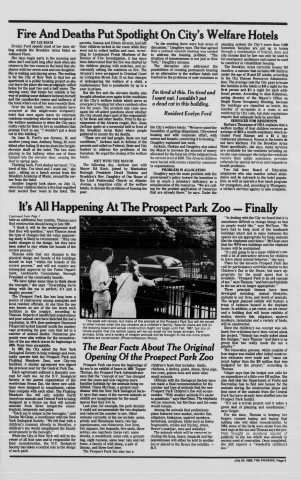
Fire And Deaths Put Spotlight On City's Welfare HotelsBY LIZ KOCHEvelyn Ford spends most of her time sitting outside the Brooklyn Arms Hotel onAshland Place.Her days begin early in the morning andoften don%u2019t end until long after dark when shereturns to the two rooms in the hotel that sheshares with her seven sons and one daughter.She is waiting and staying away. The waitingis for the City of New York to find her anapartment in a public housing project so shecan leave the place she has grudgingly calledhome for the past two and a half years. Thestaying away that keeps her outside is herway of putting some distance between herselfand the ramshackle rooms and hallways ofthe hotel where one of her sons recently died.Over the last month, two accidents haveoccurred at this single-room occupancyhotel that once again leave its reluctantresidents wondering who the real recipient ofthe welfare assistance is when the City payscostly rents for them to live in conditions thatprompt Ford to say %u201cI wouldn%u2019t put a deadcat in this building.%u201dOn June 21, Ford%u2019s son Jerome, 18, andanother young man, Anthony Young, 22, werekilled after falling 15 stories down the freightelevator shaft at the hotel. The two wereplaying in the hallway when one of thembanged into the elevator door, causing thedoor to spring open.Thinking back, Ford shakes her head. %u201cI%u2019mtired of this. I%u2019m tired and I want out,%u201d shesays , sitting on a bench across from theBrooklyn Academy of Music, around the corner from the hotel.Another tragedy took place, on July 11,when four children died in a fire that engulfedtheir second floor room in the hotel. Theparents, Susana and Edwin Alvarez, had lefttheir children locked in the room while theywent out to collect bottles and cans. According to Lieutenant Frank Martinez of theBureau of Fire Investigation, it has sincebeen determined that the fire was started bythe children playing with matches, and accidentally setting the mattress on fire. TheAlvarez%u2019s were arraigned in Criminal Courton Livingston Street July 13 on four chargesof endangering the welfare of a child, amisdemeanor that is punishable by up to ayear in prison.But the fire and the elevator deaths alsobrought attention once again to the conditionsof the City%u2019s welfare hotels which serve asemergency housing but where residents oftenlive for years. The accident also raise onceagain the oft-asked questions about whetherthe City should share part of the responsibility for these and other deaths. Prior to the arraignment of the Alvarez couple, Rev. JesseJackson spoke at a memorial held in front ofthe Brooklyn Arms Hotel where peoplegathered to mourn the six deaths.%u201cThese are not bad people, these are badconditions,%u201d Jackson said in defense of theparents and called on Federal, State and Cityleaders to address the problems of thehomeless. He urged the closing of the welfarehotels.MET WITH THE MAYORThe following day, Jackson met withMayor Ed Koch, joined by ManhattanBorough President David Dinkins andBrooklyn%u2019s Rev. Daughtry of Our House ofthe Lord Pentecostal Church on AtlanticAvenue, a long-time critic of the welfarehotels, to discuss the problems of housing thepoor.%u201cIn the meeting there were four areas ofdiscussion,%u201d Daughtry says. The four agreedthat a national snnnrnit mostino WHS HSSdsdto address the housing problem. %u201cThesituation of homelessness is not just in NewYork,%u201d Daughtry stresses.The discussion also addressed thepossibilities of creating permanent housingas an alternative to the welfare hotels andtouched on the problems of code violations inI%u2019m tired of this. I%u2019m tired and/ want out. I wouldn%u2019t puta dead cat in this building.Resident Evelyn Fordthe City%u2019s welfare hotels. %u201cWe have raised thefeasibility of getting dilapidated, City-ownedhousing and with corporate effort, withunions and tenants, converting it to housing,%u201dDaughtry explained last week.Jackson, Dinkins and Daughtry also askedthe Mayor to increase the amount of moneyallocated for the funerals of the indigent fromits current level of $250. The Alvarez childrenwere buried with money raised by community organizations.PROBLEM IS ALLOCATIONDaughtry says the main problem with thegovernment%u2019s policy toward the homeless isnot so much a monetary deficiency as amisaUocation of the resources. %u201cWe are calling for the prudent application of resourcesthat are already there,%u201d he says. Under thestanding system the City%u2019s more than 4,000homeless families are put up in hotelstHrmurVl O A / * * r \\ K l r %u00bb 1 . . J %u2018' %u201c O** *%u2022 VI 11/UViCUy OM11C CU1Ucity monies that by law can only be used tofor emergency assistance and cannot be usedto construct or rehabilitate housing.The Brooklyn Arms currently houses 263families, a number that includes 909 childrenunder the age of 18 and 327 adults, accordingto the City Human Resources Administration. The average rate the City pays to housethe families in the hotels is $49 a night for thefirst person and $11 a night for each additional person. According to Alan Kleinman,acting director of the Mayor%u2019s Office onSingle Room Occupancy Housing, becausethe buildings are classified as hotels, thenumber of occupants in a room is notrestricted by City code, but state regulationsrequire that adequate beds be provided.SERVICES FOR RESIDENTSBarbara Thompson of HRA explains that awelfare mother of four children receives anaverage of $875 a month assistance which includes Food Stamps and a $2 a dayrestaurant allowance. Rooms in the hotels donot have kitchens. For the Brooklyn ArmsHotel specifically, she says, many servicesare available for the residents including anon-site case manager who helps the residentsreceive their public assistance, providesreferrals for special services and responds tohealth problems.Two full time Board of Educationemployees who also monitor school attendance and do outreach to the hotel population, as well as operate a free lunch programfor youngsters, and, according to Thompson,a victim%u2019s services agency is also available.It's All Happening At The Prospect Park Zoo %u2014 FinallyContinued from Page Itake an additional four months, Thomas saysthat construction should being in late 1987.%u201cI think it will be the underground stuffthat they will question,%u201d says Thomas aboutthe type of changes that the value engineering study is likely to recommend. %u201cThey canmake changes to the design, but they havebeen asked to stay within the bounds of thereview process.%u201dThomas adds that any changes to thephysical design and facade of the buildingsshould be kept %u201cwithin the bounds of thereview process,%u201d and will not require anysubsequent approval by the Parks Department, Landmarks Commission, BoroughPresident or the community boards.%u201cWe have taken some time to think aboutthe concepts,%u201d she says. %u201cEverything we%u2019redoing with the zoo is perfect, it%u2019s just alengthy process.%u201dThe Prospect Park Zoo has long been asource of controversy among zoologists andlocal resident officials. At one time the zoowas known as one of the ten worst suchfacilities in the country, according toThomas. Reports of insufficient maintenanceand poor animal care have blotched the zoo%u2019sreputation. In 1974, then zookeeper RaymondFitzgerald locked himself inside the monkeycage protesting the poor care that led to anumber of animal deaths. Numerous proposals were also written for the reconstruction of the zoo which traces its beginnings to1868. None were acceptable.In 1981, the City asked the New YorkZoological Society to help redesign and eventually operate both the Prospect Park andFlushing Meadows Zoos, now City-runfacilities. A similar agreement was signedthe previous year for the Central Park Zoo.Each agreement outlined a thematic concept for each zoo. As the N.Y. ZoologicalSociety is the parent organization of theworld-class Bronx Zoo, the three new additions were designed to compliment, ratherthan compete with each other. The FlushingMeadows Zoo will only exhibit NorthAmerican animals and Central Park is beingdesigned as a biome zoo that will includeanimals from three temperate zones:tropical, temperate and polar.%u201cEach zoo is unique to the boroughs,%u201d saidDenise McClean, a coordinator with the NewYork Zoological Society. %u201cWe felt that with achildren%u2019s museum already in Brooklyn, achildren%u2019s zoo would compliment the familyenvironment in the borough.%u201dWhile die City of New York will still be theowner of all four zoos and is responsible fortheir reconstruction, the N.Y. ZoologicalSociety has taken a central role in the designof each park.The seals will rem ain, but many of the anim als at the Prospect Park Zoo will be movedto other hom es when the zoo reopens as a children%u2019s facility. Specific plans are still onthe drawing board and actual construction m ight not begin until Fall, 1987, but zoo officials expect that the exhibit space will be too sm all for the larger anim als. Farmanim als, birds, and a variety of sm aller anim als will be brought to the zoo once properhabitats are constructed. (Phoenix/Pearson Photo).The Bear Facts About The OriginalOpening Of the Prospect Park ZooProspect Park can trace the beginnings ofits zoo to an exhibit of bears in 1868. TupperThomas, the Prospect Park Administratorsays that the %u201cconcept of zoo%u201d has changedover the years and now requires morefamiliar habitats for the animals being exhibited. Diane McClean, a project coordinator with the New York Zoological Society says that many of the current animals onexhibit are inappropriate for the smallspaces that they live in.Last year, for example, the park decidedit could not accommodate the two elephantsand reduced the number to one. Otheranimals currently at the zoo include: polar,grizzly and Himalayan bears, two hippopotamuses, one rhinoceros, four lions,two jaguars, two leopards, five sesils, threezebras, one canvbara (large rat), someskunks, a woodchuck, some cats, a groundhog, eight racoons, some bear cats and redfoxes, a family of wild sheep, a pair ofllamas, and three fowl deer.The Prospect Park Zoo also has achildren%u2019s farm that includes: ducks,chickens, a donkey, goats, sheep, three pigs,two cows, guinea hens and some othersmall animals.Officials with the Zoological Society havenot made a final recommendation for thenumber and type of animals that the newProspect Park Children%u2019s Zoo will accommodate. %u201cWith smaller animals it%u2019s easierto substitute,%u201d says MacClean. The elephantswill be removed, but McClean said the sealswould remain.Among the animals that preliminaryplans featured were snakes, electric fish,alligators, kinkajous, squirrel monkeys,tarantulas, scorpions, birds such as tawnyfrogmouths, orioles and finches, otters,Reeve%u2019s muntjac, emu and wallabys.The animals which will he removed including the lions, bears, leopards and hippopotamuses will either be sold to anotherzoo or placed in the Bronx Zoo exhibits. %u2014R.T.%u201cIn dealing with the City we found that it issometimes difficult to change things as fastas people would like,%u201d says McClean. %u201cWehave had to keep most of the landmarkbuildings intact and in some instances thespaces are not appropriate for large animalslike the elephants and rhinos.%u201d McClean saysthat the WPA-era buildings and the elephanthouses will be maintained.%u201cIt%u2019s still going to be a super children%u2019s zoowith a lot of interactive devices for childrento learn about animal behavior,%u201d she says.Plans for the ten-acre Prospect Park Zoocall for participatory activities similar to theChildren%u2019s Zoo in the Bronx, but more appropriate for the small space that isavailable. %u201cProspect Park is an old conceptof zoo,%u201d says Thomas, %u201cand bars and habitatsin the zoo are no longer appropriate.%u201dThree principle themes have beendeveloped including: animal lifestyles,animals in our lives, and world of animals.The largest planned exhibit will feature atroop of baboons housed in the elephanthouse. In addition, a pet center, an art centerand a building that will house exhibits ofsnakes, electric fish, alligators, squirrelmonkeys, tarantulas and a variety of birds,will be constructed.Since the children%u2019s zoo concept was outlined, few criticisms have been voiced aboutthe project. %u201cNobody has really asked aboutthe changes,%u201d says Thomas %u201cand there is nogroup that has really made the zoo apriority.%u201dThe renovation process, which consists offour stages was stalled after initial construction estimates were made and %u201ccame outmuch higher than the $16 million that wasbudgeted for the project,%u201d according toThomas.Geiger says that the budget now calls foran expenditure of a little over $18 million. Shealso said that the Department of Parks andRecreation has to find new homes for theanimals during the construction phase andthat some of the animals from the CentralPark Zoo have already been shuffled into theProspect Park facility.%u201cIt%u2019s not a trivial project and it takes agreat deal of planning and coordination,%u201dsays Geiger.For the time, Thomas is keeping herfingers crossed hoping and hoping thatnothing else will delay reconstruction. In1984, some of the birds were stolen from thebird cage at the zoo and Thomas says the proKlom Kmitrrkf on nnAn^onc omAimf r\\tpublicity to the zoo which was already inserious need of renovation. Once completed,she still expects a %u201cwonderful children%u2019sJuly 24,1986, THE PHOENIX, Page 5


