


Page 519 - Demo
P. 519
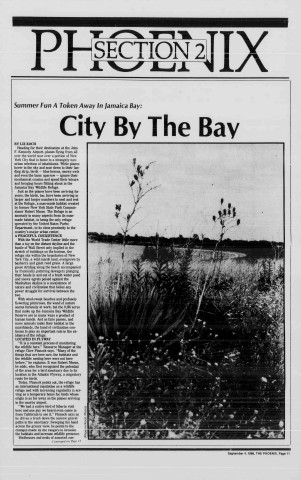
Summer Fun A Token Away In Jamaica Bay:City By The BayBY LIZ KOCHHeading for their destination at the John F. Kennedy Airport, planes flying from all over the world soar over a portion of New York City that is home to a strangely nonurban selection of inhabitants. While planes hover in the sky and soar down to their landing strip, birds %u2014 blue herons, snowy owls and even the basic sparrow %u2014 ignore their mechanical cousins and spend their leisure and foraging hours flitting about in the Jamaica Bay Wildlife Refuge.Just as the planes have been arriving for years, the birds, too, have been arriving in larger and larger numbers to nest and rest at the Refuge, a man-made habitat created by former New York State Park Commissioner Robert Moses. The Refuge is an anomaly in many aspects from its manmade habitat, to being the only refuge operated by the United States Parks Department, to its close proximity to the country%u2019s major urban center.A PEACEFUL COEXISTENCEWith the World Trade Center little more than a toy on the distant skyline and the bustle of Wall Street only implied in the stretch of buildings on the horizon, the refuge sits within the boundaries of New York City, a wild marsh land, overgrown by bayberry and giant reed grass. A large goose striding along the beach accompanied by frantically pattering dowagers plunging their heads in and out of a fresh water pond and snowy egrets poised against the Manhattan skyline is a coexistence of nature and civilization that belies any power struggle for survival between the two.With wind-swept beaches and profusely flowering primroses, the wand of nature seems furiously at work, but the 9,155 acres that make up the Jamaica Bay Wildlife Reserve are in many ways a product of human hands. And as time passes, and more animals make their habitat in the marshlands, the hand of civilization continues to play an important role in the existence of the refuge.LOCATED IN FLYWAY%u201cIt is a constant process of monitoring the wildlife here,%u201d Resource Manager at the refuge Clive Pinnock says. %u201cMany of the things that are here now, the habitats and the wildlife nesting here were not here before,%u201d he explains. It was Robert Moses, he adds, who first recognized the potential of the area for a bird sanctuary due to its location in the Atlantic Flyway, a migratory route for birds.Today, Pinnock points out, the refuge has an international reputation as a wildlife refuge and with increasing regularity is serving as a temporary home for birds whose origin is as far away as the planes arriving in the nearby airport.%u201cWe had a native bird of Siberia visit here and one guy we heard even came in from California to see it,%u201d Pinnock says as he drives a truck down the narrow gravel paths in the sanctuary. Sweeping his hand across the grassy view, he points to the changes made Dy tne rangers to broaden the habitats and increase wildlife presence.Birdhouses and nests of assorted conContinued on Pane 13Septem ber 4, 1986, THE PH OENIX, Page 11


