


Page 557 - Demo
P. 557
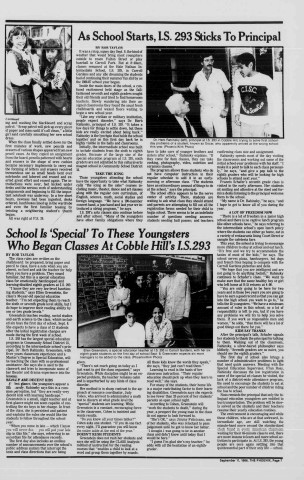
As School Starts, LS. 293 Sticks To PrincipalC ontinueding and washing the blackboard and scrap patrol. %u201cScrap patrol will pick up every piece of paper and mess until it%u2019s all clean,%u201d a little girl said carefully smoothing her new school dress.When the class finally settled down for the first minutes of work, new pencils and erasers of various shapes appeared from new pencil cases. As they copied an assignment from the board, pencils patterned with hearts and erasers in the shape of oreo cookies became necessary implements to carry out the forming of letters and erasers received tremendous use as small heads bent over notebooks and labored and erased and exerted great effort and erased again. The introductions were over, feet kicked under desks and the serious work of understanding assignments and beginning to fill the important notebook was underway. In a few short hours, newness had been ingested, desks ordered, lunchboxes lined up in the wardrobe and even the first familiar teasing by twisting a neighboring student%u2019s thumb began.All was right at P.S. 39. /RY ROR TAYI/VRIt was a crisp, sunny day Sept. 8, the kind of weather that would bring most youngsters outside to roam Fulton Street or play baseball in Carroll Park. But at 8:40am, classes resumed at the Hale Nathan Intermediate School, I.S. 293, in Carroll Gardens and any idle dreaming the students had of continuing their summer fun slid by as the 1986-87 school year began.Inside the main doors of the school, a confused excitement held stage as the fallfashioned seventh and eighth graders sought their old friends and tried to find homeroom teachers. Slowly wandering into their assigned classrooms they found the usual fresh chalkboards and waxed floors waiting to begin a new school year.%u201cLike any civilian or military institution, people expect disorder,%u201d says Dr. Herb Rahinsky, principal of I.S. 293. %u201cIt takes a few days for things to settle down, but these kids are really excited about being back.%u201d Rahinsky is the lynchpin that holds the school together and on this first day back he is highly visible in the halls and classrooms.Initially, the intermediate school was built to include students from the sixth to eighth grades. Because of the large size of the special education program at I.S. 293, sixth graders are not admitted to this cultural-arts magnet school in Community School District 15.TAKE THE ICINGThose youngsters attending the school have the opportunity to take what Rahinsky calls %u201cthe icing on the cake%u201d courses including music, theater, dance and art classes along with the regular core curriculum, of English, science, math, social studies and foreign language. %u201cWe have a 100-member concert band, a jazz band and last year we introduced a string program,%u201d he says.I.S. 293%u2019s arts classes also continue before and after school. %u201cMany of the youngsters have other family obligations where theyUr. Herb Hahinsky (left), principal at I.S. 293 in Cobble Hill, trying to solve first schoolday problems of a student, known as Oscar, who apparently arrived at the wrong school this year. (Phoenix/Kirk Photo)have to take care of younger brothers and sisters after school,%u201d Rahinsky explains. %u201cIf they come for 8am classes, they can take cooking, photography, video, nutrition and ceramics classes.%u201dThe program allows those students who do not have computer instruction in their regular schedule to add it in an earlymorning or afternoon class. %u201cThe students have an extraordinary amount of things to do at the school,%u201d says the principal.The school office appears to be the nerve center of activity. There, students are waiting to ask what class they should attend and parents are attempting to fill out all the registration forms needed for their child to begin school. There seems to be an indefinite number of questions needing answers; students needing hall passes; and teachersSchooi Is iSpecial* To l YoungstersWho Began Classes At Cobble Hill%u2019s I.S.293BY ROB TAYLORThe class rules are written on the chalkboard: be prepared, bring paper and pencil to class, have a note when you are absent, no food and ask the teacher for help when you have a problem. They sound familiar, but this is a special education class for emotionally handicapped and learning-disabled eighth graders at I.S. 293%u201cI know they are very low-level functioning students,%u201d says Ellen Greenstein, the class%u2019s 30-year-old special education teacher. %u201cI%u2019m not expecting them to reach the sixth or seventh grade level skills, but I do hope to improve their reading ability by one or two grade levels.%u201dGreenstein teaches reading, social studies and earth science to the class, which included six boys the first day of school, Sept. 8. She expects to have a class of 12 students after the initial registration charges are made during the first week of school.I.S. 293 has the largest special educaiton program in Community School District 15, according to the intermediate school%u2019s principal, Dr. Herb Rahinsky. Greenstein, with fiver years classroom experience and a Master%u2019s Degree in Special Education, will be teaching the class with no professional assistance. She says she is used to the claswork and tries to incorporate some of her theater and drama experience into the lessons.REALLY ARE DECENT KIDSA Tarst glance, the youngsters appear a liti iiruly. Rahinsky says this is a common perception, but %u201cthey are really very decent kids with learning handicaps.%u201d Greenstein is a small, slight teacher and at first glance might not seem capable of controlling the six boys in her charge. In front of the class, she is persistent and patient and explains the rides she would like the students to follow throughout the school year.%u201cWhen you come in late %u2014 which I knowJ VU ***** U V IV l UWW JV M n u i |iU b JV/MA A14 bV/slip in this file,%u201d she says, referrring to an accordian file for attendance records.The first day also includes an endless number of announcements over the school%u2019s public address system that interrupt the tests and class directions that are beingEllen Greenstein, a special education teacher at I.S. 293 in Carroll Gardens, with her six eighth-grade students on the first day of school Sept. 8. Greenstein expects six more teenagers to be added to the class. (Phoenix/Kirk Photo)given.%u201cThere%u2019s not much going on today as I just want to get the class organized,%u201d says Greenstein. While discipline might be an expected problem, the teacher remains calm and is unperturbed by any hints of class disorder.Her method is in sharp contrast to the approach of resource coordinator, Judy Cohen, who arrived to admininister a math test to discern at what grade level the %u201cspecial%u201d students are learning. While Greenstein is a constant, encouraging force in the classroom, Cohen is insistent and wants results.%u201cDo you know all your times tables?%u201d Cohen asks one student. %u201cIf you do one fact every night, I%u2019ll guarantee you will know ihe entire ia'uie at the end ox the year.\DOESN%u2019T RUSH STUDENTSGreenstein does not rush her students and says she will be using the CLASS Analysis method of instruction for the reading courses that %u201cenables a child to look at a word and group them together by sounds.All these kids know the words they speak,%u201d she says, %u201cthey just can%u2019t read them.%u201dLearning to read is the basis of her classroom instruction. %u201cTheir regular education should pick up when they learn to read well,%u201d she says.For many of the students, their home life is a major contributing factor to their learning disabilities. Greenstein says she expects to see fewer than 25 percent of her students%u2019 parents on open school night.According to Cohen, Greenstein will %u201cwork the students to death,%u201d during the year, a prospect the young man in the class do not appear to look forward to.%u201cShe%u2019s OK,%u201d says Jimmy Felicicano, one of her students, who was reluctant to pass judgement until he got to know her better.I thought I was going to De in anotner class and didn%u2019t know until today that I would be here.%u201d%u201cI guess I%u2019m glad she%u2019s my teacher,%u201d he adds with all the hesitation of an eighthgrader.confirming class size and assignment.Rahinsky spends most of the day visiting the classrooms and working out some of the initial school-year problems with his staff. %u201cI make it a point to talk to each class personally,%u201d he says, %u201cand give a pep talk to the eighth graders who will be looking for high schools to attend next year.%u201dFrancis Schafer%u2019s seventh grade class is visited in the early afternoon. Her students sit smiling and attentive at the steel and formica desks listening to the principal welcome them to the school.%u201cMy name is Dr. Rahinsky,%u201d he says, %u201cand I hope to get to know all of you during the year.A LOT OF FREEDOM NOW%u201cThere is a lot of freedom in a junior high school and there is no captive lunch program like other schools have,%u201d he says referring to the intermediate school%u2019s open lunch policy where the students can either go home, eat in a variety of restaurants lining Court Street or sample the cafeteria fare.This year, the school is trying to encourage more children to stay at school and eat lunch. %u201cIt%u2019s free and we try to accommodate the tastes of most of the kids,%u201d he says. The school serves pizza, hamburgers, hot dogs and french fries hoping to compete with the Carroll Gardens pizzerias and delis.%u201cWe hope that you are intelligent and are not going to do anything foolish,%u201d Rahinsky continues to Schafer%u2019s class. %u201cWe want to make sure that the same healthy boy or girl who left home at 8:15 returns at 4:00.%u201cYou are only going to be here for two , years and in those two years you are going to have to earn a good record so that you can get into the high school you want to go to,%u201d he tells the 25 youngsters. %u201cWe have a minimum amount of rules in this school, so a lot of responsibility is left to you, but if you have any problems we will try to help you solve them. If you work as responsible men and women,%u201d he adds, %u201cthen there will be a lot of good things out there for you.%u201dKIDS SAY THANKSAfter the principal%u2019s talk, Schafer signals her students to thank the principal for talking to them. Walking out of the classroom, Rahinsky, a silver-haired philosopher says blithely, %u201cSeventh graders are so naive, you should see the eighth graders.%u201dThe first day of school also brings a number of administrative problems to light that need quick answers. Meeting with the Special Education Supervisor, Fran Ross, Rahinsky discusses the low registration in some of the special ed classes he visited, the lack of a district-wide attendance program, the need to encourage the students to eat at school and the poor number of children riding the bus to school.Ross reminds the principal that only the bilingual education youngsters are entitled to bus transportation. The problem will be slowly solved as the students and their teachers resume their yearly education routines.The environment is encouraging and while these children, who are at that awkward, intermediate age, are still watching the minute-hand move around the standardizedn l n n l r f A im rl i n m m m r A m i n r*l a o c r o o mwaiting for their 45-minute class to end, there are more lessons to learn and more school activities to participate in. At I.S. 293, the young people are once again settling into that quintessential part of their only life %u2014 school.September 11, 1986, THE PHOENIX, Page 7


