


Page 637 - Demo
P. 637
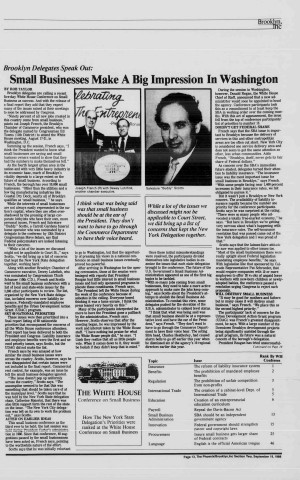
Brooklyn Delegates Speak Out:Small Businesses Make A Big Impression In WashingtonBY ROB TAYLORBrooklyn delegates are calling a recentfive-day White House Conference on SmallBusiness as success. And with the release ofa final report they add that they expectmany of the issues raised at their meetingsto soon be addressed by Congress.%u201cNinety percent of all new jobs created inthis country come from small business,%u201dpoints out Joseph French, the BrooklynChamber of Commerce president, who wasthe delegate named by Congressman EdTowns (11th District) to attend the WhiteHouse meeting, August 17-21, inWashington, D.C.Summing up the session, French says, %u201cIthink the President wanted to know whatsmall businesses are saying and smallbusiness owners wanted to show that theyhad the numbers to make themselves felt.%u201dAs the fourth largest urban area in thenation and with very little heavy industry inits economic base, much of Brooklyn%u2019svitality depends to a large extent on thefuture of small business. According toFrench, the borough has over 39,000 smallbusinesses. %u201cOther than the utilities and afew big manufacturing industries likeCoastal Dry Dock, nearly all of Brooklynqualifies as %u2018small business,%u2019 %u201d he says.While the interests of small businessesare not always easily represented in the nation%u2019s capital, where they are often overshadowed by the pressing of large corporate lobbyists who have their own, morepersonal issues, French and Salvatore%u201cBuddy%u201d Scotto, a Carroll Gardens funeralhome operator who was nominated by adelegate to the conferenc by 13th DistrictCongressman Steve Solarz, say thatFederal policymakers are indeed listeningto their concerns.%u201cWhile a lot of the issues we discussedmight not be applicable to Court St.,%u201d saysScotto, %u201cwe did bring up a list of concernsthat kept the New York State delegationtogether, working hard.%u2019Along with another Brooklyn Chamber ofCommerce executive, Dewey Lohrfink, whowas nominated by Congressman ChuckSchumer (10th C.D.), French and Scottowent to the small business conference with alist of local and state-wide issues for the3,000 other participants to review. The list,organized by the New York State delegation, included concerns over liability insurance, Federally-mandated employeebenefits and the Urban Development ActionGrant (UDAC) program.SET 60 NATIONAL PRIORITIESThese issues were then prioritized into afinal report listing of 60 nationwidepriorities that encompassed the concerns ofall the White House conference attendees.That report has been delivered to both thePresident and Congress. Liability insuranceand employee benefits were the first and second priority issues, says Scotto, but theUDAG did not make the list.French says he was amazed at howsimilar the small business issues wereacross the country. Scotto, however, says hewas disappointed that certain issues werenot included in the final report. Commercialrent control, for example, was an issue hefelt the small business delegates ignored.%u201cThe issue doesn%u2019t pop up uniformlyacross the country,%u201d Scotto says. %u201cTheassumption seemed to be that this wassomething that should be taken care of atthe municipal level.%u201d Scotto says that hewas told by the New York State delegationchair, Catherine Maiorisi, that there wasalso little support form the rest of the stateon the issue. %u201cThe New York City delegation was left on its own to work the problemout,%u201d says Scotto.ACTED ON EARLIER IDEASThis small business conference as thethird ever to be held; the last session wasL a 1 /I a / lm m i c r f u o U V IW U U l W M * *%u00ab %u2022 Mtion in 1980. Since that conference, 40 suggestions passed by the small businessmenhave been acted on, French says, pointingto the worthwhile nature of the effort.Scotto says that he was initially reluctantJoseph French (R) with Dewey Lohrfink, another chamber executive.I think what was being saidwas that small businessshould be at the ear o fthe President. They don *twant to have to go throughthe Commerce Departmentto have their voice heard.to go to Washington, but that the opportunity of pressing his views in a national conference on small business issues eventuallyproved too powerful.After arriving in Washington for the opening ceremonies, those at the session werebesieged with reports that PresidentReagan had little interest in small businessissues and had only sponsored programs toplacate these constituents. French says,%u201cThe President left the White House duringthe week of the conference because ofasbestos in the ceiling. Everyone booedthinking it was a lame excuse. I think thepress leaned very heavily on this.%u201dMany of the participants interpreted themove to have the President gone a pullbackby the administration, French says.However, Scotto observes that after themeeting began, he was impressed by thework and interest taken by the White Housestaff. %u201cI have nothing but praise for whatthe White House people did,%u201d he says. %u201cIthink they realize that all us little peoplevote. When it comes down to it, they wouldbe foolish if they didn%u2019t keep that in mind.%u201dT he White HouseConference on Small BusinessHow The New York StateDelegation%u2019s Priorities wereranked at the White HouseConference on Small BusinessSalvatore %u201c Buddy\While a lot o f the issues wediscussed might not beapplicable to Court Street, we did bring up a list o fconcerns that kept the NewYork Delegation together.Once these initial misunderstandingswere resolved, the participants dividedthemselves into legislative bodies to examine the issues that each state delegationbrought to the conference. The future of theU.S. Government%u2019s Small Business Administration appeared as one of the first bigtopics to be tackled.%u201cWith so many jobs coming from smallbusinesses, they need to take a more activeapproach to make sure the jobs keep coming,%u201d says Scotto about the President%u2019s attemps to abolish the Small Business Administration. To combat this view, somedelegates pushed for the elevation of theS.B.A. administrator to cabinet level status.%u201cI think that what was being said wasthat small business should be at a representative level and have the ear of the President,%u201d says French. %u201cThey don%u2019t want tohave to go through the Commerce Department to have their voice hear. The actingSBA head, Charles Heatherley, had causedalarm bells to go off earlier this year whenhe dismissed six of the agency%u2019s 10 regionaldirectors earlier this year.During the session in Washington,however, Donald Regan, the White HouseChief of Staff, announced that a new administrtor would soon be appointed to headthe agency. Conference participants tookthis as a commitment to at least keep theSBA in working order over the coming months. With this act of appeasement, the issuefell from the top of conference participants%u2019list of priorities to number 13.DOESN%u2019T GET FEDERAL SHAREFrench says that the SBA issue is important to Brooklyn because the delivery ofservices in this and other metropolitanareas are too often cut short. New York Cityis considered one service delivery area anddoes not seem to get the same attention asother, less urban communities. AddsFrench, %u201cBrooklyn, itself, never gets its fairshare of Federal dollars.%u201dAs concern over the SBA%u2019s immediatefuture abated, delegates turned their attention to liability insurance. %u201cThe insuranceissue was the most important issue forsmall business in Brooklyn,%u201d says French.%u201cWith some people facing near 1,400 percentincreases in their insurance rates, we feltobligated to pursue it.%u201dBut it wasn%u2019t just a Brooklyn or New Yorkconcern. The availability of liability insurance rapidly became the number onepriority for the conference participants.Scotto says he was surprised at the rating.%u201cThere were so many people who advocated a totally free-market economy,%u201d hesays. %u201cBut here in Brooklyn we%u2019re gettingvery nervous about what%u2019s happening withthe insurance rates. The self-insuranceresolution that was passed came out of theNew York delegation and I was proud ofthat.%u201dScotto says that the laissez-faire attitudehe saw was applied to other issues too.%u201cMost of the small businessmen there werereally uptight about Federal legislationmandating employee benefits,%u201d he says.With legislation like that sponsored by Colorado Representative Pat Schroeder, thatwould require companies with 15 or moreemployees to offer 18 weeks of unpaid leaveto workers with new-born children or newlyadopted babies, the conference passed aresolution urging Congress to reject suchproposals.WILL DESTROY SMALL BUSINESS%u201cIt may be good for mothers and fathersbut in many cases it will destroy smallbusiness,%u201d says French. %u201cWe place this asthe second highest priority.%u201dThe participants%u2019 lack of concern for theUrban Development Action Grant program(UDAG) was French%u2019s greatest disappointment, he says. With a large number of theDowntown Brooklyn development projectsbeing significantly assisted through thegrant program, its future was a naturalconcern of the borough%u2019s delegation.President Reagan has tried unsuccessfulC on tin u ed on Page 14Rank By WHTopic Issue ______________________________ ConfereesInsurance The reform of liability insurance system 1Benefits The prohibition of mandated employee benefits2Regulation The prohibition of unfair competition from non-profits3International Trade The creation of a cabinet-level Dept, of 5International Trade 5Education Creation of an entrepreneurial education curriculum6Payroll Repeal the Davis-Bacon ActSmall Business SBA should be an independent 13Administration government agencyInnovation Federal government should strengthen natent and convrieht laws15Procurement Insure small business gets larger share of Federal contracts25Language English is the official American tongue 46Page 13, The PhoenlxJBrooklyn.Inc Section Two, September 18,1986


