


Page 682 - Demo
P. 682
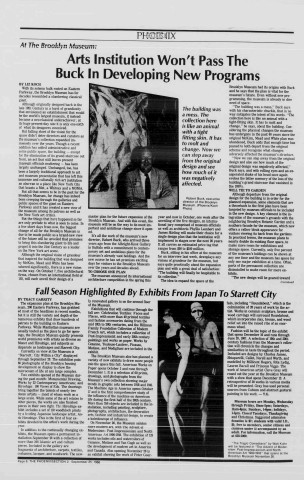
T l i o P r A n L f i / n KAi%u25a0 - .................... u i w i i i j i i # %u25a0 %u00ab . B V I V i r m i m %u2022 i n u v j c u i i i bBY LIZ KOCHWith its solemn bulk rooted on EasternParkway, the Brooklyn Museum has fordecades resembled a slumbering classicalgiant.Although originally designed back in thelate 19th Century in a burst of grandiositythat envisioned an establishment that wouldbe the world%u2019s largest museum, it insteadbecame a neo-classical underachiever; atits huge present-day size it is only one-sixthof what its designers conceived.But falling short of the vision for thespace didn%u2019t deter directors and curators asthe museum%u2019s collection expanded immensely over the years. Though a recentaddition has added administrative andsome public space, the building %u2014 exceptfor the elimination of its grand staircase outfront, an act that still leaves presentmuseum officials muttering %u2014 has beenlargely unchanged. Unchanged, too, hasbeen a largely traditional approach to artand museum presentation that has left thisimmense and culturally rich art institutionan also-ran in a place like New York Citythat boasts a Met, a Whitney and a MOMA.But all that seems to be in the past for theBrooklyn Museum, for change has indeedbeen creeping through the galleries andpublic spaces of the giant on EasternParkway and it has created a new view ofthe museum among its patrons as well asthe New York art critics.But the things that have happened so farare only prelude to what is soon to come. Ina few short days from now, the biggestchange of all for the Brooklyn Museum isdue to be made public as a brand-new viewof the future will be unveiled that promisesto bring this slumbering giant to life andpropel it into the 21st Century as a leaderon the New York art scene.Although the original vision of grandeurthat inspired the building that was designedby McKim, Mead and White has beensobered significantly, there is a new visionon the way. On October 7, five architecturalfirms, chosen from an international field of103, will each unveil their design of aBrooklyn Museum had its origins with Buckand he says that the plan is vital for themuseum%u2019s future. Even without new programming, the museum is already in direneed of space.%u201cThe building was a m ess,%u201d Buck sayswith his characteristic chuckle, that in noway mitigates the intent of his words. %u201cThecollection here is like an animal with atight-fitting skin. It has to molt andchange,%u201d he says, about the building. Considering the physical changes the museumhas undergone in the past 60 years since theoriginal McKim, Mead and White plan wasabandoned, Buck adds that enough time haspassed to both depart from the originalscheme and recognize what changesadversely affected the museum%u2019s structure.%u201cNow we can step away from the originaldesign and also see how much of theoriginal design was negatively affected,%u201dBuck says, and with rolling eyes and an exasperated shake of his head once againevokes the bitter memory of the loss of thebuilding%u2019s grand staircase that vanished inthe 1930%u2019s.WILL TIE TO GARDENAlthough departure from the originaldesign for the building is in order for theplanned expansion, some elements that area throwback to the first plan have beentargeted by museum officials to be includedin the new design. A key element is the integration of the museum%u2019s grounds with theneighboring Brooklyn Botanic Garden and asouthern facade for the museum, which nowoffers a rather bleak appearance forvisitors viewing its back from the gardens.In practical terms, the museum plans tonearly double its existing floor space, tomake more room for exhibitions andstorage space. Currently, only five percentof the museum%u2019s holdings can be shown atany one time and the museum has space foronly one major exhibition at a time. Often,parts of the permanent collection aredisinstalled to make room for more exhibits.%u201cThe new design will be geared towardContinuedThe building wasa mess. Thecollection hereis like an anim alw ith a tightfitting skin. It hasto m o lt andchange. N o w w ecan step awayfrom the originaldesign and seeh o w m uch o f itwas negativelyaffected.R o b e rt B u ck, e x e c u tiv ed ire c to r o f th e B ro o klynM u s e u m . (P h o e n ix /K o c hP h o to )master plan for the future expansion of theBrooklyn Museum. And with this event, themuseum will be on the way to its most important and ambitious change since it opened.It%u2019s all the work of the museum%u2019s newdirector, Robert Buck, who arrived threeyears ago from the Albright-Knox Galleryin Buffalo with a commitment to contemporary art and ambitious plans for themuseum%u2019s already vast holdings. And thenew course he has set promises excitingdays for visitors to the Brooklyn Museumover the years and decades ahead.TO CHOOSE ONE PLANThe museum announced its internationalarchitecture competition in the spring thisyear and now in October, one week after theunveiling of the five designs, an international jury comprised of museum officialsas well as architects Phyllis Lambert andJames Stirling will make their choice for asingle design plan that the institution willimplement in stages over the next 20 years.It all carries an estimated price tag thatranges from $50 to $100 million.Buck, sitting in his office at the museumfor an interview last week, downplays anyvisions of grandeur for the museum, butsays quite practically about the expansionplan and with a great deal of satisfaction:%u201cThe building will finally be hospitable toits collection.%u201dThe idea to expand the space at theArts Institution Won't Pass TheBuck In Developing New ProgramsFall Season Highlighted By Exhibits From Japan To Starrett CitvBY TRACY GARRITY r . %u00bb p n i T v /The expansion plan at the Brooklyn Museum, 200 Eastern Parkway, has grabbeded most of the headlines in recent months,but it is still the variety and depth of thenumerous exhibits that draw hundreds ofpatrons to the building on EasternParkway. While Manhattan museums areusually touted as the place to go for openings, the Brooklyn Museum quietly presentsworld premieres with artists as diverse asMonet and Hiroshige, and subjects asdisparate as landscapes and Starrett City.Currently on view at the Museum is%u201cStarrett: City Within a City%u201d displayedthrough September 29. The exhibition puts80 photographs of the Brooklyn housingdevelopment on display to show themicrocosm of life at any large complex.Two exhibits opened at the Museum during the past month: Monumental Drawing,Works by 22 Contemporary Americans; andHiroshige: 100 Views of Edo. The drawingsbring together the talents of nearly twodozen artists %u2014 most of whom work on alarge scale. While some of the art relates toother pieces, the works are also finishedpieces in their own right. Th? Hiroshige exhibit includes a set of 118 woodblock printsby a leading Japanese landscape artist, Ando Hiroshige. Tlus is the first of four exhibits devoted to the artist%u2019s work during theyear.In addition to the continually changing exhibits, the Museum opens a permanent installation September 26 with a collection ofmore than 200 Islamic art and culturepieces. Included in the gallery arefragments of architecture, carpets, textiles,costumes, lacquer, and woodwork. The newly renovated gallery is on the second floorof the Museum.Exhibitions that will continue through thefall are: Celebration Textiles: Faces andPlaces, with more than 40 printed textilesand fashion accessories dating from themid 18th to 20th centuries, and the HillmanFamily Foundation Collection of ModemFrench Art, which includes a collection ofPost-Impressionist and early 20th centurypaintings and works on paper. Works byCezanne, Toulouse-Lautrec, Picasso,Matisse, and Modigliani are included in theexhibit.The Brooklyn Museum also has planned avariety of new exhibits to draw more peopleinto the space this fall. American Works onPaper opens October 3 and runs throughDecember 1. It is a selection of 60 prints,drawings, and photographs from theMuseum%u2019s own collection showing majortrends in graphic arts between 1918 and 1941.The Machine Age in America opens October17 and is the first comprehensive study ofthe influence of the machine on Americanlife during the first half of the 20th century.More than 350 objects are included in the installation, including painting, sculpture,photography, architecture, the decorativearts, fashion and industrial design, to createa kaleidoscope of influence.On November 26, the Museum salutesmore modern an, witn m e Advent otModernism: Post Impressionism and NorthAmerican Art 1900-1918. The exhibition of 125works includes oils and watercolors ofCezanne, Matisse and Van Gogh as well asthe development of modem art in Americaand Canada. Also opening November 26 isan exhibit showing the work of Peter Gourrauc u. m trnoLm A iocoilU IN beptemDer 1986fain, including %u201cRoundabout,%u201d which is theculmination of 20 years of work by the artist. Works in ceramic sculpture, bronze andwood carvings will surround Roundabout,which incorporates clay, bronze, and woodrelief set into the raised ribs of an enormous wheel.Fashion will be the topic of the exhibitthat opens December 10 and runs throughJune 29,1987. A selection of 19th and 20thcentury fashions from the Museum%u2019s collection will chronicle the changes andsimilarities in taste throughout the period.Included are designs by Charles James,Shiaparelli, Callot, Norell and Worth, andmodelled by Millicent Rogers, Rita Lydig,Lauren Bacall and Princess Viggo. Thework of American artist Cleve Gray willround out the year at the Brooklyn Museumwith a show that opens December 12. Aretrospective of 50 works in various mediawill be presented. Gray has used personalsources from Cubism and abstract gesturalpainting in his work. %u2014 T.G.Museum hours are Monday, Wednesdaythrough Friday, 10am-5pm; Saturdays,llam-6pm; Sundays, l-6pm; holidays,l-5pm. Closed Tuesdays, Thanksgivingand Christmas. Suggested admissiondonation is $2; students with valid I.D.,$1; free to members, senior citizens andchUdren under 12 accompanied ny anadult. For information, call the Museumat 638-5000.%u201c T h e T ra g ic C o m e d ia n s \w ill be fe a tu re d in \n ism : P o s t-Im p re s s io n is m and N orthA m e ric a n A rt 1900-1918\B ro o klyn M u s e u m N o v e m b e r 26.


