


Page 679 - Demo
P. 679
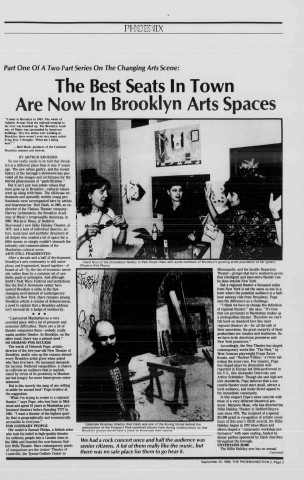
Part One Of A Two Part Series On The Changing Arts SceneThe Best Seats In TownAre Now In Brooklyn Arts Spaces\Atlantic Avenue from the railroad terminal to the river was boarded up. The Brooklyn Academy of Music was surrounded by burnt-out buildings. Very few artists were working in Brooklyn; there weren't even very many artists living here. I thought, %u2018What am I doing here?%u2019\%u2014Burl Hash, producer of the Celebrate Brooklyn summer arts festival.BY ARTHUR KROEBERNo one really needs to be told that Brooklyn is a different place than it was 17 yearsago. The new urban gentry, and the recenthistory of the borough%u2019s downtown has provided all the images and archetypes for thestoried phenomenon of %u201cgentrification.%u201dBut it isn%u2019t just real estate values thathave gone up in Brooklyn%u2014cultural valueswent up along with them. The old-house enthusiasts and upwardly mobile young professionals were accompanied here by artistsand impressarios: Burl Hash, in 1969, as codirector of the Chelsea Theater company;Harvey Lichtenstein, the Brooklyn Academy of Music%u2019s irrepressible demiurge, in1966; Marjorie Moon, of BedfordStuyvesant%u2019s new Billie Holiday Theater, in1972; and a host of individual dancers, actors, musicians and aesthetic dreamers ofall stripes who needed a lot of space for alittle money or simply couldn%u2019t stomach theintensity and commercialism of theManhattan cultural scene.ARTS STILL FRAGMENTEDAfter a decade and a half of development,Brooklyn%u2019s arts community is still amorphous and fragmented, bound together%u2014ifbound at all%u2014by the ties of economic necessity rather than by a common set of aesthetic goals or principles. And althoughBAM's Next Wave Festival and institutionslike the BACA Downtown center haveearned Brooklyn a niche in the fastchanging environment of contemporaryculture in New York, there remains amongBrooklyn artists a residue of defensiveness,a need to explain that a Brooklyn addressisn%u2019t necessarily a badge of mediocrity.%u2022 %u2022 %u2022%u201cI perceived Manhattan as a verycrowded place with a lot of pressure andeconomic difficulties. There are a lot oftheater companies there%u2014nobody reallywants another theater. In Brooklyn, on theother hand, there was a primal need.%u201dNO DEMAND FOR SUCCESSThe words of Deborah Pope, artisticdirector of the two-year-old New Theater ofBrooklyn, neatly sum up the reasons almostevery Brooklyn artist gives when askedwhy they live here: No incessant demandsfor success. Reduced competition. A chanceto cultivate an audience that is sophisticated by virtue of its proximity to Manhattan but hungry for more home-grown entertainment.But is this merely the song of one willingto settle for second best? Pope bristles atthe suggestion.%u201cWhat I%u2019m trying to create is a regionaltheater,%u201d says Pope, who was bom in Midwood and spent 10 years in Manhattan professional theaters before founding TNT in1984. %u201cI want a theater of the highest quality that is geographically and economicallyaccessible to everyone.%u201dFOR ORDINARY PEOPLEHer model is Samuel Phelps, a British actorwho took his belief in high-quality theaterfor ordinary people into a London slum inthe 1850s and founded the now-famous Sadlers Wells Theater. More contemporary pointsof comparison are the Actors%u2019 Theatre ofLouisville, the Tyrone Guthrie Center inC a ro l Brys o f th e C h a m e le o n G allery in P ark S lo p e c h a ts w ith so m e m e m b e rs o f B ro o k ly n 's g ro w in g a rtis t p o p u la tio n at h e r g allery.(P h o e n ix /K irk P h o to )C e le b ra te B ro o k ly n d ire c to r B url H a s h w as o n e o f th e d riv in g fo rces b e h in d th ere v ita liz a tio n o f th e P ro s p e c t P ark b a n d s h e ll (s h o w n h ere d u rin g c o n s tru c tio n ), so th a tn rArvlrlv/n nroi m e u/nulH hav/o o n la ro try ch n u /n aco th o ir to lo n teW e had a rock concert once and h a lf th e audience wassenior citizens. A lo t o f them really like th e music, butth ere was no safe place fo r them to go h ear it.Minneapolis, and the Seattle RepertoryTheater%u2014groups that have worked to provethat intelligent and innovative theater canbe done outside New York.But a regional theater a thousand milesfrom New York is not the same as one in atown where the potential audience is a halfhour subway ride from Broadway. Popesees the difference as a challenge.%u201cI think we have to change the definitionof regional theater,%u201d she says. %u201cIt%u2019s truethat our proximity to Manhattan makes usa metropolitan theater. Therefore we can%u2019tfall back on standard fare like mostregional theaters do%u2014for all the talk oftheir innovation, the great majority of theirproductions are classics and warhorses. Sowe have to do American premieres andNew York premieres.%u201dAccordingly, the New Theater has stagedcontemporary works like %u201cThe Nest,%u201d byWest German playwright Franz XaverKroetz, and %u201cNuclear Follies,%u201d a revue satirizing the arms race. For classics, Popehas staged plays by dramatists wellregarded in Europe but little-performed inthe U.S., like Alexander Ostrovsky andArthur Schnitzler. Though she sets high artistic standards, Pope believes that a successful theater must start small, attract alocal audience, and make direct appeal tothe immediate community.In this respect Pope%u2019s aims coincide withthose of a very different theatrical producer, Marjorie Moon, who has directed theBillie Holiday Theater in Bedford-Stuyvesant since 1975. The recipient of a special$15,000 grant in recognition of artistic excellence at this year%u2019s OBIE awards, the BillieHoliday began in 1972 when Moon andothers staged a %u201ccommunity workshop performance%u201d with open casting, funded bydinner parties sponsored by black churchesthroughout the borough.ENTERTAINS 30,000The Billie Holiday now has an annualContinuedS e p te m b e r 25, 1 9 8 6 , T H E P H O E N IX /S E C T IO N 2, P a g e 3


