


Page 86 - Centena Group PR Report - May 2025
P. 86
How the pandemic shaped the future of STEAM education in schools - Education Middle East
                 Kay adds that an audit of technologies, curriculum and projects was carried out
                 to make sure that children across the school experienced a wider selection of
                 integrated learning. In Early Years and Key Stage 1, teachers have had to find
                 new ways of integrating the practical sciences and the arts so that children
                 develop a broader skill set to enable them to excel in their learning as they get
                 older.

                 To overcome the issue of sharing equipment and collaborating at a physically
                 close distance as social distancing remains in place for in-person learning,
                 educators are splitting the class into two halves or, in some cases, three. It
                 allows the students to have their own piece of equipment while having enough
                 space among themselves to carry out the tasks.


                 According to Ali, schools were forced to adapt to the new reality. “For example
                 with labs, I’ve been able to utilise online simulations and ‘dry’ labs,” she says.
                 “Last year we had blended learning for most of the year, and so our class sizes
                 were drastically smaller. While we may have taken longer to get through the
                 content, we were also able to have more meaningful inquiry activities and
                 explorations and provide more one-on-one feedback,” she adds.


                 Ali says that they plan to address the issue of overcoming the lack of learning
                 skills with mini-review sessions at the start of each unit. According to her, they
                 are building these back through increased modelling and heightened reward
                 systems.

                 “STEAM is a key driver of such competencies,” says Kay, referring to qualities
                 such as grit, collaboration and group reasoning. “We are now finding ways to
                 get the children back into our STEAM labs through innovative ways of
                 collaboration. Digital collaboration platforms and a tweaking of lesson plans to
                 cover more objectives are starting to address the gaps,” adds Kay.


                                                    Meanwhile, teachers had to adapt their
                                                    teaching techniques. “For example in Science,
                                                    the teacher performed a live demonstration of
                                                    the experiment or shared a simulation where
                                                    students could change the variables and work
                                                    on the scientific method. Google Earth and
                                                    other interactive resources helped connect
                                                    Math to real-life and look at elevation and
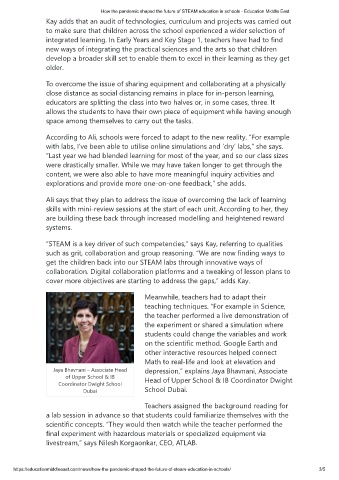
                    Jaya Bhavnani – Associate Head  depression,” explains Jaya Bhavnani, Associate
                        of Upper School & IB        Head of Upper School & IB Coordinator Dwight
                      Coordinator Dwight School
                              Dubai                 School Dubai.

                                                    Teachers assigned the background reading for
                 a lab session in advance so that students could familiarize themselves with the
                 scientific concepts. “They would then watch while the teacher performed the
                 final experiment with hazardous materials or specialized equipment via
                 livestream,” says Nilesh Korgaonkar, CEO, ATLAB.


      https://educationmiddleeast.com/news/how-the-pandemic-shaped-the-future-of-steam-education-in-schools/     3/5

