


Page 87 - Centena Group PR Report - May 2025
P. 87
How the pandemic shaped the future of STEAM education in schools - Education Middle East
                 On the upside, e-learning accelerated collaboration among students and
                 helped them develop a range of skills including sharing ideas in a group,
                 logging in to multiple accounts, keeping track of their schedule and managing
                 assignments.

                                                    “The steep learning curve of digital literacy was
                                                    significant, and students began to show
                                                    stronger ownership of their learning; organising
                                                    files, preparing lesson materials ahead of time,
                                                    and seeking out further feedback from
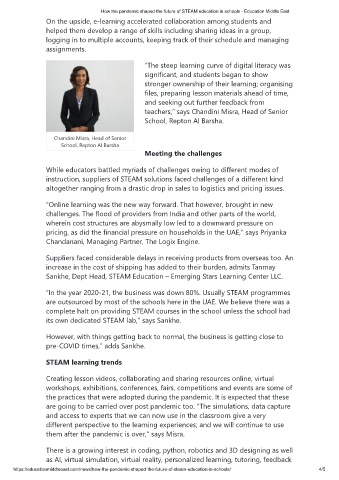
                                                    teachers,” says Chandini Misra, Head of Senior
                                                    School, Repton Al Barsha.


                    Chandini Misra, Head of Senior
                      School, Repton Al Barsha
                                                    Meeting the challenges


                 While educators battled myriads of challenges owing to different modes of
                 instruction, suppliers of STEAM solutions faced challenges of a different kind
                 altogether ranging from a drastic drop in sales to logistics and pricing issues.


                 “Online learning was the new way forward. That however, brought in new
                 challenges. The flood of providers from India and other parts of the world,
                 wherein cost structures are abysmally low led to a downward pressure on
                 pricing, as did the financial pressure on households in the UAE,” says Priyanka
                 Chandanani, Managing Partner, The Logix Engine.

                 Suppliers faced considerable delays in receiving products from overseas too. An
                 increase in the cost of shipping has added to their burden, admits Tanmay

                 Sankhe, Dept Head, STEAM Education – Emerging Stars Learning Center LLC.

                 “In the year 2020-21, the business was down 80%. Usually STEAM programmes
                 are outsourced by most of the schools here in the UAE. We believe there was a
                 complete halt on providing STEAM courses in the school unless the school had
                 its own dedicated STEAM lab,” says Sankhe.


                 However, with things getting back to normal, the business is getting close to
                 pre-COVID times,” adds Sankhe.

                 STEAM learning trends


                 Creating lesson videos, collaborating and sharing resources online, virtual
                 workshops, exhibitions, conferences, fairs, competitions and events are some of
                 the practices that were adopted during the pandemic. It is expected that these
                 are going to be carried over post pandemic too. “The simulations, data capture
                 and access to experts that we can now use in the classroom give a very
                 different perspective to the learning experiences; and we will continue to use
                 them after the pandemic is over,” says Misra.


                 There is a growing interest in coding, python, robotics and 3D designing as well
                 as AI, virtual simulation, virtual reality, personalized learning, tutoring, feedback
      https://educationmiddleeast.com/news/how-the-pandemic-shaped-the-future-of-steam-education-in-schools/     4/5

