


Page 77 - UP PR REPORT - APRIL 2026
P. 77
4/15/26, 10:39 AM                       Real Estate Investment: Pricing Environmental Risk Over Market Volatility
                          Understanding Environmental Exposure

                          Environmental exposure is increasingly viewed as a proxy for management quality, strategic
                          foresight, and long-term asset resilience. Investors now understand that assets misaligned with
                          environmental regulation, energy-transition pathways, or resilience standards will face inevitable
                          repricing, whether through higher capital costs, reduced liquidity, or functional obsolescence.

                          As a result, environmental risk is moving ahead of traditional market indicators in underwriting
                          discussions. It directly affects operating expenses, insurance viability, financing terms, and tenant
                          demand. In practical terms, it determines whether an asset remains competitive and financeable
                          over time.


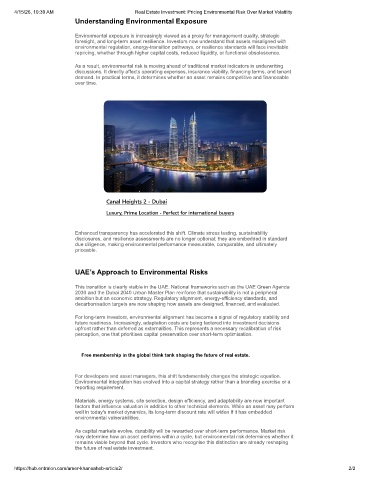
                                    Canal Heights 2 - Dubai
                                    Luxury, Prime Location - Perfect for international buyers


                          Enhanced transparency has accelerated this shift. Climate stress testing, sustainability
                          disclosures, and resilience assessments are no longer optional; they are embedded in standard
                          due diligence, making environmental performance measurable, comparable, and ultimately
                          priceable.


                          UAE’s Approach to Environmental Risks


                          This transition is clearly visible in the UAE. National frameworks such as the UAE Green Agenda
                          2030 and the Dubai 2040 Urban Master Plan reinforce that sustainability is not a peripheral
                          ambition but an economic strategy. Regulatory alignment, energy-efficiency standards, and
                          decarbonisation targets are now shaping how assets are designed, financed, and evaluated.

                          For long-term investors, environmental alignment has become a signal of regulatory stability and
                          future readiness. Increasingly, adaptation costs are being factored into investment decisions
                          upfront rather than deferred as externalities. This represents a necessary recalibration of risk
                          perception, one that prioritises capital preservation over short-term optimisation.


                            Free membership in the global think tank shaping the future of real estate.


                          For developers and asset managers, this shift fundamentally changes the strategic equation.
                          Environmental integration has evolved into a capital strategy rather than a branding exercise or a
                          reporting requirement.

                          Materials, energy systems, site selection, design efficiency, and adaptability are now important
                          factors that influence valuation in addition to other technical elements. While an asset may perform
                          well in today's market dynamics, its long-term discount rate will widen if it has embedded
                          environmental vulnerabilities.
                          As capital markets evolve, durability will be rewarded over short-term performance. Market risk
                          may determine how an asset performs within a cycle, but environmental risk determines whether it
                          remains viable beyond that cycle. Investors who recognise this distinction are already reshaping
                          the future of real estate investment.


      https://hub.entralon.com/amer-khansaheb-article2/                                                             2/2

