


Page 298 - Ranah Studi Agraria: Penguasaan Tanah dan Hubungan Agraris
P. 298
Landownership Tenancy, and ...

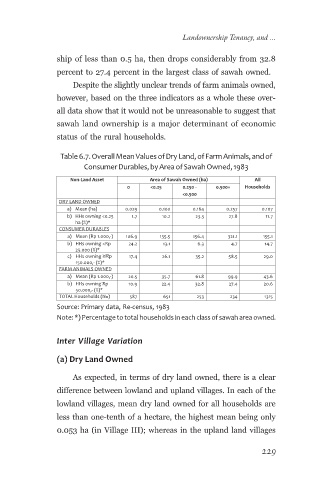
               ship of less than 0.5 ha, then drops considerably from 32.8
               percent to 27.4 percent in the largest class of sawah owned.
                   Despite the slightly unclear trends of farm animals owned,
               however, based on the three indicators as a whole these over-
               all data show that it would not be unreasonable to suggest that
               sawah land ownership is a major determinant of economic
               status of the rural households.


                Table 6.7. Overall Mean Values of Dry Land, of Farm Animals, and of
                      Consumer Durables, by Area of Sawah Owned, 1983

                   Non-Land Asset     Area of Sawah Owned (ha)  All
                                 0    <0.25   0.250 -  0.500+  Households
                                              <0.500
                DRY LAND OWNED
                  a) Mean (ha)  0.029    0.100   0.164   0.257    0.107
                  b) HHs owning <0.25  1.7  10.2  23.3    27.8     11.7
                    ha (%)*
                CONSUMER DURABLES
                  a) Mean (Rp 1.000,-)  106.9  135.5  156.4  321.1  155.1
                  b) HHs owning <Rp  24.2  13.1   6.3      4.7     14.7
                    25.000 (%)*
                  c) HHs owning ≥Rp  17.4  26.1   35.2    58.5     29.0
                    150.000,- (%)*
                FARM ANIMALS OWNED
                  a) Mean (Rp 1.000,-)  20.5  35.7  61.8  99.9     43.6
                  b) HHs owning Rp  10.9  22.4    32.8    27.4     20.6
                    50.000,- (%)*
                TOTAL Households (N=)  587  651   253     234      1315
               Source: Primary data, Re-census, 1983
               Note: *) Percentage to total households in each class of sawah area owned.

               Inter Village Variation

               (a) Dry Land Owned

                   As expected, in terms of dry land owned, there is a clear
               difference between lowland and upland villages. In each of the
               lowland villages, mean dry land owned for all households are
               less than one-tenth of a hectare, the highest mean being only
               0.053 ha (in Village III); whereas in the upland land villages

                                                                  229

