


Page 308 - Ranah Studi Agraria: Penguasaan Tanah dan Hubungan Agraris
P. 308
Landownership Tenancy, and ...

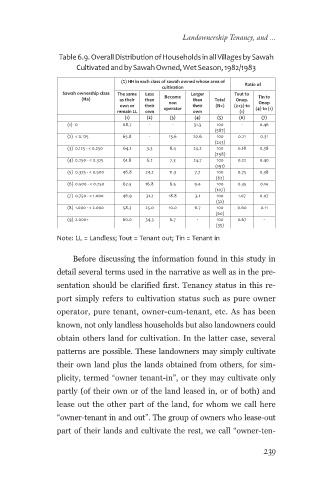
                Table 6.9. Overall Distribution of Households in all Villages by Sawah
                    Cultivated and by Sawah Owned, Wet Season, 1982/1983
                               (%) HH in each class of sawah owned whose area of  Ratio of
                                         cultivation
                 Sawah ownership class  The same  Less  Larger  Tout to
                     (Ha)      as their  than  Become  than  Total  Onop.  Tin to
                                           non
                                                                 Onop
                               own or  their  operator  their  (N=)  (2+3) to  (4) to (1)
                              remain LL  own     own         (1)
                                (1)   (2)  (3)   (4)   (5)  (6)   (7)
                  (1) 0         68.7  -     -    31.3  100   -    0.46
                                                      (587)
                  (2) < 0.125   65.8  -    13.6  20.6  100  0.21  0.31
                                                      (243)
                  (3) 0.125 - < 0.250  64.1  3.3  8.4  24.2  100  0.18  0.38
                                                      (298)
                  (4) 0.250 - < 0.375  61.8  6.2  7.3  24.7  100  0.22  0.40
                                                       (191)
                  (5) 0.375 - < 0.500  46.8  24.2  11.3  7.7  100  0.75  0.38
                                                       (62)
                  (6) 0.500 - < 0.750  67.3  16.8  6.5  9.4  100  0.35  0.14
                                                       (107)
                  (7) 0.750 - < 1.000  46.9  31.2  18.8  3.1  100  1.07  0.07
                                                       (32)
                  (8) 1.000 - < 2.000  58.3  25.0  10.0  6.7  100  0.60  0.11
                                                       (60)
                  (9) 2.000+    60.0  34.3  6.7   -    100  0.67   -
                                                       (35)
               Note: LL = Landless; Tout = Tenant out; Tin = Tenant in
                   Before discussing the information found in this study in
               detail several terms used in the narrative as well as in the pre-

               sentation should be clarified first. Tenancy status in this re-
               port simply refers to cultivation status such as pure owner
               operator, pure tenant, owner-cum-tenant, etc. As has been
               known, not only landless households but also landowners could
               obtain others land for cultivation. In the latter case, several
               patterns are possible. These landowners may simply cultivate
               their own land plus the lands obtained from others, for sim-
               plicity, termed “owner tenant-in”, or they may cultivate only
               partly (of their own or of the land leased in, or of both) and
               lease out the other part of the land, for whom we call here
               “owner-tenant in and out”. The group of owners who lease-out
               part of their lands and cultivate the rest, we call “owner-ten-

                                                                   239

