


Page 6 - Print
P. 6
 Classroom Life and Student Experiences
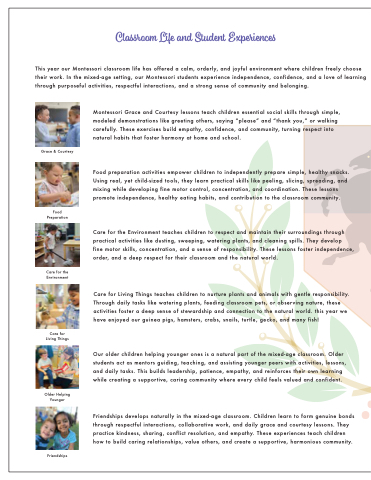
This year our Montessori classroom life has offered a calm, orderly, and joyful environment where children freely choose their work. In the mixed-age setting, our Montessori students experience independence, confidence, and a love of learning through purposeful activities, respectful interactions, and a strong sense of community and belonging.
    Grace & Courtesy
Food Preparation
Care for the Environment
Care for Living Things
Older Helping
Younger
Montessori Grace and Courtesy lessons teach children essential social skills through simple, modeled demonstrations like greeting others, saying “please” and “thank you,” or walking carefully. These exercises build empathy, confidence, and community, turning respect into natural habits that foster harmony at home and school.
Food preparation activities empower children to independently prepare simple, healthy snacks. Using real, yet child-sized tools, they learn practical skills like peeling, slicing, spreading, and mixing while developing fine motor control, concentration, and coordination. These lessons promote independence, healthy eating habits, and contribution to the classroom community.
Care for the Environment teaches children to respect and maintain their surroundings through practical activities like dusting, sweeping, watering plants, and cleaning spills. They develop
fine motor skills, concentration, and a sense of responsibility. These lessons foster independence, order, and a deep respect for their classroom and the natural world.
Care for Living Things teaches children to nurture plants and animals with gentle responsibility. Through daily tasks like watering plants, feeding classroom pets, or observing nature, these activities foster a deep sense of stewardship and connection to the natural world. this year we have enjoyed our guinea pigs, hamsters, crabs, snails, turtle, gecko, and many fish!
Our older children helping younger ones is a natural part of the mixed-age classroom. Older students act as mentors guiding, teaching, and assisting younger peers with activities, lessons, and daily tasks. This builds leadership, patience, empathy, and reinforces their own learning while creating a supportive, caring community where every child feels valued and confident.
Friendships develops naturally in the mixed-age classroom. Children learn to form genuine bonds through respectful interactions, collaborative work, and daily grace and courtesy lessons. They practice kindness, sharing, conflict resolution, and empathy. These experiences teach children how to build caring relationships, value others, and create a supportive, harmonious community.
                          Friendships


