


Page 7 - Print
P. 7
 Academics
Our students have enjoyed exploring academics using concrete materials that make abstract concepts clear. Their lessons are individualized, allowing each child to progress at their own pace, fostering deep understanding, joy in learning, and intrinsic motivation rather than rote memorization.
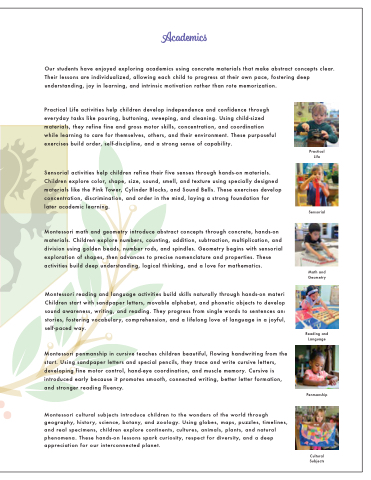
 Practical Life activities help children develop independence and confidence through everyday tasks like pouring, buttoning, sweeping, and cleaning. Using child-sized materials, they refine fine and gross motor skills, concentration, and coordination while learning to care for themselves, others, and their environment. These purposeful exercises build order, self-discipline, and a strong sense of capability.
Sensorial activities help children refine their five senses through hands-on materials. Children explore color, shape, size, sound, smell, and texture using specially designed materials like the Pink Tower, Cylinder Blocks, and Sound Bells. These exercises develop concentration, discrimination, and order in the mind, laying a strong foundation for later academic learning.
Montessori math and geometry introduce abstract concepts through concrete, hands-on materials. Children explore numbers, counting, addition, subtraction, multiplication, and division using golden beads, number rods, and spindles. Geometry begins with sensorial exploration of shapes, then advances to precise nomenclature and properties. These activities build deep understanding, logical thinking, and a love for mathematics.
Montessori reading and language activities build skills naturally through hands-on materials. Children start with sandpaper letters, movable alphabet, and phonetic objects to develop sound awareness, writing, and reading. They progress from single words to sentences and stories, fostering vocabulary, comprehension, and a lifelong love of language in a joyful, self-paced way.
Montessori penmanship in cursive teaches children beautiful, flowing handwriting from the start. Using sandpaper letters and special pencils, they trace and write cursive letters, developing fine motor control, hand-eye coordination, and muscle memory. Cursive is introduced early because it promotes smooth, connected writing, better letter formation, and stronger reading fluency.
Montessori cultural subjects introduce children to the wonders of the world through geography, history, science, botany, and zoology. Using globes, maps, puzzles, timelines, and real specimens, children explore continents, cultures, animals, plants, and natural phenomena. These hands-on lessons spark curiosity, respect for diversity, and a deep appreciation for our interconnected planet.
Practical Life
Sensorial
Math and Geometry
Reading and Language
Penmanship
Cultural Subjects


