


Page 9 - Priorities 6
P. 9
e Let’s start with something a student wrote. He is describing his own experience:
“When playing in an ensemble, each musician must listen to the other players. They communicate, and each musician can agree or disagree through his or her playing, while always acting as a complement to the other musicians...When a dozen people are talking, all you hear is chaos. When a dozen people are playing, every intonation is crystal clear. So I suppose you could say that music is a language of emotion. But while you can speak dispassionately, you can never play dispassionately.”
Is this typical of a student’s experience in a choir or orchestra? Or would it describe only someone who was very involved and talented?
Mayer: I think the most important thing this student touches on is cooperation. Choir and orchestra may be the only activity in school where cooperation is the number one goal. In sports, personal achievement is still important – for example the number of baskets you personally make. In ensemble music, the unified sound is the main concern. There is competition in the beginning for the different chairs but that is separate from their work as a group.
Davison: The emotional component that the student mentioned is very important for adolescent development. Theyneedtoparticipateinsomething that has emotional content but within a context that makes sense, where they can be expressive but take things in steps. Some take this farther than others, of course, but they all get something from music that is unique from anything else they do.
Music also has an intellectual component and the physical component of using the body in singing or playinganinstrument. Thisexperiencebringsabout an integration that is in itself very helpful and challenging for students of this age.
Sims: In the movie, Amadeus, Mozart says that an opera is the only place where you can have more than one person talking loudly at the same time and it’s not chaos, it’s beautiful music! As students learn to listen to music they probably develop their ability to hear and understand complexity in other contexts, too.
Davison: By the way, we at the Priory make a conscious choice to organize cooperatively – it is possible to do it other ways and many groups do... I
know of students who were influenced in their decision to come here because they like the style of the music program, which is distinctly the Priory’s.
e So students may gain a variety of benefits, developmentally and socially. It sounds as though the style of the individual group has a lot to do with the experience.
Salsbury: The conductor sets the tone. Just for the sake of an example, let’s look at the Priory orchestra. We have about 30 students with different instrumentation (that is, a wide variety of instruments are played) and of course different levels of ability. Should we set a tone of just writing off those younger players, or the weaker sections where we may have only one or two instruments? Or should we set a positive expectation with the whole orchestra that everyone will improve and rise to the challenge?
I take the approach that the director has to look at a wide range of music to find something appropriate for each of the sections, something that will work for the newer members and still interest the others. In the sectional practices, I encourage the more experienced players to work with the others. That has worked well and now they are all up a notch.
e How do you answer the parent who says “My child played that piece three years ago...He or she isn’t moving ahead?”
Salsbury: They play more challenging music in small quartets and trios. While those groups practice, I can be working with the others to improve their
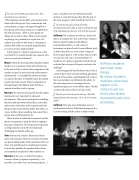
All Priory students learn basic music literacy.
By choice, students musicians collectively support a full orchestra and two choirs, plus several instrumental and voice ensembles.
9


