


Page 11 - Priorities 6
P. 11
Davison: To the extent that (those conclusions) are true, there could be several reasons for it. The discipline required to perform, to be part of a musical group must have transferability to other areas.
Salsbury: There is discipline, patience, the ability to listen, and to focus, to integrate, to break things down into small parts and put them together again – all of that must benefit their other academic work.
Sims: Someofthoseskillsarethesameasthe higher-order thinking processes.
e All the research leads me to ask whether music instruction is the new magic pill. Should every student be required to take music because it’s a good brain-builder? Even if they hate it?
Mayer: That would probably produce some painful sounds!
e How does a parent decide? For example, how long should a parent go on encouraging a reluctant student?
Salsbury: I think it depends on the age. Many kids hit an age where they just hate everything and they want to give it up. I know several kids who, when they got through that, were glad their parents helped them stick it out. But you have to be realistic.
e Is that age around 9 or 10?
Salsbury: No, I’d say it’s around eighth grade.
(Nods around the table.)
Mayer: In the cases I’ve seen, when music is important to the kids, it’s because music is important to the family. Parents aren’t saying “You have to do it, Iwantyoutodoit,it’sgoodforyoutodoit,”—they are genuinely interested in music themselves and it has always been part of the family. If there is a connection between brain and music, maybe it comes from this continuous involvement.
Davison: I think every student benefits from exposure and opportunity to play but I would have trouble requiring every student to play an instrument... (Nods again.)
e In schools, the trend is clearly towards providing music
Historical Note
“Listen, ...with the ear of your heart...”
...from the opening line of The Rule of St. Benedict
Music arrived at Woodside Priory with the monks and their schedule of daily singing, as laid forth in St. Benedict’s Rule. Soon, the chapel needed a choir and, naturally, monks and students were drafted. The 1962 daily schedule simply states that, on Tuesdays and Fridays, “all students will report to the Chapel for choir practice...”
Among early musical offerings for area residents was a two-week course in medieval music and culture, including a workshop in Gregorian chants. Participants attended daily lectures, workshops, daily Mass and vespers with the Monastic choir, and a concert on the concluding Sunday.
Today, area residents, chapel friends, Father Martin and one student, flutist Devin Coats, join together in making music for monthly Taize services (an ecumenical musical and meditative program that originated in France) on the campus.
11
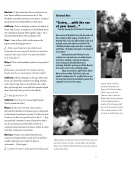
Andrew Smith and Brian Gundell, both members of Ragazzi, The Peninsula Boys Chorus, sang in the San Francisco Opera Chorus for Tosca, which closed in January. In these backstage photos, a member of the costuming staff puts on the last-minute touches, and a costumed member of the cast stops to wish the boys well.
Many students are selected to represent the Priory in regional and state orchestras or choirs. Carolyn Hayes was principal oboist in the California Music Educators Association regional orchestra this winter.


