


Page 10 - Priorities 6
P. 10
technique. A school is very lucky to be able to schedule time for both sectionals and the full orchestra, as the Priory does. The more advanced ensembles can perform independently, if they want to. (The choirs also have an advanced ensemble.)
Davison: In the mix, we try to see that everyone is challenged, but it isn’t just about musical challenge. At the Priory, a sense of community is an important value that is reinforced in other classes. In music, we look to the able students to develop their skills in leading the others — to be role models. Occasionally, this means spending some portion of time playing music that is quite easy for a particular player, but if they didn’t offer their leadership the whole community would suffer.
Mayer: The same thing is true of the San Francisco Symphony or any other large, professional group. Section leaders are expected to coach their section. It’s part of their job description. They are responsible for the sound in their section.
One thing I especially like is the mix of age relationships possible in the school orchestra. It is an interesting experience, I think, for the older students to see that sometimes a much younger student should be a section leader.
Sims: Studentsgainself-esteem.Thereisa camaraderie that comes from a common goal. The good times they have, and the times they start on a piece and think the group will never, ever get it right but at the performance it’s great – those experiences will stick with them for twenty years.
e I see hundreds of students participating in community groups such as Sara’s Peninsula Youth Orchestra or the Peninsula Boys Chorus. What do students gain from this experience that is different from school music?
Salsbury: Interesting question. I think it’s different for each person. And the groups are different. I can compare what I’m doing here at the Priory with what I’m doing with Peninsula Youth Orchestra. One difference is instrumentation. The out-of-school orchestra is typically going to be balanced. It will typically be larger. That means a difference in the
literature that’s being played. Most of the out-of- school orchestras have two or three different levels, so the student might be playing with a group geared more exactly to where they are.
Usually, the student is playing at school and just wants to try more...maybe they have a friend in one of the groups. Or they like the idea of more performance opportunities and tours.
Sims: The professional associations (such as California Music Educators Association) provide great opportunities to take students off the campus. They have those varied experiences, but with less time commitment. The four-day music cruise for our orchestra and choirs last spring was extraordinary in that respect. The students were playing with high school and college level musicians, with professional leadership...the students have a new perspective of what they might do if they go farther with their music.
Mayer: I like the California Music Educators Association’s approach to evaluations of the students. A student can request an evaluation and the process is to provide feedback about each individual performance, rather than comparisons among performers. That means our students are very supportive of each other, in that they help each other prepare and deal with nervousness, because they can all achieve Excellents and Superiors.
e To change the subject a little, I am interested in your reaction to the various studies of music’s association with intelligence. The University of California, Irvine campus, has a clearinghouse for scientific abstracts, the Music Brain Information Center. Among its more interesting studies are some linking musical instruction with higher SATs and better spatial intelligence. I haven’t seen but have read in the news of links between music and math ability.
What do you think?
Mayer: Playing an instrument or singing has tremendous payoff and it gives students some lifelong skills. Whether it actually changes their SAT’s or not – most of the studies I know of show correlation but that doesn’t mean a causal relationship. It’s not a guarantee. Still, I’ve always wanted to see a study of Priory musicians’ grade averages as compared with non-musicians’. I’m sure musicians’ are higher!
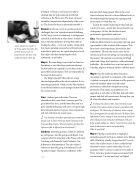
Alison Schmidt is a member of the Priory Guitar Ensemble. Like all of the music groups, the guitarists meet with their coach weekly, during the school day.
10


