


Page 44 - 71187_NSAA_FallJournal2016
P. 44
Environmental

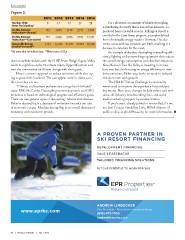
Figure 2.

                           2011 2012 2013 2014 2015

Number of Ski              8 17 17 27 28                                For a ski resort, an example of relative decoupling
Areas Participating*                                                is purchasing electricity that is less carbon intensive, i.e.,
                                                                    produced from renewable sources. Killington Resort is
On-Site Emission           172 3,694 1,130 2,147 5,588              enrolled in the Cow Power program, a completely local
Reductions** (Annual)                                               form of renewable energy made in Vermont. The elec-
                                                                    tricity comes with less emissions per kWh, resulting in a
On-Site Emission           172     3,866 4,996 7,143 12,731         decrease in emissions for the resort.
Reductions** (Cumulative)
                                                                        An example of absolute decoupling is installing effi-
Renewable Energy           2,134 33,346 41,819 41,944 38,580        ciency lighting and snowmaking equipment that reduces
Credits Purchased**                                                 the overall energy consumption and therefore emissions.
                                                                    New Mexico’s Taos Ski Valley is investing in its new
*Ski areas that submitted data; **Metric tons of C02e               base area but also focusing on energy efficiency to min-
                                                                    imize emissions. Either way, both can result in reduced
seven snowflake stickers with the POW Seven Pledge. Squaw Valley    emissions even with growth.
wants to capitalize on the 10-minute ride to Upper Mountain and
start the conversation on climate change with their guests.             The NSAA Climate Challenge is continually
                                                                    reevaluated to improve the experience for participat-
    How is a resort supposed to reduce emissions while also try-    ing resorts. Next year, changes include minor tool revi-
ing to grow their business? The two appear to be in direct con-     sions, ski industry benchmarking data, and social
flict, but they are not.                                            media marketing support by student interns.

    “Climate and business performance can go hand-in-hand,”             If you haven’t already joined or re-enrolled, it’s not
states EPA’s McCarthy. Decoupling economic growth and GHG           too late! Contact Geraldine Link, NSAA director of
emissions is based on technological progress and efficiency gains.  public policy, at glink@nsaa.org for more information.
There are two general types of decoupling: relative and absolute.
Relative decopuling is a decrease of emissions intensity per unit
of economic output. Absolute decoupling is an overall decrease of
emissions with economic growth.

42  |  NSAA JOURNAL  |  FALL 2016

