


Page 42 - 71187_NSAA_FallJournal2016
P. 42
Environmental

CLIMATE CHALLENGE RESULTS
FOR 2015-16

Program Shows Ongoing Reduction of Ski Area Emissions

BY BROOK MASON, BRENDLE GROUP

THE NSAA CLIMATE CHALLENGE encourages member resorts           project, 4) submit at least two climate legislation advocacy let-
to do their part to address climate change head on. “Climate   ters, and 5) publicly report emissions annually.
change threatens our health, our economy, and our way of
life, and nobody knows that better than the winter sports          The participating resorts reduced on-site emissions by
community,” said Gina McCarthy, administrator of the           5,588 MTCO2e this year—more than double the amount in
Environmental Protection Agency. “[The] EPA is proud to        2014 and the highest level since the Climate Challenge (an
recognize the winter sports industry for the many different    average of nearly 200 MTCO2e per resort). Figures 1 and 2
ways in which you’re acting on climate.”                       summarize the progress ski areas have made toward reducing
                                                               GHG emissions during the five years of the Climate Challenge.
    The Climate Challenge has five components: inventory,
target, reduce, advocate, and report. This means resorts must      In 2015-16, many ski resorts engaged in local advocacy
1) inventory their greenhouse gas emissions (GHG), 2) set an   efforts as well. One creative idea came from California’s Squaw
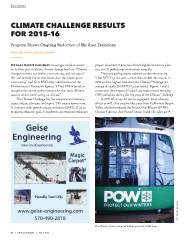
emissions reduction goal, 3) implement an emissions reduction  Valley, which introduced the Protect Our Winters (POW)
                                                               Climate Cabin to their Funitel lineup. Inside the cabin are

    Geise
Engineering

       Sales and Engineering

                               Magic
                              Carpet®

                  Handle Tow Lifts                                                                                                Courtesy Squaw Valley

   www.geise-engineering.com                                   The Climate Cabin at Squaw Valley sports the POW logo.
             570-490-2818

40  |  NSAA JOURNAL  |  FALL 2016

