


Page 98 - pharmacognosy2- pharmD- e-book
P. 98
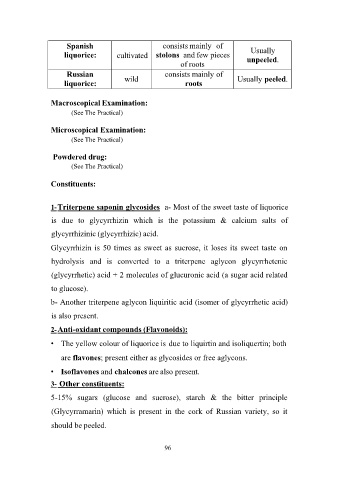
Spanish        cultivated       consists mainly of         Usually
liquorice:       wild         stolons and few pieces     unpeeled.

Russian                                of roots       Usually peeled.
liquorice:
                                 consists mainly of
                                         roots

Macroscopical Examination:

         (See The Practical)

Microscopical Examination:

         (See The Practical)

Powdered drug:

         (See The Practical)

Constituents:

1-Triterpene saponin glycosides a- Most of the sweet taste of liquorice
is due to glycyrrhizin which is the potassium & calcium salts of
glycyrrhizinic (glycyrrhizic) acid.
Glycyrrhizin is 50 times as sweet as sucrose, it loses its sweet taste on
hydrolysis and is converted to a triterpene aglycon glycyrrhetenic
(glycyrrhetic) acid + 2 molecules of glucuronic acid (a sugar acid related
to glucose).
b- Another triterpene aglycon liquiritic acid (isomer of glycyrrhetic acid)
is also present.
2-Anti-oxidant compounds (Flavonoids):
• The yellow colour of liquorice is due to liquirtin and isoliquertin; both

   are flavones; present either as glycosides or free aglycons.
• Isoflavones and chalcones are also present.
3- Other constituents:
5-15% sugars (glucose and sucrose), starch & the bitter principle
(Glycyrramarin) which is present in the cork of Russian variety, so it
should be peeled.

                              96

