


Page 13 - Statistics presented by Dr. Sara Ismail Aborass
P. 13
9/8/2023
Relative Standard Deviation (RSD) and
Coefficient of Variation (CV)
Frequently standard deviations are given in relative rather than
absolute terms.
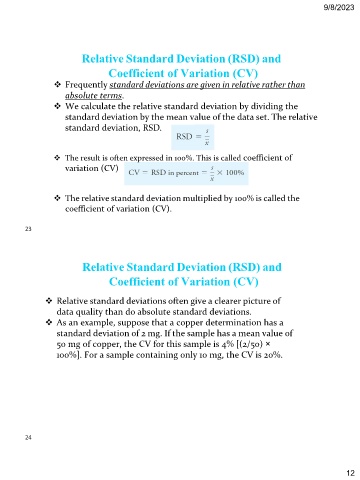
We calculate the relative standard deviation by dividing the
standard deviation by the mean value of the data set. The relative
standard deviation, RSD.
The result is often expressed in 100%. This is called coefficient of
variation (CV)
The relative standard deviation multiplied by 100% is called the
coefficient of variation (CV).
23
Relative Standard Deviation (RSD) and
Coefficient of Variation (CV)
Relative standard deviations often give a clearer picture of
data quality than do absolute standard deviations.
As an example, suppose that a copper determination has a
standard deviation of 2 mg. If the sample has a mean value of
50 mg of copper, the CV for this sample is 4% [(2/50) ×
100%]. For a sample containing only 10 mg, the CV is 20%.
24
12

