


Page 330 - Atlas Sea Birds Ver1
P. 330
3.3  Numbers, trends, status, and conservation of Leach’s Storm
                           Petrel (Hydrobates leucorhous) breeding in South Africa


                  Authors: PA Whittington, JL Visagie, L Upfold, BM Dyer, RJM Crawford, and AB Makhado


                  Abstract:
                  Leach’s Storm Petrel (Hydrobates leucorhous) bred in small numbers at two islands off South Africa, and possibly at a third, between
                  1995 and 2021, and at least one individual Leach’s Storm Petrel was present each summer at a fourth from 1976-1984. The maximum
                  number recorded in a season was 20 pairs at Dyer Island in 1998, which decreased by 80% to just four pairs at Dassen Island in 2021.
                  Loss of suitable breeding habitat in an area having low densities of Kelp Gulls (Larus dominicanus) at Dyer Island may have contributed
                  to the demise of that colony. A lack of such habitat may now limit the South African population, which is Critically Endangered. Migratory
                  Leach’s Storm Petrels from the North Atlantic visit the Benguela upwelling ecosystem and adjacent waters in their non-breeding season,
                  the austral summer.

                  Introduction:
                     Most Leach’s Storm Petrels (Hydrobates leucorhous) breed in the North Pacific and North Atlantic oceans. The northern populations
                  migrate south into the tropics in winter, reaching the equator in the Pacific and as far south as south Brazil and South Africa in the Atlantic
                  (del Hoyo et al. 1992). The species is a common offshore summer visitor to South Africa (Underhill et al. 2002). Some Leach’s Storm
                  Petrels from colonies off Nova Scotia, Canada, migrated to winter in waters off southern Africa using stopover areas associated with
                  the Canary and Benguela upwelling ecosystems (Pollet et al. 2019). Petrels from these colonies also travelled substantial distances
                  (600–1000 km) to feeding grounds in the North Atlantic during incubation (Pollet et al. 2014).
                     In 2022, the global population of Leach’s Storm Petrels was 6.7–8.3 million breeding pairs, but the species was regarded as Vulnerable
                  on account of a decline of ≥ 30% over three generations. The cause(s) of the decline were unknown, but were likely multi-faceted and
                  further research was needed to inform conservation actions (BirdLife International 2022). Leach’s Storm Petrels attain sexual maturity at
                  five years, occasionally at four years (del Hoyo et al. 1992), annual adult survival ranges from 0.79–0.94, and birds have lived 36 years
                  in the wild (Huntington et al. 1996). The species is single brooded with a fledging success of 20–57% at colonies in the Pacific Ocean
                  (Ainley et al. 1990).
                     Leach’s Storm Petrel was first confirmed breeding in southern Africa (and the Southern Hemisphere) at Dyer Island (Figure 1) in
                  November 1996 (Whittington et al. 1999). However, 17 birds occupied sites at this island in November 1995, when it was likely that
                  they bred (Whittington et al. 1999). Subsequently, breeding was also confirmed at Dassen Island and thought to occur at Jutten Island
                  (Whittington et al. 2001). Earlier, Leach’s Storm Petrel was seasonally recorded ashore at St Croix Island, in Algoa Bay, from 1976–1984
                  (Randall and Randall 1986) and may have bred there (Underhill et al. 2002).
                     This chapter collates estimates of numbers of pairs of Leach’s Storm Petrel breeding in South Africa from 1995–2021. It makes a
                  preliminary, updated assessment of the Red List status of, identifies Important Bird and Biodiversity Areas (IBAs) for, and summarises the
                  main threats to the South African population.
                  Numbers and population trend                      2005, the petrels have only bred at Dassen Island, where
                                                                    3–6 pairs nested each season from 2003–2022.
                  In South Africa, Leach’s Storm Petrel breeds in the austral
                  summer (Whittington et al. 1999). Presumed numbers of   Conservation status, Important Bird and Biodiversity
                  pairs of Leach’s Storm Petrel breeding at different localities   Areas, and threats
                  from 1995–2021, based on counts of different sites from
                  which  the  petrels  were  calling,  were  collated  in Table  1.   In 2015, Leach’s Storm Petrel was classified as Critically
                  Information  was  collated  from  Whittington  et  al.  (1999,   Endangered (CR) in South Africa (Taylor and Whittington
                  2001),  Underhill  et  al.  (2002),  Crawford  et  al.  (2007),   2015).  Numbers  breeding  in  South  Africa  decreased  by
                  Taylor  and  Whittington  (2015). These  were  updated  with   80%  over  23  years  from  20  pairs  in  1998  to  four  pairs
                  unpublished  estimates  made  by  CapeNature  (CN)  and   (eight mature individuals) in 2021. Generation length (G)
                  South  Africa’s  Department  of  Forestry,  Fisheries  and   for  Leach’s  Storm  Petrel  was  estimated  to  be  13  years
                  Environment  (DFFE).  Nests  were  found  at  Dyer  and   (BirdLife International 2022), so the decrease occurred in
                  Dassen  islands  and  breeding  was  assumed  at  Jutten   c. 1.77 G and was equivalent to c. 45% in 1 G. Therefore,
                  Island, where birds were calling in the air around buildings,
                  from cavities in dry stone walls, and responded to playback
                  calls  and  behaved  in  a  similar  way  to  those  breeding  at
                  Dyer and Dassen islands (BMD pers. obs).
                     Maximum  numbers  thought  to  have  bred  in  a  season
                  at  Jutten,  Dassen  and  Dyer  islands  were  six,  five  and
                  20  pairs,  respectively  (Table  1).  Leach’s  Storm  Petrel
                  probably  bred  prior  to  1995  at  Dyer  Island  but  went
                  undetected due to its nocturnal habits and to the irregular
                  and infrequent visits to the island by researchers, who may
                  not have been familiar with its calls. The largest number
                  breeding at all localities in a given season was 20 pairs
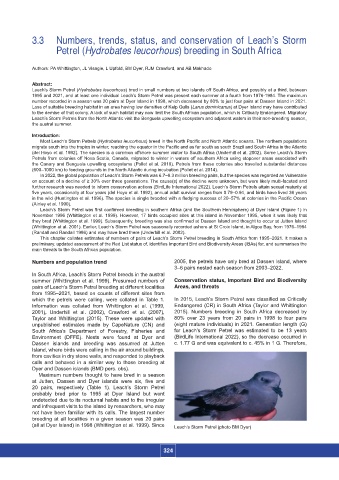
                  (all at Dyer Island) in 1998 (Whittington et al. 1999). Since   Leach’s Storm Petrel (photo BM Dyer)


                                                                324

