


Page 332 - Atlas Sea Birds Ver1
P. 332
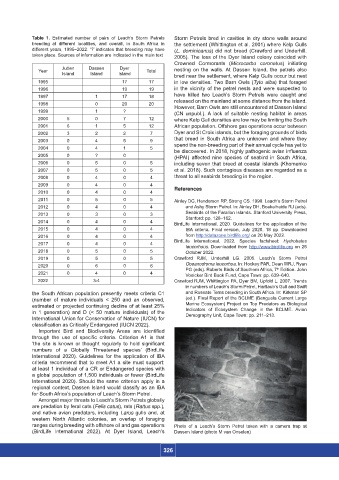
Table 1.  Estimated  number  of  pairs  of  Leach’s  Storm  Petrels   Storm  Petrels  bred  in  cavities  in  dry  stone  walls  around
                  breeding  at  different  localities,  and  overall,  in  South  Africa  in   the settlement (Whittington et al. 2001) where Kelp Gulls
                  different years, 1995–2022. ‘?’ indicates that breeding may have   (L. dominicanus)  did  not  breed  (Crawford  and  Underhill.
                  taken place. Sources of information are indicated in the main text  2005). The loss of the Dyer Island colony coincided with
                                                                    Crowned  Cormorants  (Microcarbo  coronatus)  initiating
                    Year     Jutten   Dassen     Dyer     Total     nesting  on  the  walls. At  Dassen  Island,  the  petrels  also
                             Island    Island    Island             bred near the settlement, where Kelp Gulls occur but nest
                    1995                          17       17       in low densities. Two Barn Owls (Tyto alba) that foraged
                    1996                          19       19       in  the  vicinity  of  the  petrel  nests  and  were  suspected  to
                    1997                1         17       18       have  killed  two  Leach’s  Storm  Petrels  were  caught  and
                    1998                0         20       20       released on the mainland at some distance from the island.
                                                                    However, Barn Owls are still encountered at Dassen Island
                    1999                1         ?                 (CN  unpubl.). A  lack  of  suitable  nesting  habitat  in  areas
                    2000      5         0         7        12       where Kelp Gull densities are low may be limiting the South
                    2001      6         1         5        12       African population. Offshore gas operations occur between
                    2002      3         2         2         7       Dyer and St Croix islands, but the foraging grounds of birds
                    2003      0         4         5         9       that  breed  in  South Africa  are  unknown  and  where  they
                    2004      0         4         1         5       spend the non-breeding part of their annual cycle has yet to
                                                                    be discovered. In 2018, highly pathogenic avian influenza
                    2005      0         ?         0                 (HPAI)  affected  nine  species  of  seabird  in  South Africa,
                    2006      0         5         0         5       including seven that breed at coastal islands (Khomenko
                    2007      0         5         0         5       et al. 2018). Such contagious diseases are regarded as a
                    2008      0         4         0         4       threat to all seabirds breeding in the region.
                    2009      0         4         0         4
                    2010      0         4         0         4       References
                    2011      0         5         0         5       Ainley DG, Henderson RP, Strong CS. 1990. Leach’s Storm Petrel
                    2012       0        4         0         4           and Ashy Storm Petrel. In: Ainley DH, Boekelheide RJ (eds).
                    2013       0        3         0         3           Seabirds of the Farallon Islands. Stanford University Press,
                                                                        Stanford: pp. 128–162.
                    2014       0        4         0         4       BirdLife International. 2020. Guidelines for the application of the
                    2015       0        4         0         4           IBA  criteria.  Final  version,  July  2020.  18  pp.  Downloaded
                    2016       0        4         0         4           from http://datazone.birdlife.org/ on 20 May 2022.
                    2017       0        4         0         4       BirdLife  International.  2022.  Species  factsheet:  Hydrobates
                                                                        leucorhous. Downloaded from http://www.birdlife.org on 25
                    2018       0        5         0         5           October 2022.
                    2019       0        5         0         5       Crawford  RJM,  Underhill  LG.  2005.  Leach’s  Storm  Petrel
                    2020       0        6         0         6           Oceanodroma leucorhoa. In: Hockey PAR, Dean WRJ, Ryan
                                                                                                        th
                    2021       0        4         0         4           PG (eds). Roberts Birds of Southern Africa, 7  Edition. John
                                                                        Voelcker Bird Book Fund, Cape Town: pp. 639–640.
                    2022                3-4                         Crawford RJM, Whittington PA, Dyer BM, Upfold L. 2007. Trends
                                                                        in numbers of Leach’s Storm Petrel, Hartlaub’s Gull and Swift
                  the  South African  population  presently  meets  criteria  C1   and Roseate Terns breeding in South Africa. In: Kirkman SP
                  (number  of  mature  individuals  <  250  and  an  observed,   (ed.). Final Report of the BCLME (Benguela Current Large
                  estimated or projected continuing decline of at least 25%   Marine Ecosystem) Project on Top Predators as Biological
                  in  1  generation)  and  D  (<  50  mature  individuals)  of  the   Indicators  of  Ecosystem  Change  in  the  BCLME.  Avian
                  International Union for Conservation of Nature (IUCN) for   Demography Unit, Cape Town: pp. 211–213.
                  classification as Critically Endangered (IUCN 2022).
                     Important  Bird  and  Biodiversity  Areas  are  identified
                  through  the  use  of  specific  criteria.  Criterion  A1  is  that
                  ‘the site is known or thought regularly to hold significant
                  numbers  of  a  Globally  Threatened  species’  (BirdLife
                  International  2020).  Guidelines  for  the  application  of  IBA
                  criteria recommend that to meet A1 a site must support:
                  at least 1 individual of a CR or Endangered species with
                  a global population of 1,500 individuals or fewer (BirdLife
                  International 2020). Should the same criterion apply in a
                  regional context, Dassen Island would classify as an IBA
                  for South Africa’s population of Leach’s Storm Petrel.
                     Amongst major threats to Leach’s Storm Petrels globally
                  are predation by feral cats (Felis catus), rats (Rattus spp.),
                  and native avian predators, including Larus gulls and, at
                  western  North  Atlantic  colonies,  an  overlap  of  foraging
                  ranges during breeding with offshore oil and gas operations   Photo  of  a  Leach’s  Storm  Petrel  taken  with  a  camera  trap  at
                  (BirdLife  International  2022).  At  Dyer  Island,  Leach’s   Dassen Island (photo M van Onselen)


                                                                326

