


Page 337 - Atlas Sea Birds Ver1
P. 337
7 000
                    2 500
                                                                      6 000
                    2 000
                                                                      5 000
                    PAIRS  1 500                                     PAIRS  4 000

                                                                      3 000
                    1 000
                                                                      2 000
                     500
                                                                      1 000
                       1963  1969  1975  1981  1987  1993  1999  2005  2011  2017  1975  1979  1973  1987  1991  1995  1999  2003  2007  2011  2015  2019


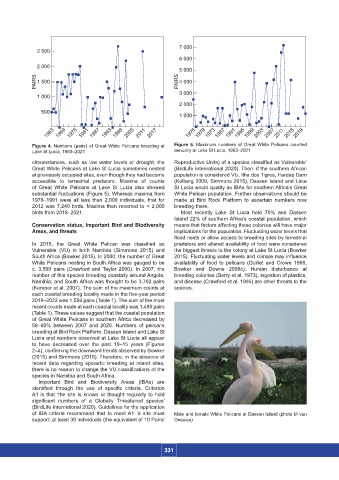
                  Figure 4.  Numbers  (pairs)  of  Great  White  Pelicans  breeding  at   Figure 5.  Maximum  numbers  of  Great  White  Pelicans  counted
                  Lake St Lucia, 1963–2021                          annually at Lake St Lucia, 1963–2021
                  circumstances,  such  as  low  water  levels  or  drought,  the   Reproductive Units) of a species classified as Vulnerable’
                  Great White Pelicans at Lake St Lucia sometimes nested   (BirdLife International 2020). Then, if the southern African
                  at previously occupied sites, even though they had become   population is considered VU, Ilha dos Tigres, Hardap Dam
                  accessible  to  terrestrial  predators.  Maxima  of  counts   (Kolberg 2009, Simmons 2015), Dassen Island and Lake
                  of  Great  White  Pelicans  at  Lake  St  Lucia  also  showed   St Lucia would qualify as IBAs for southern Africa’s Great
                  substantial fluctuations (Figure 5). Whereas maxima from   White Pelican population. Further observations should be
                  1976–1991  were  all  less  than  2,000  individuals,  that  for   made  at  Bird  Rock  Platform  to  ascertain  numbers  now
                  2012 was 7,240 birds. Maxima then reverted to < 2,000   breeding there.
                  birds from 2018–2021.                               Most  recently  Lake  St  Lucia  held  70%  and  Dassen
                                                                    Island 22% of southern Africa’s coastal population, which
                  Conservation status, Important Bird and Biodiversity   means that factors affecting these colonies will have major
                  Areas, and threats                                implications for the population. Fluctuating water levels that
                                                                    flood nests or allow access to breeding sites by terrestrial
                  In  2015,  the  Great  White  Pelican  was  classified  as   predators and altered availability of food were considered
                  Vulnerable  (VU)  in  both  Namibia  (Simmons  2015)  and   the biggest threats to the colony at Lake St Lucia (Bowker
                  South Africa (Bowker 2015). In 2000, the number of Great   2015). Fluctuating water levels and climate may influence
                  White Pelicans nesting in South Africa was gauged to be   availability  of  food  to  pelicans  (Guillet  and  Crowe  1968,
                  c.  3,500  pairs  (Crawford  and  Taylor  2000).  In  2007,  the   Bowker  and  Downs  2008c).  Human  disturbance  at
                  number of this species breeding coastally around Angola,   breeding colonies (Berry et al. 1973), ingestion of plastics,
                  Namibia, and South Africa was thought to be 3,702 pairs   and disease (Crawford et al. 1995) are other threats to the
                  (Kemper et al. 2007). The sum of the maximum counts at   species.
                  each coastal breeding locality made in the five-year period
                  2018–2022 was 1,556 pairs (Table 1). The sum of the most
                  recent counts made at each coastal locality was 1,480 pairs
                  (Table 1). These values suggest that the coastal population
                  of Great White Pelicans in southern Africa decreased by
                  58–60%  between  2007  and  2020.  Numbers  of  pelicans
                  breeding at Bird Rock Platform, Dassen Island and Lake St
                  Lucia and numbers observed at Lake St Lucia all appear
                  to  have  decreased  over  the  past  10–15  years  (Figures
                  2–4), confirming the downward trends observed by Bowker
                  (2015) and Simmons (2015). Therefore, in the absence of
                  recent  data  regarding  sporadic  breeding  at  inland  sites,
                  there is no reason to change the VU classifications of the
                  species in Namibia and South Africa.
                     Important  Bird  and  Biodiversity  Areas  (IBAs)  are
                  identified  through  the  use  of  specific  criteria.  Criterion
                  A1 is that ‘the site is known or thought regularly to hold
                  significant  numbers  of  a  Globally  Threatened  species’
                  (BirdLife International 2020). Guidelines for the application
                  of  IBA  criteria  recommend  that  to  meet A1  ‘a  site  must   Male and female White Pelicans at Dassen Island (photo M van
                  support: at least 30 individuals (the equivalent of 10 Pairs/  Onselen)


                                                                 331

