


Page 336 - Atlas Sea Birds Ver1
P. 336
ousted from Quoin Rock by a growing colony of Cape Fur
                                                                    Seals (Arctocephalus pusillus pusillus) (Rand 1963, Brooke
                                                                    1984). They moved to Seal Island (False Bay) but growth
                                                                    of the seal herd at that island and disturbance by sealers
                                                                    caused  them  to  leave  it  for  Dassen  Island  (Rand  1963,
                                                                    Crawford et al. 1995). It is likely that the few pairs that bred
                                                                    at Vondeling Island in 2001 and 2005, and at Jutten Island
                                                                    in 2012 were from Dassen Island. The breeding attempts at
                                                                    Vondeling Island coincided with colonisation of that island
                                                                    by Cape Fur Seals (Seakamela et al. 2024), and, because
                                                                    Great White Pelicans fed on chicks of threatened, endemic
                                                                    seabirds (Mwema et al. 2010), their colonisation of Jutten
                                                                    Island was discouraged (Makhado et al. 2024). Numbers of
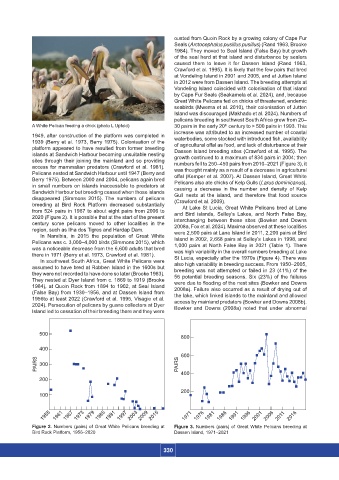
                                                                    pelicans breeding in southwest South Africa grew from 20–
                  A White Pelican feeding a chick (photo L Upfold)  30 pairs in the early 20  century to > 500 pairs in 1993. This
                                                                                      th
                                                                    increase was attributed to an increased number of coastal
                  1949, after construction of the platform was completed in
                  1939 (Berry et al. 1973, Berry 1975). Colonisation of the   waterbodies, some stocked with introduced fish, availability
                  platform appeared to have resulted from former breeding   of agricultural offal as food, and lack of disturbance at their
                  islands at Sandwich Harbour becoming unsuitable nesting   Dassen Island breeding sites (Crawford et al. 1995). The
                  sites through their joining the mainland and so providing   growth continued to a maximum of 834 pairs in 2004; then
                  access  for  mammalian  predators  (Crawford  et  al.  1981).   numbers fell to 250–450 pairs from 2010–2021 (Figure 3), it
                  Pelicans nested at Sandwich Harbour until 1947 (Berry and   was thought mainly as a result of a decrease in agricultural
                  Berry 1975). Between 2000 and 2004, pelicans again bred   offal (Kemper et al. 2007). At Dassen Island, Great White
                  in small numbers on islands inaccessible to predators at   Pelicans also ate chicks of Kelp Gulls (Larus dominicanus),
                  Sandwich Harbour but breeding ceased when those islands   causing  a  decrease  in  the  number  and  density  of  Kelp
                  disappeared  (Simmons  2015).  The  numbers  of  pelicans   Gull  nests  at  the  island,  and  therefore  that  food  source
                  breeding  at  Bird  Rock  Platform  decreased  substantially   (Crawford et al. 2009).
                  from 524 pairs in 1967 to about eight pairs from 2006 to   At Lake St Lucia, Great White Pelicans bred at Lane
                  2020 (Figure 2). It is possible that at the start of the present   and  Bird  islands,  Selley’s  Lakes,  and  North  False  Bay,
                  century  some  pelicans  moved  to  other  localities  in  the   interchanging  between  these  sites  (Bowker  and  Downs
                  region, such as Ilha dos Tigres and Hardap Dam.   2008a, Fox et al. 2024). Maxima observed at these localities
                     In  Namibia,  in  2015  the  population  of  Great  White   were 2,500 pairs at Lane Island in 2011, 2,200 pairs at Bird
                  Pelicans was c. 3,000–4,000 birds (Simmons 2015), which   Island in 2002, 2,668 pairs at Selley’s Lakes in 1998, and
                  was a noticeable decrease from the 6,600 adults that bred   1,000 pairs at North False Bay in 2021 (Table 1). There
                  there in 1971 (Berry et al. 1973, Crawford et al. 1981).  was high variability in the overall numbers breeding at Lake
                     In southwest South Africa, Great White Pelicans were   St Lucia, especially after the 1970s (Figure 4). There was
                  assumed to have bred at Robben Island in the 1600s but   also high variability in breeding success. From 1950–2005,
                  they were not recorded to have done so later (Brooke 1983).   breeding was not attempted or failed in 23 (41%) of the
                  They nested at Dyer Island from c. 1869 to 1919 (Brooke   56  potential  breeding  seasons.  Six  (23%)  of  the  failures
                  1984), at Quoin Rock from 1894 to 1902, at Seal Island   were due to flooding of the nest sites (Bowker and Downs
                  (False Bay) from 1930–1956, and at Dassen Island from   2008a). Failure also occurred as a result of drying out of
                  1956to at least 2022 (Crawford et al. 1995, Visagie et al.   the lake, which linked islands to the mainland and allowed
                  2024). Persecution of pelicans by guano collectors at Dyer   access by mainland predators (Bowker and Downs 2008b).
                  Island led to cessation of their breeding there and they were   Bowker  and  Downs  (2008a)  noted  that  under  abnormal


                     500
                                                                      800
                     400
                                                                      600
                    PAIRS  300                                       PAIRS

                                                                      400
                     200

                                                                      200
                     100

                      1955  1961  1967  1973  1979  1985  1991  1997  2003  2009  2015  1971  1976  1981  1986  1991  1996  2001  2006  2011  2016

                  Figure 2.  Numbers  (pairs)  of  Great  White  Pelicans  breeding  at   Figure 3.  Numbers  (pairs)  of  Great  White  Pelicans  breeding  at
                  Bird Rock Platform, 1956–2020                     Dassen Island, 1971–2021


                                                                330

