


Page 379 - Atlas Sea Birds Ver1
P. 379
Longevity of at least 16 years has been recorded (Underhill   < 100 pairs. Two sites, Schaapen Island and Robbesteen,
                  et al. 1999). Use of these parameters gave G ≥ 7.5 years   each had a maximum of just one pair. The sum of maxima
                  and 3 G ≥ 22.5 years. Hence, the decrease over 42 years   at all sites was 11,544 pairs (Table 3). This could be used
                  equated  to  ≥  43%  in  3  G  and  was  within  the  30–50%   as  an  approximate  carrying  capacity  of  the  Benguela
                  range of IUCN’s Red List criterion A2 for classification as   ecosystem for the species. Of this, 45% was contributed
                  Vulnerable (VU, IUCN 2022).                       by Ichaboe Island and 22% by Mercury Island, and 79%
                     In  Namibia,  numbers  of  Bank  Cormorants  decreased   by  Namibia  and  21%  by  South  Africa.  In  2020–2022,
                  by  84%  from  7,166  pairs  in  1978–1980  (Crawford  et  al.   numbers  in  Namibia  and  South Africa  were  at  13%  and
                  1999)  to  1,182  pairs  in  2018–2022  (Table  2).  In  South   23% of their respective carrying capacities.
                  Africa, they decreased by 63% from 1,506 pairs (Crawford   By 2022, breeding had ceased at 18 of the 59 known
                  et al. 1999) to 560 pairs over the same period (Table 2).   breeding sites (Table 2), so that only 41 colonies remained
                  These decreases amounted to ≥ 45% in 3G in Namibia and    extant.  At  colonies  monitored  annually,  extinctions
                  ≥ 34% in 3G in South Africa and both met IUCN’s Red List   occurred at Lambert’s Bay within 10 years of its holding
                  criterion A2 for classification as VU.            33 pairs, at Marcus Island six years after it had 35 pairs
                     In  2015,  Bank  Cormorants  were  classified  as   and at Jutten Island 11 years after it numbered 27 pairs
                  Endangered  (EN)  in  Namibia  (Roux  and  Kemper  2015)    (Table 1). Therefore, every effort should be made to avoid
                  and  in  South  Africa  (Cook  2015).  In  2022,  they  were   reductions  of  colonies  to  below  c.  50  pairs  and  to  grow
                  classified as EN by BirdLife International (2022).   smaller  colonies  above  that  level,  for  example  through
                                                                    the provision of additional nesting space.
                  Important Bird and Biodiversity Areas
                                                                    Conservation issues
                  Important Bird and Biodiversity Areas (IBAs) are identified
                  through  the  use  of  specific  criteria.  Criterion  A1  is  that   Threats to Bank Cormorants include loss of breeding habitat
                  ‘the site is known or thought regularly to hold significant   as  a  result  of  human  disturbance  (Crawford  et  al.  1999,
                  numbers  of  a  Globally  Threatened  species’  (BirdLife   2018) or displacement by Cape Fur Seals (Arctocephalus
                  International  2020).  Guidelines  for  the  application  of  IBA   pusillus  pusillus,  Crawford  et  al.  1989);  competition  with
                  criteria recommend that, to meet A1, ‘a site must support: at   fisheries for prey species near breeding colonies (Sherley
                  least 30 individuals (the equivalent of 10 Pairs/Reproductive   et al. 2017); and potential impacts of climate change, such
                  Units) of a VU species with a global population of > 1,500   as  reduced  breeding  success  caused  by  an  increased
                  individuals …’’ (BirdLife International 2020). In view of this,   loss of nests to storms or abandonment of nests on account
                  and given that the species’ population is > 1,500 individuals,   of  heat  waves  (Sherley  et  al.  2012),  and  displacement
                  should the Bank Cormorant be reclassified as VU, all sites   of prey away from breeding sites (Crawford et al. 2008).
                  holding ≥ 10 pairs would qualify as IBAs. There are 11 such   Additionally,  oil  spills  around  colonies  may  kill  adult
                  sites in Namibia and 15 in South Africa (Table 2). Based   birds, which are difficult to catch for rehabilitation (Crawford
                  upon  the  most  recent  counts  made  at  colonies,  10  sites   et al. 2000).
                  in Namibia and 11 in South Africa had ≥ 1% of the overall   In order to mitigate these risks, spatial planning should
                  population (Table 2). The largest colonies were at Mercury   target effective management at and around breeding sites
                  Island (54% of the overall population), Groot Paternoster   with  priority  being  given  to  larger  colonies.  Adult  Bank
                  Rocks (5%) and Ichaboe Island (3%).               Cormorants  often  remain  within  10  km  of  breeding  sites
                     The  biggest  Bank  Cormorant  colony  to  have  been   (Cooper 1985) but have moved 63 km between colonies
                  observed  was  5,182  pairs  at  Ichaboe  Island  in  1993.  In   (Crawford et al. 1999). Young birds disperse more widely
                  2020–2022,  the  global  population  was  just  34%  of  that   (Cooper 1981). Bank Cormorants are benthic feeders and
                  amount. The only other site that supported > 1,000 pairs   at  Mercury  Island  foraged  within  c.  3  km  of  the  colony
                  was Mercury Island. The maxima observed for twelve sites   (Ludynia et al. 2010).
                  were  from  100–362  pairs  and  45  sites  had  a  maximum    The Namibian Islands Marine Protected Area restricts
                                                                    access to and controls activities at most breeding sites of
                                                                    Bank Cormorants in Namibia (Ludynia et al. 2012). However,
                                                                    consideration  should  also  be  given  to  implementing
                                                                    shipping routes that minimise the risk of oil washing ashore
                                                                    at  key  colonies,  staffing  such  sites  to  avoid  their  being
                                                                    colonised by seals with resultant loss of breeding habitat
                                                                    (as occurred in the late 20  century, Crawford et al. 1989),
                                                                                         th
                                                                    and  excluding  fishing  of  prey  species  around  them.  In  a
                                                                    Bayesian  state-space  model,  Bank  Cormorant  numbers
                                                                    responded positively to an increased availability of Cape
                                                                    rock lobsters (Jasus lalandii), a main prey item in South
                                                                    Africa  (Dyer  et  al.  2019),  within  20–30  km  of  two  South
                                                                    African colonies, so that precautionary implementation of
                                                                    closures to rock lobster fishing around important colonies
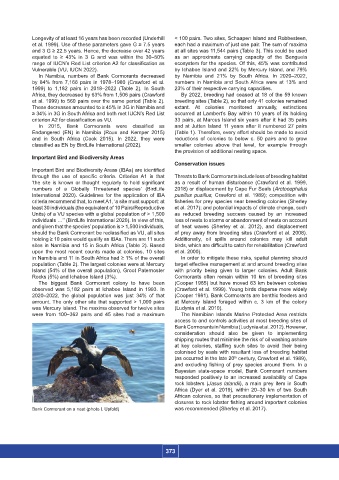
                  Bank Cormorant on a nest (photo L Upfold)         was recommended (Sherley et al. 2017).


                                                                 373

