


Page 376 - Atlas Sea Birds Ver1
P. 376
3.7  Numbers, trends, status, and conservation of Bank Cormorant
                           (Phalacrocorax neglectus)


                  Authors: DB Tom, PA Bartlett, RJM Crawford, J-A Delport, BM Dyer, R Jones, L Upfold, and AB Makhado


                  Abstract:
                  The Bank Cormorant (Phalacrocorax neglectus) is endemic to the Benguela ecosystem and has bred at 59 sites between Hollamsbird
                  Island in Namibia and Quoin Rock in South Africa, of which 19 are in Namibia and 40 in South Africa. However, by 2022 breeding had
                  ceased at 18 sites, so that only 41 colonies remained extant. Sums of maxima at sites decreased by 80% over 42 years from 8,672 pairs in
                  1978–1980 to 1,742 pairs in 2020–2022. Generation length (G) for Bank Cormorants was ≥ 7.5 years; hence the decrease was equivalent
                  to ≥ 43% in 3G and met IUCN’s Red List criterion A2 for classification as Vulnerable (VU). In 2020–2022, Namibia had 68% of the overall
                  population and South Africa 32%. Based on the most recent counts at breeding sites, the three largest colonies were at Mercury Island
                  (54% of the species’ population), Groot Paternoster Rocks (5%), and Ichaboe Island (3%). Eleven sites in Namibia and 15 in South Africa
                  held ≥ 10 pairs and so met criterion A1 for an Important Bird and Biodiversity Area for a VU species.
                  Introduction:
                  Bank Cormorants (Phalacrocorax neglectus) are endemic to the Benguela upwelling ecosystem, where they have bred at 59 sites between
                  Hollamsbird Island in Namibia and Quoin Rock in South Africa (Figure 1). Of these, 19 are in Namibia and 40 in South Africa. Farther north,
                  birds in breeding plumage were observed undertaking courtship displays at the mouth of the Swakop River, Namibia, but no breeding was
                  confirmed at that site (Williams 1987).
                     This chapter collates information on numbers breeding at the different sites in order to examine trends in the Bank Cormorant population.
                  It assesses the Red List status of, identifies Important Bird and Biodiversity Areas (IBAs) for, and summarises threats to the species.

                  Numbers                                           contributed 92% of the sum of most recent counts, from the
                                                                    2000s 5%, and from the 1990s the balance of 3% (Table
                  Counts  of  nests  or  breeding  pairs  of  Bank  Cormorants   2), so estimates for most of the population were obtained
                  were  collated  from  Rand  (1952,  1963),  Shaughnessy   in the past 13 years. The decrease in 2020–2022, after a
                  (1980), Cooper (1981), Williams (1987), Williams and Dyer   period of apparent stabilisation, is of concern and should
                  (1990), Crawford et al. (1999, 2008, 2015, 2018), Bartlett   be confirmed by ongoing monitoring.
                  et al. (2003), Du Toit et al. (2003), Kemper et al. (2007),
                  AEWA (2015), and Roux and Kemper (2015), as well as   Population trends and conservation status
                  from unpublished records of Namibia’s Ministry of Fisheries
                  and  Marine  Resources  and  South  Africa’s  Department   Across  a  period  of  42  years,  the  overall  population  of
                  of  Forestry,  Fisheries  and  the  Environment.  Maximum   Bank Cormorants decreased by 80% from 8,672 pairs in
                  numbers breeding annually at each site are shown in Table   1978–1980 (Crawford et al. 1999) to 1,742 pairs in 2020–
                  1.                                                2022 (Table 2). Generation length (G) for the species was
                     Previously  published  estimates  of  numbers  of  Bank   calculated  as:  G  = A  +  (1  /  (1  −  ϕ )),  where A  is  age  at
                                                                                                 α
                  Cormorants  breeding  in  Namibia  and  South  Africa  in   first breeding and φ  is adult survival (Birdlife International
                                                                                    α
                  different periods (Cooper 1981, Crawford et al. 1999, 2015,   2000). The mean age at first breeding of Bank Cormorants
                  Kemper et al. 2007, AEWA 2015) are shown in Table 2. Also   was  2.5  years  (Crawford  et  al.  2001). Adult  survival  has
                  shown are estimates for two recent 3-year periods (2017–  not  been  measured  but,  from  comparison  with  other
                  2019 and 2020–2022), which were obtained by summing   cormorants, was thought to be at least 80% p.a. (Crawford
                  the  maximum  values  recorded  at  each  colony  in  those   et al. 1991, Crawford and Cooper 2005). An estimate of
                  periods, and for five decadal periods (1970s, 1980s, 1990s,   adult survival for the species should be made from ringing
                  2000s, and 2010s) that were similarly derived. About 8,672   and  recapture  records  to  obtain  a  firmer  appraisal  of  G.
                  pairs of Bank Cormorants bred from 1978–1980 (Crawford
                  et al. 1999). This value excluded unoccupied nest mounds
                  at  breeding  areas.  Cooper’s  (1981)  estimate  included
                  unused nests and was accordingly 350 pairs more. About
                  8,650 pairs bred in the 1970s and 1980s and c. 8,200 in
                  the  1990s  (Table  2).  However,  numbers  breeding  fell  to
                  c. 4,900 pairs in 1995–1997 (Crawford et al. 1999). Sums
                  of maxima at sites suggested that c. 4,300 pairs bred in
                  the 2000s and 4,400 in the 2010s (Table 2), levels about
                  half of those for the 1970s–1990s. The estimate of c. 2,850
                  pairs by Kemper et al. (2007) was probably too low and
                  that of c. 3,650 pairs by AEWA (2015) more correct. Sums
                  of maxima were 3,682 pairs for 2017–2019 and 1,742 pairs
                  for 2020–2022 (Table 2), suggesting the overall population
                  is  still  decreasing.  The  total  of  the  most  recent  counts
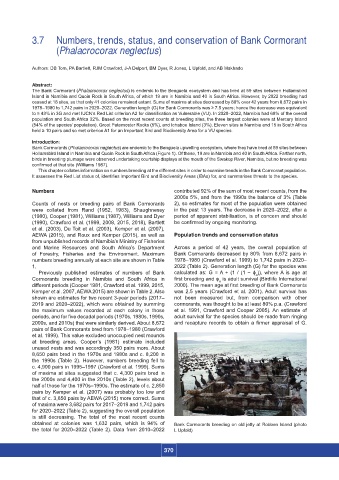
                  obtained  at  colonies  was  1,632  pairs,  which  is  94%  of   Bank Cormorants breeding on old jetty at Robben Island (photo
                  the total for 2020–2022 (Table 2). Data from 2010–2022   L Upfold)


                                                                 370

