


Page 468 - Atlas Sea Birds Ver1
P. 468
Numbers of Kelp Gulls breeding  in South  Africa
                  increased  from about 10,000  pairs in 1976–1980  to
                  c.  21,100 pairs from  2000–2005  and then decreased to
                  17,600 pairs from 2009–2014  (Whittington et al. 2016).
                  The sum of the maximum  count at each colony  made
                  during 2018–2022 was c.  14,000 pairs and the sum of
                  the most  recent count at  each  locality c.  12,750 pairs
                  (Table 2).  These values show that the South  African
                  population  has continued  to decrease  since  its peak  at
                  the start of the present century. The increase in the late
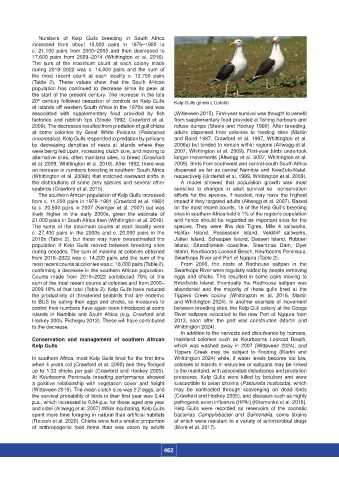
                  20  century followed cessation of controls on Kelp Gulls   Kelp Gulls (photo L Upfold)
                    th
                  at islands off western South Africa in the 1970s and was
                  associated  with  supplementary  food  provided  by  fish   (Witteveen 2015). First-year survival was thought to benefit
                  factories and rubbish tips (Steele 1992, Crawford et al.   from supplementary food provided at fishing harbours and
                  2009). The decreases resulted from predation of gull chicks   refuse dumps (Steele and Hockey 1990). After breeding,
                  at some colonies  by Great White Pelicans  (Pelecanus   adults dispersed  from colonies  to feeding  sites (Martin
                  onocrotalus). Kelp Gulls responded to predation by pelicans   and  Baird  1987,  Crawford  et al. 1997,  Whittington  et al.
                  by  decreasing densities of  nests  at  islands where they   2006a) but tended to remain within regions (Altwegg et al.
                  were being fed upon, increasing clutch size, and moving to   2007, Whittington et al. 2009). First-year birds undertook
                  alternative sites, often mainland sites, to breed (Crawford   longer movements (Altwegg et al. 2007, Whittington et al.
                  et al. 2009, Whittington et al. 2016). After 1982, there was   2009). Birds from southwest and central-south South Africa
                  an increase in numbers breeding in southern South Africa   dispersed  as  far  as  central  Namibia  and  KwaZulu-Natal,
                  (Whittington et al. 2006b) that matched eastward shifts in   respectively (Underhill et al. 1999, Whittington et al. 2009).
                  the distributions of some prey species and several other   A model showed that population  growth was most
                  seabirds (Crawford et al. 2015).                  sensitive to  changes in adult survival so   conservation
                     The southern African population of Kelp Gulls increased   efforts  for  the  species,  if  needed,  may  have  the  highest
                  from c. 11,200 pairs in 1976–1981 (Crawford et al. 1982)    impact if they targeted adults (Altwegg et al. 2007). Based
                  to c. 20,500 pairs in 2007 (Kemper et al. 2007) but was    on the most recent counts, 16 of the Kelp Gull’s breeding
                  likely higher  in the early 2000s, given the estimate of   sites in southern Africa held ≥ 1% of the region’s population
                  21,000 pairs in South Africa then (Whittington et al. 2016).   and hence should be regarded as important sites for the
                  The sums of the maximum counts at each locality were     species.  They were Ilha dos  Tigres, Mile 4 saltworks,
                  c.  27,400 pairs in the 2000s and c.  20,000 pairs in the   Halifax Island, Possession Island, Velddrif saltworks,
                  2010s (Table 2), but these may have overestimated  the   Jutten Island, Schaapen  Island, Dassen Island, Robben
                  population  if Kelp Gulls moved between breeding  sites   Island, Strandfontein coastline,  Steenbras Dam, Dyer
                  during decades. The sum of maxima at colonies obtained   Island, Keurbooms Lookout Beach, Keurbooms Peninsula,
                  from 2018–2022 was c. 14,200 pairs and the sum of the   Swartkops River and Port of Ngqura (Table 2).
                  most recent counts at colonies was c. 16,000 pairs (Table 2),   From 2000, the nests at Redhouse  saltpan in the
                  confirming a decrease in the southern African population.  Swartkops River were regularly raided by people removing
                  Counts made from  2010–2022  contributed 79% of  the   eggs and chicks.  This resulted in some pairs moving to
                  sum of the most recent counts at colonies and from 2000–  Brickfields  Island.  Eventually  the  Redhouse  saltpan  was
                  2009 18% of that total (Table 2). Kelp Gulls have reduced   abandoned  and the majority  of those gulls  bred  at the
                  the productivity of  threatened seabirds that  are endemic   Tippers Creek colony (Whittington et al. 2016, Martin
                  to BUS by eating their eggs and chicks, so measures to   and Whittington 2024). In another example of movement
                  control their numbers have again been introduced at some   between breeding sites, the Kelp Gull colony at the Coega
                  islands  in Namibia  and South Africa (e.g. Crawford and   River saltpans relocated to the new Port of Ngqura from
                  Hockey 2005, Pichegru 2012). These will have contributed   2013,  soon  after the port was  constructed  (Martin  and
                  to the decrease.                                  Whittington 2024).
                                                                      In addition to the harvests and disturbance by humans,
                  Conservation and management  of southern  African   mainland  colonies  such  as Keurbooms  Lookout  Beach,
                  Kelp Gulls                                        which  was washed  away in 2007  (Witteveen 2024), and
                                                                    Tippers  Creek  may  be  subject  to  flooding  (Martin  and
                  In southern Africa, most Kelp Gulls bred for the first time   Whittington  2024) while,  if water levels  become  too low,
                  when 4 years old (Crawford et al. 2000) and they fledged   colonies at islands in estuaries or saltpans may be linked
                  up to 1.33 chicks per pair (Crawford and Hockey 2005).   to the mainland, with associated disturbance and predation
                  At  Keurbooms Peninsula  breeding  performance showed   pressures. Kelp Gulls were  killed  by botulism  and were
                  a positive relationship  with vegetation cover and height   susceptible to avian cholera (Pasturella multocida), which
                  (Witteveen 2015). The mean clutch size was 2.2 eggs, and   may be contracted through  scavenging  on dead  birds
                  the survival probability of birds in their first year was 0.44   (Crawford and Hockey 2005), and diseases such as highly
                  p.a., which increased to 0.84 p.a. for those aged one year   pathogenic avian influenza (HPAI) (Khomenko et al. 2018).
                  and older (Altwegg et al. 2007).While incubating, Kelp Gulls   Kelp Gulls were recorded as reservoirs of the zoonotic
                  spent more time foraging in natural than artificial habitats   bacterias  Campylobacter  and  Salmonella, some strains
                  (Reusch et al. 2020). Chicks were fed a smaller proportion   of which were resistant to a variety of antimicrobial drugs
                  of anthropogenic food items than was eaten by adults   (Moré et al. 2017).


                                                                 462

