


Page 464 - Atlas Sea Birds Ver1
P. 464
3.10  Numbers,  trends,  status,  conservation,  and  management
                           of Kelp Gull (Larus dominicanus) in southern Africa


                  Authors: RJM Crawford, AP Martin, M Morais, DB Tom, PA Whittington, M Witteveen, BM Dyer, M Masotla, L Upfold, and AB Makhado


                  Abstract:
                  The subspecies vetula of Kelp Gull (Larus dominicanus) is endemic to southern Africa, where it bred coastally at 127 sites in the Benguela
                  upwelling ecosystem (BUS) from Ilha dos Tigres in southern Angola to the Nculura River mouth, east of Woody Cape on South Africa’s
                  south coast. The species’ global and regional Red List classification is Least Concern. The southern African population increased from
                  c. 11,200 pairs in 1976–1981 to > 21,000 pairs from 2000–2004 and then decreased to 14,000–16,000 pairs from 2018–2022. The
                  increase in Kelp Gulls in the latter part of the 20  century was attributed to the cessation of controls on Kelp Gulls breeding at islands off
                                                    th
                  South Africa’s west coast and to the provision of supplementary food at fishing harbours and rubbish tips. Predation of chicks by Great
                  White Pelicans (Pelecanus onocrotalus) later caused decreases at the same islands. Kelp Gulls were able to relocate breeding to other,
                  including mainland, sites and there was growth of numbers at southern colonies. Control of Kelp Gull numbers has been reinstated at
                  some islands due to Kelp Gull predation of eggs and chicks of threatened seabirds that are endemic to BUS. This will have contributed to
                  the recent decrease of southern African Kelp Gulls.

                  Introduction:
                  The Kelp Gull (Larus dominicanus) is widely distributed in the southern hemisphere, breeding in southern Africa, south Madagascar,
                  southern Australia, New Zealand, around South America from northern Peru in the Pacific Ocean to southern Brazil in the Atlantic Ocean,
                  at subantarctic islands, and in Antarctica (Del Hoyo et al. 1996). In 2014, the global population of Kelp Gulls was estimated to number
                  3.3 to 4.3 million birds, to be increasing, and its Red List status, in terms of criteria of the International Union for Conservation of Nature
                  (IUCN), was Least Concern (LC) (Whittington et al. 2016). It was also regarded as LC in Namibia and South Africa (Simmons et al. 2015,
                  Taylor et al. 2015).
                     Kelp Gulls in southern Africa were recognised as a distinct subspecies (L. d. vetula) (Brooke and Cooper 1979). They bred almost
                  exclusively at coastal sites within the Benguela upwelling ecosystem (BUS), which ranges from Benguela in south Angola to Woody
                  Cape at the east of Algoa Bay in southern South Africa (Figure 1). One to two pairs of Kelp Gulls were recorded nesting at three sites
                  farther east, between Woody Cape and Hamburg, each on one occasion, and are the most eastern records of breeding by this species in
                  southern Africa (Whittington and Crawford 2024).
                     This chapter updates information on numbers of Kelp Gulls breeding in southern Africa and their distribution. It identifies present
                  important breeding areas for the species and briefly considers factors that may affect their numbers.

                  Numbers and distribution                          maxima between 1,000 and 2,000 pairs and 26 sites had
                                                                    maxima between 100 and 957 pairs (Table 2).
                  Records  of breeding  by Kelp  Gulls  at coastal  sites in    In  Angola, 954 pairs of Kelp Gull bred at Ilha dos
                  Angola, Namibia, and South Africa in different years from   Tigres in 2005 (Table 2, Dyer 2007). The colony has not
                  1755–2022 are shown in Table 1. Information was collated   subsequently been censused but Kelp Gulls still bred there
                  from  Crawford et  al.  (1982, 2009), Steele and Hockey   in 2020 (Morais 2024).
                  (1990), Du  Toit et al. (2003), Whittington et al. (2006b,   In Namibia, 2,293 pairs of Kelp Gulls bred at 18 sites
                  2016), Dyer (2007), Kemper et al. (2007), Witteveen (2015),   from 1976–1981 (Table 2, Crawford et al. 1982) and 2,497
                  and relevant breeding  locality chapters in this volume.   were thought to breed c. 2007 (Kemper et al. 2007). About
                  When multiple counts were obtained at a locality in a given   1,500 pairs bred at  Possession Island in 2006 but that
                  year, the maximum was used. When a range was given,   colony has not been counted since then. The sum of the
                  the mid-point was used. ‘√’ signifies that breeding occurred   most recent count of Kelp Gulls at each Namibian breeding
                  at a locality but the numbers were not ascertained; ‘?’ that   locality was 2,336 pairs (Table 2). These values suggest the
                  breeding may have taken place. In southern Africa, Kelp   Namibian population is of the order of 2,300–2,500 pairs.
                  Gulls bred in the austral summer, with laying recorded from   However, more up-to-date counts of numbers at breeding
                  September to January and replacement clutches up to   colonies would be useful.
                  February (Crawford and Hockey 2005). Years indicated in
                  Tables 1 and 2 and in text that makes mention of the period
                  of breeding refer to the first year in the split year breeding
                  season.
                     Kelp Gulls were recorded nesting at 127 sites in southern
                  Africa, of which one was in Angola, 28 were in Namibia, and
                  98 were in South Africa (Figure 1). Twenty-nine of the sites
                  had only solitary pairs. Five sites at some stage held > 2,000
                  pairs: Dassen, Schaapen, Robben, Jutten, and Meeuw
                  islands  had  maxima  of 6,406 pairs, 6,225  pairs, 3,395
                  pairs, 2,582 pairs,  and 2,215 pairs, respectively.  These
                  sites all lie between Saldanha Bay and Cape Town. Five
                  other sites (Possession Island in south Namibia, Velddrift
                  Saltworks  in St Helena  Bay, Strandfontein  coastline  and
                  Wolfgat Nature Reserve on the northern False Bay coast,
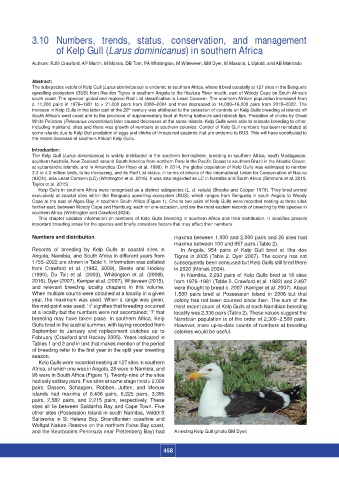
                  and the Keurbooms Peninsula near Plettenberg Bay) had   A nesting Kelp Gull (photo BM Dyer)


                                                                458

