


Page 55 - Atlas Sea Birds Ver1
P. 55
2.2.2.1 Coastal breeding sites of seabirds in Angola


                  Author: Michel Morais
                  Abstract:
                  Six species of seabird have bred at four localities along the Angolan coastline between Luanda and Namibia: Great White Pelican (Pele-
                  canus onocrotalus), Cape Cormorant (Phalacrocorax capensis), White-breasted Cormorant (P. lucidus), Kelp Gull (Larus dominicanus),
                  Caspian Tern (Hydroprogne caspia) and Damara Tern (Sternula balaenarum). This chapter collates estimates of numbers of each species
                  breeding at the different localities. Two of the localities are in Baía do Mussulo, which is situated south of Luanda. More than 16,000 pairs
                  of Cape Cormorant and 500 pairs of Kelp Gull bred at Ilha dos Tigres farther south and the northernmost breeding record for Damara Terns
                  was 30 km north of the Cunene River mouth.

                  Introduction:
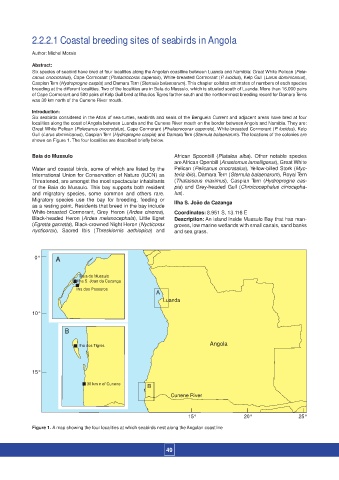
                  Six seabirds considered in the Atlas of sea-turtles, seabirds and seals of the Benguela Current and adjacent areas have bred at four
                  localities along the coast of Angola between Luanda and the Cunene River mouth on the border between Angola and Namibia. They are:
                  Great White Pelican (Pelecanus onocrotalus), Cape Cormorant (Phalacrocorax capensis), White-breasted Cormorant (P. lucidus), Kelp
                  Gull (Larus dominicanus), Caspian Tern (Hydroprogne caspia) and Damara Tern (Sternula balaenarum). The locations of the colonies are
                  shown on Figure 1. The four localities are described briefly below.

                  Baía do Mussulo                                   African  Spoonbill  (Platalea  alba).  Other notable  species
                                                                    are African Openbill (Anastomus lamelligerus), Great White
                  Water and coastal birds, some of which are listed by the   Pelican (Pelicanus onocratalus), Yellow-billed Stork (Myc-
                  International Union for Conservation of Nature (IUCN) as   teria ibis), Damara Tern (Sternula balaenarum), Royal Tern
                  Threatened, are amongst the most spectacular inhabitants   (Thalasseus maximus),  Caspian Tern (Hydroprogne  cas-
                  of the Baía do Mussulo. This bay supports both resident   pia) and Grey-headed Gull (Chroicocephalus cirrocepha-
                  and migratory species, some common and others rare.   lus).
                  Migratory species use the bay for  breeding,  feeding or   Ilha S. João da Cazanga
                  as a resting point. Residents that breed in the bay include
                  White-breasted Cormorant, Grey  Heron (Ardea cinerea),   Coordinates: 8.951 S, 13.116 E
                  Black-headed Heron (Ardea melanocephala), Little Egret   Description: An island inside Mussulo Bay that has man-
                  (Egretta garzetta), Black-crowned Night Heron (Nycticorax   groves, low marine wetlands with small canals, sand banks
                  nycticorax), Sacred Ibis (Threskiornis  aethiopica) and    and sea grass.


                   0°      A


                                   Baia do Mussulo
                                  Ilha S. Joao da Cazanga
                                  Ilha dos Passaros
                                                              A
                                                                Luanda

                  10°

                              B


                                   Ilha dos Tigres                               Angola


                  15°

                                     30 km n of Cunene     B

                                                                   Cunene River


                                                                         15°                 20°                25°

                  Figure 1. A map showing the four localities at which seabirds nest along the Angolan coastline


                                                                 49

