


Page 577 - Atlas Sea Birds Ver1
P. 577
4.1  Harvest of eggs of African Penguins (Spheniscus demersus)
                           in the Benguela upwelling ecosystem


                  Authors: AB Makhado, DB Tom, and RJM Crawford
                  Abstract:
                  At least 23 million eggs of African Penguins (Spheniscus demersus) were collected at 10 islands (2 in Namibia, 8 in South Africa) in the
                  Benguela ecosystem between 1871 and 1967, of which 84% were from Dassen Island. Eggs were also collected at an 11  island, for
                                                                                                          th
                  which no records of harvests were found. The harvests were unsustainable and led to large decreases in numbers of penguins in South
                  Africa in the early to mid-20  century.
                                      th
                  Introduction:
                  Large numbers of African Penguins (Spheniscus demersus) bred at islands around southern Africa in the 1800s and early 1990s (Kearton
                  1931, Shelton et al. 1984). In about 1930 there were from c. 570,000 pairs (Shannon and Crawford 1999) to c. 926,000 pairs (Crawford
                  et al. 2007) at Dassen Island. At that time, the Benguela ecosystem likely supported 1.5–3.0 million African Penguins aged two years or
                  older (Crawford et al. 2007).
                     African Penguin eggs were regarded as very palatable and were exploited following the arrival of Europeans in the region (Randall
                  1989), or earlier, until 1967 (Shelton et al. 1984). From the late 1800s until 1967, the collection and sale of penguin eggs was undertaken
                  by the Guano Islands division of the South African government (Siegfried and Crawford 1978).
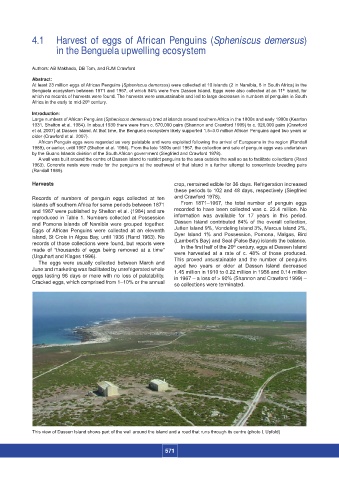
                     A wall was built around the centre of Dassen Island to restrict penguins to the area outside the wall so as to facilitate collections (Rand
                  1963). Concrete nests were made for the penguins at the southwest of that island in a further attempt to concentrate breeding pairs
                  (Randall 1989).

                  Harvests                                          crop, remained edible for 36 days. Refrigeration increased
                                                                    these periods to 102 and 48 days, respectively (Siegfried
                  Records of numbers of penguin  eggs collected at ten   and Crawford 1978).
                  islands off southern Africa for some periods between 1871   From  1871–1967,  the  total  number  of  penguin  eggs
                  and 1967 were published by Shelton et al. (1984) and are   recorded to have been collected was c. 23.4 million. No
                  reproduced in Table 1. Numbers collected at Possession   information was available  for 17 years in this period.
                  and Pomona islands off Namibia were grouped together.  Dassen  Island  contributed  84%  of  the  overall  collection,
                  Eggs  of African  Penguins  were  collected  at  an  eleventh   Jutten Island 9%, Vondeling Island 3%, Marcus Island 2%,
                  island, St Croix in Algoa Bay, until 1936 (Rand 1963). No   Dyer  Island  1%  and  Possession,  Pomona,  Malgas,  Bird
                  records of those collections were found, but reports were   (Lambert’s Bay) and Seal (False Bay) islands the balance.
                                                                                         th
                  made  of “thousands  of eggs  being  removed  at a time”   In the first half of the 20  century, eggs at Dassen Island
                  (Urguhart and Klages 1996).                       were  harvested  at  a  rate  of  c.  48%  of  those  produced.
                     The  eggs  were  usually  collected  between  March  and   This proved unsustainable  and the number of penguins
                                                                    aged  two  years  or  older  at  Dassen  Island  decreased
                  June and marketing was facilitated by unrefrigerated whole   1.45 million in 1910 to 0.22 million in 1956 and 0.14 million
                  eggs lasting 96 days or more with no loss of palatability.   in 1967 – a loss of > 90% (Shannon and Crawford 1999) –
                  Cracked eggs, which comprised from 1–10% or the annual   so collections were terminated.


                  This view of Dassen Island shows part of the wall around the island and a road that runs through its centre (photo L Upfold)


                                                                 571

