


Page 573 - Atlas Sea Birds Ver1
P. 573
3.18  The overall status of Damara Tern (Sternula balaenarum)


                  Authors: RJ Braby, AP Martin, PA Whittington, and RJM Crawford


                  Damara Terns (Sternula balaenarum) breed only within the Benguela upwelling system (BUS), where they nest around
                  the coast from Baia dos Tigres, in southern Angola, to the Alexandria Dunefields, in South Africa’s Eastern Cape Province.
                  They have been recorded breeding at one site in Angola, 57 in Namibia and 14 in South Africa. Preliminary analyses of
                  trends in numbers of Damara Terns breeding in Angola and Namibia, and in South Africa, suggested that in terms of criteria
                  of the International Union for Conservation of Nature (IUCN 2012), the species should be classified as Endangered (EN)
                  in both these regions (Braby et al. 2024, Martin et al. 2024).
                     Based on the most recent minimum estimates of numbers breeding at sites, the overall population of Damara Terns in
                  2021/22 was thought to comprise 773 pairs, of which six were in Angola, 715 in Namibia and 52 in South Africa. Generation
                  length (G) for Damara Terns is 12.33 years (Braby et al. 2024). In Namibia and Angola, between 1991 and 2021/22
                  (a period of 30 years), numbers decreased by 52%, equivalent to 64% in 3G. Between 2010 and 2021/22 numbers in
                  Angola and Namibia decreased by 23%, which equated to 25.7% in 1G (Braby et al. 2024). In South Africa, numbers
                  decreased from c. 150 pairs in about 1980 to c. 52 pairs in 2020/21, at a rate of 60% in 3G. They decreased by 20% from
                  c. 65 pairs in 2010 to c. 52 pairs in 2018–2021, which amounted to a decrease of 24.7% in 1G (Martin et al. 2024). Minimum
                  estimates of the overall population fell from 1,001 pairs in 2010 (Braby 2011) to 773 pairs in about 2021 (Braby et al. 2024,
                  Martin et al. 2024), i.e. by c. 23% in 11 years or 25.5% in 1G.
                     Both the rates of decrease calculated for Namibia and Angola, both those estimated for South Africa, and the overall rate
                  of decrease were equivalent to losses of between 60% and 77% in 3G. They suggest that the overall population of Damara
                  Terns should be classified as Endangered (EN). In that event, all sites holding ≥ five pairs would be considered Important
                  Bird and Biodiversity Areas (BirdLife International 2020). As detailed by Braby et al. (2024) and Martin et al. (2024), there
                  are 36 such sites, one in Angola, 31 in Namibia, and four in South Africa. These are high priority areas for protection and
                  management.
                     It should be borne in mind that in addition to conserving breeding areas it is equally important to give consideration to
                  non-breeding habitat and sites. In recent years, it would appear that the bulk of the South African population of Damara
                  Terns has spent the non-breeding period at the San Sebastian Peninsula in Mozambique (Allport et al. 2022, Martin et al.
                  2024), which has been identified as a Key Biodiversity Area (Allport et al. 2022). Breeding birds from Namibia and South
                  Africa are known to spend the non-breeding season in various West African countries from Gabon to Côte d’Ivoire (Braby
                  2010, BirdLife International 2023), where they may be at risk from trapping for food (Braby 2010). Although beyond the
                  scope of this volume, it would be desirable to protect key sites within these non-breeding areas. Conservation measures
                  for this species can only be fully effective if applied throughout the birds’ annual cycle.
                  References                                        Braby  RJ,  Braby  J,  Braby  S,  Simmons  RE,  Crawford  RJM.
                                                                        2024. Numbers, trends, and conservation of Damara Terns
                  Allport G, Gilroy D, Read C. 2022. The status and distribution of   (Sternula balaenarum) in Namibia and Angola: This volume.
                      three species of Sternula terns on the eastern coast of Africa   IUCN. 2012. IUCN Red List Categories and Criteria: Version 3.1.
                      and in the western Indian Ocean, with two species new for   Second edition. IUCN: Gland, Switzerland and Cambridge,
                      Mozambique. Bulletin of the British Ornithologists' Club 142:   UK. iv + 32pp.
                      190–208.                                      Martin AP, Whittington PA, Dyer BM, Crawford RJM, Makhado AB.
                  BirdLife International. 2020. Guidelines for the application of the   2024. Numbers, trends, status, movement, and conservation
                      IBA  criteria.  Final  version,  July  2020.  18  pp.  Downloaded   of Damara Terns (Sternula balaenarum) in South Africa. This
                      from http://datazone.birdlife.org/ on 20 May 2022.  volume.
                  BirdLife  International.  2023.  Species  factsheet:  Sternula
                      balaenarum. Downloaded from http://www.birdlife.orgon 19
                      January 2023.
                  Braby J. 2010. New migration records for the Damara Tern Sterna
                      balaenarum. Ornithological Observations 1: 38–41.
                  Braby J. 2011. The biology and conservation of the Damara Tern in
                      Namibia. PhD thesis. University of Cape Town, South Africa,
                      233 pp.

                  Footnote
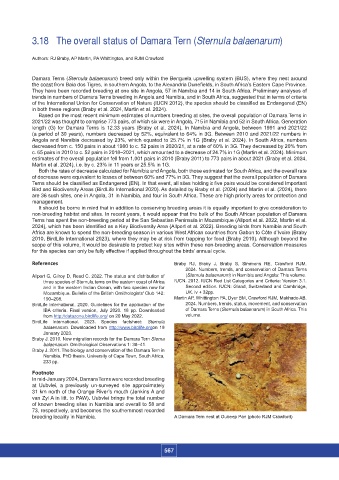
                  In mid-January 2024, Damara Terns were recorded breeding
                  at  Uubvlei, a  previously un-surveyed site  approximately
                  31 km north of the Orange River’s mouth (Jenkins A and
                  van Zyl A in litt. to PAW). Uubvlei brings the total number
                  of known breeding sites in Namibia and overall to 58 and
                  73, respectively, and becomes the southernmost recorded
                  breeding locality in Namibia.                     A Damara Tern nest at Oubeep Pan (photo RJM Crawford)


                                                                 567

