


Page 571 - Atlas Sea Birds Ver1
P. 571
Acknowledgements

                                                                    APM  is  indebted  to  Dr  G  Hofmeyr  of  the  Port  Elizabeth
                                                                    Museum at Bayworld for vehicle logistics and Dr M Connan,
                                                                    Coastal  Marine  Research  Institute,  Nelson  Mandela
                                                                    University, for assistance  with  counts at  Alexandria
                                                                    Dunefields. SANParks, Coega Development Corporation,
                                                                    Pearson  Park  Resort,  and  Transnet  National  Ports
                                                                    Authority allowed  access to  the  areas under their
                                                                    jurisdiction.  PAW  acknowledges  funding  support  from
                                                                    Marine  and  Coastal  Management  of  the  Department  of
                                                                    Environmental Affairs (now branch Oceans and Coasts of
                                                                    the Department of Forestry, Fisheries and the Environment)
                                                                    and from the National Research Foundation. The late Tony
                                                                    Tree carried out counts of  breeding  Damara  Terns and
                                                                    provided  transport.  SANParks  provided  PAW  and  Tony
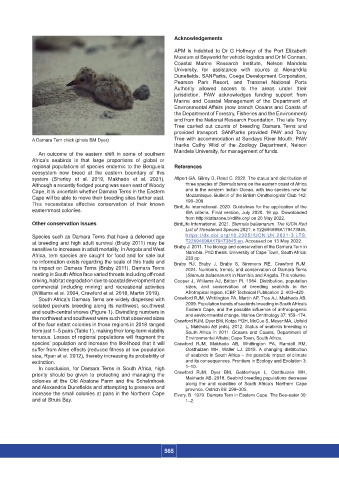
                  A Damara Tern chick (photo BM Dyer)               Tree with accommodation at Sundays River Mouth. PAW
                                                                    thanks Cathy Wiid of the Zoology Department, Nelson
                     An outcome of the eastern shift in some of southern   Mandela University, for management of funds.
                  Africa’s seabirds is that large  proportions  of global  or
                  regional populations of species endemic to the Benguela   References
                  ecosystem now breed  at the eastern boundary  of this
                  system  (Sherley  et  al.  2019,  Makhado  et  al.  2021).   Allport GA, Gilroy D, Reed C. 2022. The status and distribution of
                  Although a recently fledged young was seen east of Woody   three species of Sternula terns on the eastern coast of Africa
                  Cape, it is uncertain whether Damara Terns in the Eastern   and in the western Indian Ocean, with two species new for
                  Cape will be able to move their breeding sites farther east.   Mozambique. Bulletin of the British Ornithologists' Club 142:
                  This  necessitates  effective  conservation  of  their  known   190–208.
                  easternmost colonies.                             BirdLife International. 2020. Guidelines for the application of the
                                                                        IBA  criteria.  Final  version,  July  2020.  18  pp.  Downloaded
                                                                        from http://datazone.birdlife.org/ on 20 May 2022.
                  Other conservation issues                         BirdLife International. 2021. Sternula balaenarum. The IUCN Red
                                                                        List of Threatened Species 2021: e.T22694699A179473845.
                  Species such as Damara Terns that have a deferred age   https://dx.doi.org/10.2305/IUCN.UK.2021-3.LTS.
                  at breeding and high adult survival (Braby 2011) may be   T22694699A179473845.en. Accessed on 13 May 2022.
                  sensitive to increases in adult mortality. In Angola and West   Braby J. 2011. The biology and conservation of the Damara Tern in
                  Africa, tern species are caught for food and for sale but   Namibia. PhD thesis. University of Cape Town, South Africa:
                                                                        233 pp.
                  no information exists regarding the scale of this trade and   Braby  RJ,  Braby  J,  Braby  S,  Simmons  RE,  Crawford  RJM.
                  its impact on Damara Terns (Braby 2011). Damara Terns   2024. Numbers, trends, and conservation of Damara Terns
                  nesting in South Africa face varied threats including off-road   (Sternula balaenarum) in Namibia and Angola. This volume.
                  driving, habitat degradation due to coastal development and   Cooper J, Williams AJ, Britton PI. 1984. Distribution, population
                  commercial (including mining) and recreational  activities   sizes,  and  conservation  of  breeding  seabirds  in  the
                  (Williams et al. 2004, Crawford et al. 2018, Martin 2019).  Afrotropical region. ICBP Technical Publication 2: 403–420.
                     South Africa’s Damara Terns are widely dispersed with   Crawford RJM, Whittington PA, Martin AP, Tree AJ, Makhado AB.
                  isolated pockets breeding along its northwest, southwest   2009. Population trends of seabirds breeding in South Africa’s
                  and south-central shores (Figure 1). Dwindling numbers in   Eastern Cape, and the possible influence of anthropogenic
                  the northwest and southwest were such that observed sizes   and environmental change. Marine Ornithology 37: 159–174.
                  of the four extant colonies in those regions in 2018 ranged   Crawford RJM, Dyer BM, Kotze PGH, McCue S, Meyer MA, Upfold
                                                                        L, Makhado AB (eds). 2012. Status of seabirds breeding in
                  from just 1–5 pairs (Table 1), making their long-term viability   South Africa  in 2011.  Oceans and Coasts,  Department of
                  tenuous. Losses of regional populations will fragment the   Environmental Affairs; Cape Town, South Africa.
                  species’ population and increase the likelihood that it will   Crawford  RJM,  Makhado  AB,  Whittington  PA,  Randall  RM,
                  suffer from Allee effects (reduced fitness at low population   Oosthuizen  WH,  Waller  LJ.  2015.  A  changing  distribution
                  size, Ryan et al. 2012), thereby increasing its probability of   of seabirds in South Africa – the possible impact of climate
                  extinction.                                           and its consequences. Frontiers in Ecology and Evolution 3:
                     In  conclusion,  for  Damara Terns  in  South Africa,  high   1–10.
                  priority should be given to  protecting and managing  the   Crawford  RJM,  Dyer  BM,  Geldenhuys  L,  Oosthuizen  WH,
                  colonies  at  the  Old Abalone  Farm  and  the  Schelmhoek   Makhado AB. 2018. Seabird breeding populations decrease
                  and Alexandria Dunefields and attempting to preserve and   along the arid coastline of South  Africa’s Northern Cape
                                                                        province. Ostrich 89: 299–305.
                  increase the small colonies at pans in the Northern Cape   Every, B. 1979. Damara Tern in Eastern Cape. The Bee-eater 30:
                  and at Struis Bay.                                    1–2.


                                                                 565

