


Page 566 - Atlas Sea Birds Ver1
P. 566
3.17  Numbers,  trends,  status, movement and conservation of
                           Damara Tern (Sternula balaenarum) in South Arica


                  Authors: AP Martin, PA Whittington, BM Dyer, RJM Crawford, and AB Makhado


                  Abstract:
                  Damara Terns (Sternula balaenarum) are a breeding endemic to the Benguela upwelling ecosystem, where they breed between south
                  Angola and southern South Africa, mostly in Namibia. In the late 1970s c.150 pairs of Damara Terns bred in South Africa, reducing to
                  an estimated minimum of 65 pairs in 2010. Following losses in the west and despite increases in the east, this decreased over the next
                  10 years by c. 20% to 52 pairs in 2018–2021. Then the South African population was confined to three isolated pockets of c. 5 pairs,
                  c. 4 pairs and c. 43 pairs in the Northern, Western and Eastern Cape Provinces, respectively, and breeding had ceased at six of the
                  species’ 14 South African colonies. Although Damara Terns were first recorded breeding in the Eastern Cape in 1980, that province held
                  83% of South Africa’s population in 2018–2021 when there were < 200 mature individuals in South Africa. The South African Damara Tern
                  population satisfied IUCN criteria for Regionally Endangered. A main cause of the decrease in west South Africa was disturbance at and
                  displacement from breeding sites. Some colonies in the Eastern Cape are facing similar threats and urgently require protection. Almost
                  all Damara Terns were previously thought to migrate to coastal waters off West Africa during their non-breeding season. However, more
                  recently, it is likely that most Damara Terns from the Eastern Cape overwintered in Mozambique. One chick banded in the Eastern Cape
                  in January 2022, was photographed at the San Sebastian Peninsula near Vilanculos in Mozambique in June 2022 and seen back in the
                  Eastern Cape in October 2022.

                  Introduction:
                  The Damara Tern (Sternula balaenarum) is one of seven seabird species that are breeding endemics to the Benguela ecosystem off
                  southwest Africa, where it breeds around the coast from south Angola to South Africa’s Eastern Cape Province (Hockey et al. 2005).
                  It has bred at one site in Angola (Simmons 2010), 57 in Namibia (Braby 2011), and 14 in South Africa (Randall and McLachlan 1982, Martin
                  1991, 2019, Tree 2000, Martin and Taylor 2002, Braby 2011, Department of Forestry, Fisheries and the Environment (DFFE) unpubl.). All
                  breeding sites, except Possession Island in Namibia, are on the mainland. The locations of the South African breeding sites are shown
                  in Figure 1. This chapter collates information on numbers breeding at these sites in order to gauge the present level of, and trends in, the
                  abundance of Damara Terns. It assesses the Red List status of, identifies Important Bird and Biodiversity Areas (IBAs) for, and considers
                  threats to Damara Terns in South Africa and documents movements to a new over-wintering area.

                  Numbers
                  Numbers of  Damara  Terns estimated to  have bred at
                  South African sites from 1980–2021 are shown in Table 1.
                  Information was collated from various sources: the count
                  for  Brandfontein  in  1995  was  by  PA  Whittington  and  G
                  Nunn (unpubl.). Other information for the seven colonies
                  located  west of Cape Agulhas  and for De Hoop  Nature
                  Reserve  up until 2010  was from Braby (2011), who for
                  the  20  pairs  shown  for  Dreyers  Pan  for  1990  gave  the
                  date  as  the  ‘1990s’  and  for  the  c.  2  pairs  shown  for  De
                  Hoop for 1990 gave no date. Information for these seven
                  sites for 2011–2017 was from Crawford et al. (2018) and
                  thereafter from DFFE (unpubl.). Counts for Struis Bay for
                  1992–1996  and  2010–2018  were  from  DFFE  (unpubl.)
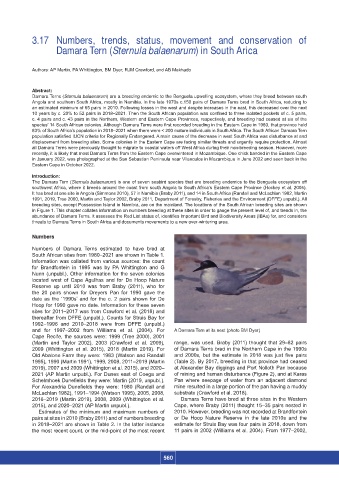
                  and  for  1997–2002  from  Williams  et  al.  (2004).  For   A Damara Tern at its nest (photo BM Dyer)
                  Cape Recife, the sources were: 1999 (Tree 2000), 2001
                  (Martin  and  Taylor  2002),  2003  (Crawford  et  al.  2009),   range, was used. Braby (2011) thought that 29–82 pairs
                  2009  (Whittington  et  al.  2015),  2018  (Martin  2019).  For   of Damara Terns bred in the Northern Cape in the 1990s
                  Old Abalone Farm they were: 1983 (Watson and Randall   and  2000s,  but  the  estimate  in  2018  was  just  five  pairs
                  1995), 1990 (Martin 1991), 1999, 2008, 2011–2019 (Martin   (Table 2). By 2017, breeding in that province had ceased
                  2019), 2007 and 2009 (Whittington et al. 2015), and 2020–  at Alexander Bay diggings and Port Nolloth Pan because
                  2021 (AP Martin unpubl.). For Dunes east of Coega and   of mining and human disturbance (Figure 2), and at Karas
                  Schelmhoek Dunefields they were: Martin (2019, unpubl.).   Pan  where  seepage  of  water  from  an  adjacent  diamond
                  For Alexandria Dunefields they were: 1980 (Randall and   mine resulted in a large portion of the pan having a muddy
                  McLachlan 1982), 1991–1994 (Watson 1995), 2005, 2008,   substrate (Crawford et al. 2018).
                  2016–2019 (Martin 2019), 2008, 2009 (Whittington et al.   Damara Terns have bred at three sites in the Western
                  2015), and 2020–2021 (AP Martin unpubl.).         Cape, where Braby (2011) thought 15–35 pairs nested in
                     Estimates  of  the  minimum  and  maximum  numbers  of   2010. However, breeding was not recorded at Brandfontein
                  pairs at sites in 2010 (Braby 2011) and of numbers breeding   or De Hoop  Nature Reserve  in the late 2010s  and the
                  in 2018–2021 are shown in Table 2. In the latter instance   estimate for Struis Bay was four pairs in 2018, down from
                  the most recent count, or the mid-point of the most recent   11 pairs in 2002 (Williams et al. 2004). From 1977–2002,


                                                                560

