


Page 563 - Atlas Sea Birds Ver1
P. 563
Site                            Estimated number of breeding pairs  Period of   1980s  2000s
                                                             From Kolberg   Braby RJ   estimate  1990s  2010-2021/22
                                               Braby (2011)
                                                               (2022)   (unpublished)      Most recent estimate
                                           Minimum  Maximum   Minimum    Minimum    Minimum    Year     % of total
                   Wlotzkasbaken             0        17         1                    1       2021/22    0.13
                   Mile 8                    3        15                              3        2010      0.39
                   Mile 4                    10       20                              10       2010      1.29
                   Horses Graves             30       60                   20         20       2014      2.59
                   Caution Reef              60       100                  147        147      2014      19.02
                   Dolphin Beach             0        32                              0        2005      0.00
                   Donkey Bay, Pelican Point  8       15                              8        2009      1.03
                   Sandwich Harbour          15       35                   10         10      2021/22    1.29
                   Conception Bay            14       50                              14       1994      1.81
                   Meob                      18       100                             18       1994      2.33
                   Hottentots Bay           187       300       23                    23      2021/22    2.98
                   Guano Bay                 0         1                              0        2009      0.00
                   Grosse Bucht              15       17                              15       2009      1.94
                   Elizabeth Bay             7        10                              7        2008      0.91
                   Possession Island         2         2                              2        2008      0.26
                   Marmora Pan               13       55         5                    5       2021/22    0.65
                   Chameis Pan               1         6         2                    2       2021/22    0.26
                   Single pairs             120       430                             120      2010      15.52
                   Total Angola              6        190                             6                  0.78
                   Total Namibia            930       2347                            715                92.50
                   Total South Africa        65       148                             52                 6.73
                   Total overall            1001      2685                            773               100.00


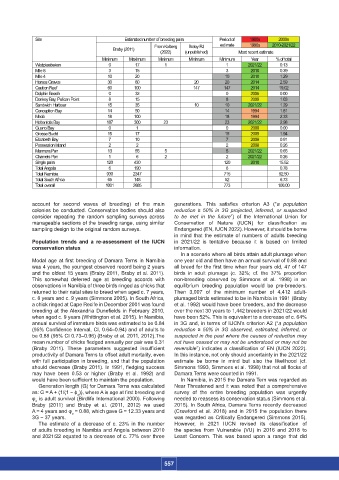
                  account for second  waves of breeding)  of the main   generations.  This  satisfies  criterion  A3  (“a population
                  colonies be conducted. Conservation bodies should also   reduction  ≥  50%  in  3G  projected,  inferred,  or  suspected
                  consider repeating the random sampling  surveys across   to  be  met  in  the  future”)  of  the  International  Union  for
                  manageable sections of the breeding range, using similar   Conservation  of  Nature  (IUCN)  for  classification  as
                  sampling design to the original random surveys.   Endangered (EN, IUCN 2022). However, it should be borne
                                                                    in mind that the estimate of numbers  of adults breeding
                  Population  trends and  a re-assessment of  the IUCN   in 2021/22  is tentative because  it is based  on limited
                  conservation status                               information.
                                                                      In a scenario where all birds attain adult plumage when
                  Modal age at first breeding of Damara Terns in Namibia   one year old and then have an annual survival of 0.88 and
                  was 4 years, the youngest observed record being 2 years   all breed for the first time when four years old, 47 of 147
                  and the oldest 15 years (Braby 2011, Braby et al. 2011).   birds  in  adult  plumage  (c.  32%;  cf.  the  37%  proportion
                  This somewhat deferred age at breeding  accords with   non-breeding  observed  by  Simmons  et  al.  1998)  in  an
                  observations in Namibia of three birds ringed as chicks that   equilibrium  breeding  population  would  be pre-breeders.
                  returned to their natal sites to breed when aged c. 7 years,   Then 3,007 of the minimum  number  of 4,412 adult-
                  c. 8 years and c. 9 years (Simmons 2005). In South Africa,   plumaged birds estimated to be in Namibia in 1991 (Braby
                  a chick ringed at Cape Recife in December 2001 was found   et al. 1992) would have been breeders, and the decrease
                  breeding  at  the Alexandria  Dunefields  in  February  2010,   over the next 30 years to 1,442 breeders in 2021/22 would
                  when aged c. 9 years (Whittington et al. 2015). In Namibia,   have been 52%. This is equivalent to a decrease of c. 64%
                  annual survival of immature birds was estimated to be 0.84   in 3G and, in terms of IUCN’s criterion A2 (“a population
                  (95% Confidence Interval, CI, 0.64–0.94) and of adults to   reduction  ≥  50%  in  3G  observed,  estimated,  inferred,  or
                  be 0.88 (95% CI 0.73–0.96) (Braby et al. 2011, 2012).The   suspected in the past where the causes of reduction may
                  mean number of chicks fledged annually per pair was 0.31   not have ceased or may not be understood or may not be
                  (Braby  2011).  These  parameters  suggested  insufficient   reversible”) indicates a classification of EN (IUCN 2022).
                  productivity of Damara Terns to offset adult mortality, even   In this instance, not only should uncertainty in the 2021/22
                  with full participation in breeding, and that the population   estimate be borne in mind but  also the  likelihood  (cf.
                  should decrease (Braby 2011). In 1991, fledging success   Simmons 1993, Simmons et al. 1998) that not all flocks of
                  may have been 0.53 or higher (Braby et al. 1992) and   Damara Terns were counted in 1991.
                  would have been sufficient to maintain the population.  In Namibia, in 2015 the Damara Tern was regarded as
                     Generation length (G) for Damara Terns was calculated   Near Threatened and it was noted that a comprehensive
                  as: G = A + (1/(1 − ϕ )), where A is age at first breeding and   survey of the entire breeding  population  was urgently
                                  α
                  φ  is adult survival (Birdlife International 2000). Following   needed to reassess its conservation status (Simmons et al.
                   α
                  Braby (2011) and Braby et al. (2011, 2012) we used    2015). In South Africa, Damara Terns recently decreased
                  A = 4 years and φ  = 0.88, which gave G = 12.33 years and   (Crawford  et  al.  2018)  and  in  2015  the  population  there
                                α
                  3G ~ 37 years.                                    was regarded as Critically Endangered (Simmons 2015).
                     The estimate of a decrease  of c. 23% in the number   However,  in  2021  IUCN  revised  its  classification  of
                  of adults breeding in Namibia and Angola between 2010   the  species  from  Vulnerable  (VU)  in  2016  and  2018  to
                  and 2021/22 equated to a decrease of c. 77% over three   Least Concern.  This was based  upon  a range  that did


                                                                 557

