


Page 569 - Atlas Sea Birds Ver1
P. 569
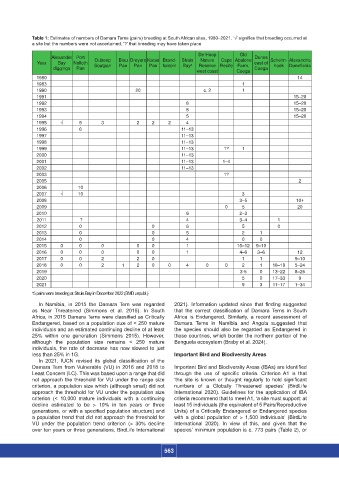
Table 1: Estimates of numbers of Damara Terns (pairs) breeding at South African sites, 1980–2021. ‘√’ signifies that breeding occurred at
                  a site but the numbers were not ascertained; ‘?’ that breeding may have taken place
                                                                             De Hoop       Old
                         Alexander  Port   Oubeep  Blou  Dreyers Karas  Brand-  Struis   Nature   Cape  Abalone   Dunes   Schelm- Alexandria
                    Year   Bay   Nolloth   Soutpan  Pan  Pan  Pan  fontein  Bay a  Reserve  Recife Farm,   east of   hoek  Dunefields
                          diggings  Pan                                                         Coega
                                                                            west coast    Coega
                    1980                                                                                       14
                    1983                                                                    1
                    1990                               20                     c. 2          1
                    1991                                                                                      15–20
                    1992                                                8                                     15–20
                    1993                                                8                                     15–20
                    1994                                                5                                     15–20
                    1995    √      5       3           2    2     2     4
                    1996           6                                   11–13
                    1997                                               11–13
                    1998                                               11–13
                    1999                                               11–13          1?    1
                    2000                                               11–13
                    2001                                               11–13         1–4
                    2002                                               11–13
                    2003                                                              1?
                    2005                                                                                        2
                    2006          10
                    2007    √     10                                                        3
                    2008                                                                   3–5                 10+
                    2009                                                              0     5                  20
                    2010                                                6                  2–3
                    2011            ?                                   4                  3–4          1
                    2012           0                        0           6                   5           0
                    2013           0                        0           5                   2     1
                    2014           0                        0           4                   0     0
                    2015    0      0       0           0    0           1                 10–12  9–10
                    2016    0      0       0           0    0           1                  4–6   3–6           12
                    2017    0      0       2           2    0                               1     1           9–10
                    2018    0      0       2      1    2    0     0     4      0      0     2     1    18–19  5–24
                    2019                                                                   3-5    0    13–22   8–25
                    2020                                                                    5     0    17–33    9
                    2021                                                                    9     3    11–17  1–34
                  a 5 pairs were breeding at Struis Bay in December 2022 (BMD unpubl.)

                     In  Namibia,  in  2015  the  Damara  Tern  was  regarded   2021).  Information  updated  since  that  finding  suggested
                  as  Near  Threatened  (Simmons  et  al.  2015).  In  South   that  the  correct  classification  of  Damara  Terns  in  South
                  Africa, in 2015 Damara Terns were classified as Critically   Africa  is  Endangered.  Similarly,  a  recent  assessment  of
                  Endangered, based on a population size of < 250 mature   Damara  Terns in Namibia  and  Angola suggested that
                  individuals and an estimated continuing decline of at least   the  species  should  also  be  regarded  as  Endangered  in
                  25% within one generation  (Simmons 2015). However,   those countries, which border the northern portion of the
                  although  the  population  size  remains  <  250  mature   Benguela ecosystem (Braby et al. 2024).
                  individuals,  the rate of decrease  has now slowed  to just
                  less than 25% in 1G.                              Important Bird and Biodiversity Areas
                     In  2021,  IUCN  revised  its  global  classification  of  the
                  Damara Tern from Vulnerable (VU) in 2016 and 2018 to   Important Bird and Biodiversity Areas (IBAs) are identified
                  Least Concern (LC). This was based upon a range that did   through  the  use  of  specific  criteria.  Criterion  A1  is  that
                  not  approach  the  threshold  for  VU  under  the  range  size   ‘the site is known or thought regularly to hold significant
                  criterion, a population size which (although small) did not   numbers  of a Globally  Threatened  species’ (BirdLife
                  approach the threshold for VU under the population size   International  2020).  Guidelines  for  the  application  of  IBA
                  criterion  (<  10,000  mature  individuals  with  a  continuing   criteria recommend that to meet A1, ‘a site must support: at
                  decline  estimated to be > 10% in ten years or three   least 15 individuals (the equivalent of 5 Pairs/Reproductive
                  generations, or with a specified population structure) and   Units) of a Critically Endangered or Endangered species
                  a population trend that did not approach the threshold for   with a global  population  of > 1,500 individuals’ (BirdLife
                  VU under the population  trend criterion (> 30% decline   International  2020).  In  view  of  this,  and  given  that  the
                  over ten years or three generations, BirdLife International   species’ minimum population is c. 773 pairs (Table 2), or


                                                                 563

