


Page 570 - Atlas Sea Birds Ver1
P. 570
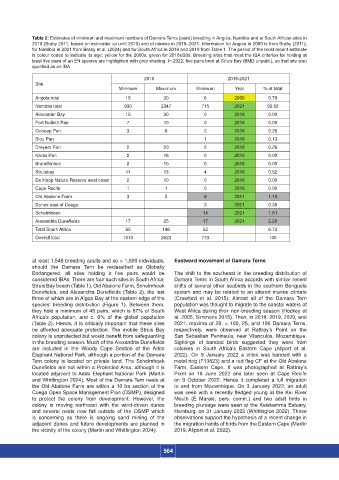
Table 2: Estimates of minimum and maximum numbers of Damara Terns (pairs) breeding in Angola, Namibia and at South African sites in
                  2010 (Braby 2011, based on estimates up until 2010) and of minima in 2018–2021. Information for Angola in 2009 is from Braby (2011),
                  for Namibia in 2021 from Braby et al. (2024) and for South Africa in 2018 and 2019 from Table 1. The period of the most recent estimate
                  is colour coded to indicate its age: yellow for the 2000s, green for 2010s/20s. Breeding sites that meet the IBA criterion for holding at
                  least five pairs of an EN species are highlighted with grey shading. In 2022, five pairs bred at Struis Bay (BMD unpubl.), so that site also
                  qualified as an IBA
                                                          2010                         2018-2021
                   Site
                                                 Minimum      Maximum       Minimum      Year      % of total
                   Angola total                    15           30             6         2009        0.78
                   Namibia total                   930         2347           715        2021        92.50
                   Alexander Bay                   15           30             0         2018        0.00
                   Port Nolloth Pan                7            10             0         2018        0.00
                   Oubeep Pan                      3             6             2         2018        0.26
                   Blou Pan                                                    1         2018        0.13
                   Dreyers Pan                     2            20             2         2018        0.26
                   Karas Pan                       2            16             0         2018        0.00
                   Brandfontein                    2            10             0         2018        0.00
                   Struisbay                       11           13             4         2018        0.52
                   De Hoop Nature Reserve west coast  2         10             0         2018        0.00
                   Cape Recife                     1             1             0         2018        0.00
                   Old Abalone Farm                3             5             9         2021        1.16
                   Dunes east of Coega                                         3         2021        0.39
                   Schelmhoek                                                 14         2021        1.81
                   Alexandria Dunefields           17           25            17         2021        2.20
                   Total South Africa              65           146           52                     6.73
                   Overall total                  1010         2523           773                    100


                  at least 1,546 breeding adults and so > 1,500 individuals,    Eastward movement of Damara Terns
                  should  the  Damara  Tern  be  reclassified  as  Globally
                  Endangered,  all  sites  holding  ≥  five  pairs  would  be   The shift to the southeast in the breeding  distribution  of
                  considered IBAs. There are four such sites in South Africa:   Damara Terns in South Africa accords with similar recent
                  Struis Bay beach (Table 1), Old Abalone Farm, Schelmhoek   shifts of several other seabirds in the southern Benguela
                  Dunefields, and Alexandria Dunefields (Table 2), the last   system and may be related to an altered marine climate
                  three of which are in Algoa Bay at the eastern edge of the   (Crawford et al. 2015).  Almost all of the Damara  Tern
                  species’  breeding  distribution  (Figure  1).  Between  them,   population was thought to migrate to the coastal waters of
                  they hold a minimum of 45 pairs, which is 87% of South   West Africa during their non-breeding season (Hockey et
                  Africa’s population, and  c. 6% of the global  population   al. 2005, Simmons 2015). Then, in 2018, 2019, 2020, and
                  (Table 2). Hence, it is critically important that these sites   2021, maxima of 29, > 100, 25, and 106 Damara Terns,
                  be  afforded  adequate  protection.  The  mobile  Struis  Bay   respectively,  were  observed  at  Rattray’s  Point  on  the
                  colony is unprotected but would benefit from safeguarding   San Sebastian Peninsula, near Vilanculos, Mozambique.
                  in the breeding season. Much of the Alexandria Dunefields   Sightings of banded birds suggested they were from
                  are included  in the Woody Cape Section of the  Addo   colonies  in  South  Africa’s  Eastern  Cape  (Allport  et  al.
                  Elephant National Park, although a portion of the Damara   2022). On 9 January 2022 a chick was banded with a
                  Tern colony  is located  on  private  land. The Schelmhoek   metal ring (F13823) and a red flag CF at the Old Abalone
                  Dunefields are not within a Protected Area, although it is   Farm,  Eastern  Cape.  It  was  photographed  at  Rattray’s
                  located adjacent to Addo Elephant National Park (Martin   Point  on  18  June  2022  and  later  seen  at  Cape  Recife
                  and Whittington 2024). Most of the Damara Tern nests at   on 9 October 2022. Hence it completed a full migration
                  the  Old Abalone  Farm  are  within  a  10  ha  section  of  the   to  and  from  Mozambique.  On  3  January  2022,  an  adult
                  Coega Open Space Management Plan (OSMP), designed   was seen with a recently fledged young at the Kei River
                  to protect  the colony from development. However,  the   Mouth  (E  Marais,  pers.  comm.)  and  two  adult  birds  in
                  colony  is moving northeast with the wind-driven  dunes   breeding plumage were seen at the Keiskamma Estuary,
                  and  several  nests  now  fall  outside  of  the  OSMP  which   Hamburg, on 31 January 2022 (Whittington 2022). These
                  is concerning  as there is ongoing  sand  mining  of the    observations support the hypothesis of a recent change in
                  adjacent  dunes  and future developments  are planned  in   the migration habits of birds from the Eastern Cape (Martin
                  the vicinity of the colony (Martin and Whittington 2024).   2019, Allport et al. 2022).


                                                                564

