


Page 583 - Atlas Sea Birds Ver1
P. 583
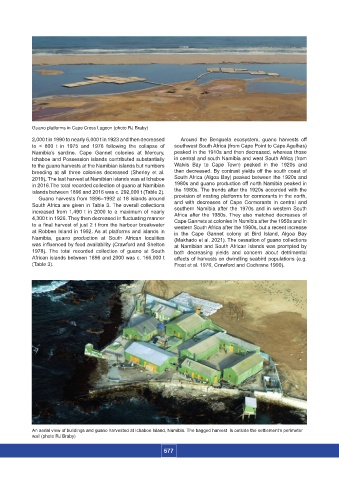
Guano platforms in Cape Cross Lagoon (photo RJ Braby)

                  2,000 t in 1990 to nearly 6,000 t in 1923 and then decreased   Around  the  Benguela  ecosystem,  guano  harvests  off
                  to  <  800  t  in  1975  and  1976  following  the  collapse  of   southwest South Africa (from Cape Point to Cape Agulhas)
                  Namibia’s  sardine.  Cape  Gannet  colonies  at  Mercury,   peaked in the 1910s and then decreased, whereas those
                  Ichaboe and Possession islands contributed substantially   in central and south Namibia and west South Africa (from
                  to the guano harvests at the Namibian islands but numbers   Walvis Bay to Cape  Town) peaked in the 1920s and
                  breeding  at  all three colonies decreased (Sherley et al.   then decreased. By contrast yields off the south coast of
                  2019). The last harvest at Namibian islands was at Ichaboe   South Africa (Algoa Bay) peaked between the 1920s and
                  in 2016.The total recorded collection of guano at Namibian   1980s and guano production off north Namibia peaked in
                  islands between 1896 and 2016 was c. 292,000 t (Table 2).  the 1980s. The trends after the 1920s accorded with the
                     Guano harvests from 1896–1992 at 18 islands around   provision of nesting platforms for cormorants in the north,
                  South Africa are given in Table 3. The overall collections   and with decreases of Cape Cormorants in central and
                                                                    southern Namibia after the 1970s and in western South
                  increased  from 1,490 t  in 2000 to a maximum of nearly   Africa  after  the  1980s. They  also  matched  decreases  of
                  4,300 t in 1926. They then decreased in fluctuating manner   Cape Gannets at colonies in Namibia after the 1950s and in
                  to a final harvest of just 2 t from the harbour breakwater   western South Africa after the 1990s, but a recent increase
                  at Robben Island in 1992. As at platforms and islands in   in  the  Cape  Gannet  colony  at  Bird  Island,  Algoa  Bay
                  Namibia,  guano  production  at South  African localities   (Makhado et al. 2021). The cessation of guano collections
                  was influenced by food availability (Crawford and Shelton   at Namibian and South African islands was prompted by
                  1978).  The  total  recorded  collection  of  guano  at  South   both decreasing  yields  and  concern  about  detrimental
                  African islands between 1896 and 2000 was c. 166,000 t   effects of harvests on dwindling seabird populations (e.g.
                  (Table 3).                                        Frost et al. 1976, Crawford and Cochrane 1990).


                  An aerial view of buildings and guano harvested at Ichaboe Island, Namibia. The bagged harvest  is outside the settlement’s perimeter
                  wall (photo RJ Braby)


                                                                 577

