


Page 723 - Atlas of Creation Volume 1
P. 723
Harun Yahya


                 According to Darwin, there is a ruthless struggle for survival and an eternal conflict in nature. The
             strong always overcome the weak, and this enables development to take place. The subtitle he gave to his
             book The Origin of Species, "The Origin of Species by Means of Natural Selection or the Preservation of Favoured

             Races in the Struggle for Life", encapsulates that view.
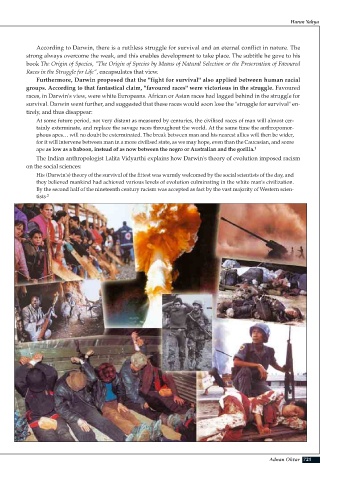
                 Furthermore, Darwin proposed that the "fight for survival" also applied between human racial
             groups. According to that fantastical claim, "favoured races" were victorious in the struggle. Favoured
             races, in Darwin's view, were white Europeans. African or Asian races had lagged behind in the struggle for
             survival. Darwin went further, and suggested that these races would soon lose the "struggle for survival" en-

             tirely, and thus disappear:
                 At some future period, not very distant as measured by centuries, the civilised races of man will almost cer-
                 tainly exterminate, and replace the savage races throughout the world. At the same time the anthropomor-
                 phous apes… will no doubt be exterminated. The break between man and his nearest allies will then be wider,
                 for it will intervene between man in a more civilised state, as we may hope, even than the Caucasian, and some
                 ape as low as a baboon, instead of as now between the negro or Australian and the gorilla.        1

                 The Indian anthropologist Lalita Vidyarthi explains how Darwin's theory of evolution imposed racism
             on the social sciences:
                 His (Darwin's) theory of the survival of the fittest was warmly welcomed by the social scientists of the day, and
                 they believed mankind had achieved various levels of evolution culminating in the white man's civilization.
                 By the second half of the nineteenth century racism was accepted as fact by the vast majority of Western scien-
                 tists .2


                                                                                                                          Adnan Oktar    721

