


Page 724 - Atlas of Creation Volume 1
P. 724
Darwin's Source of Inspiration: Malthus's Theory of Ruthlessness


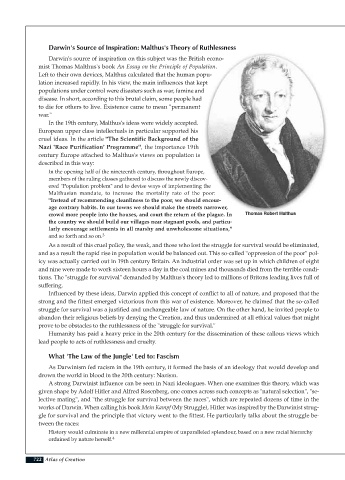
                       Darwin's source of inspiration on this subject was the British econo-
                  mist Thomas Malthus's book An Essay on the Principle of Population.
                  Left to their own devices, Malthus calculated that the human popu-
                  lation increased rapidly. In his view, the main influences that kept

                  populations under control were disasters such as war, famine and
                  disease. In short, according to this brutal claim, some people had
                  to die for others to live. Existence came to mean "permanent

                  war."
                       In the 19th century, Malthus's ideas were widely accepted.
                  European upper class intellectuals in particular supported his
                  cruel ideas. In the article "The Scientific Background of the
                  Nazi 'Race Purification' Programme", the importance 19th

                  century Europe attached to Malthus's views on population is
                  described in this way:
                       In the opening half of the nineteenth century, throughout Europe,
                       members of the ruling classes gathered to discuss the newly discov-
                       ered "Population problem" and to devise ways of implementing the
                       Malthusian mandate, to increase the mortality rate of the poor:
                       "Instead of recommending cleanliness to the poor, we should encour-
                       age contrary habits. In our towns we should make the streets narrower,
                       crowd more people into the houses, and court the return of the plague. In               Thomas Robert Malthus
                       the country we should build our villages near stagnant pools, and particu-
                       larly encourage settlements in all marshy and unwholesome situations,"
                       and so forth and so on. 3

                       As a result of this cruel policy, the weak, and those who lost the struggle for survival would be eliminated,
                  and as a result the rapid rise in population would be balanced out. This so-called "oppression of the poor" pol-
                  icy was actually carried out in 19th century Britain. An industrial order was set up in which children of eight

                  and nine were made to work sixteen hours a day in the coal mines and thousands died from the terrible condi-
                  tions. The "struggle for survival" demanded by Malthus's theory led to millions of Britons leading lives full of
                  suffering.

                       Influenced by these ideas, Darwin applied this concept of conflict to all of nature, and proposed that the
                  strong and the fittest emerged victorious from this war of existence. Moreover, he claimed that the so-called
                  struggle for survival was a justified and unchangeable law of nature. On the other hand, he invited people to
                  abandon their religious beliefs by denying the Creation, and thus undermined at all ethical values that might
                  prove to be obstacles to the ruthlessness of the "struggle for survival."

                       Humanity has paid a heavy price in the 20th century for the dissemination of these callous views which
                  lead people to acts of ruthlessness and cruelty.


                       What 'The Law of the Jungle' Led to: Fascism

                       As Darwinism fed racism in the 19th century, it formed the basis of an ideology that would develop and
                  drown the world in blood in the 20th century: Nazism.

                       A strong Darwinist influence can be seen in Nazi ideologues. When one examines this theory, which was
                  given shape by Adolf Hitler and Alfred Rosenberg, one comes across such concepts as "natural selection", "se-
                  lective mating", and "the struggle for survival between the races", which are repeated dozens of time in the
                  works of Darwin. When calling his book Mein Kampf (My Struggle), Hitler was inspired by the Darwinist strug-

                  gle for survival and the principle that victory went to the fittest. He particularly talks about the struggle be-
                  tween the races:
                       History would culminate in a new millennial empire of unparalleled splendour, based on a new racial hierarchy
                       ordained by nature herself. 4


                722 Atlas of Creation

