


Page 741 - Atlas of Creation Volume 1
P. 741
Harun Yahya


             years. Young Darwin was greatly impressed by various living species, espe-
             cially by certain finches that he saw in the Galapagos Islands. He thought that
             the variations in their beaks were caused by their adaptation to their habitat.

             With this idea in mind, he supposed that the origin of life and species lay in
             the concept of "adaptation to the environment". Darwin opposed the fact that
             God created different living species separately, suggesting that they rather
             came from a common ancestor and became differentiated from each other as a
             result of natural conditions.

                 Darwin's hypothesis was not based on any scientific discovery or experi-
             ment; in time however he turned it into a pretentious theory with the support
             and encouragement he received from the famous materialist biologists of his

             time. The idea was that the individuals that adapted to the habitat in the best
             way transferred their qualities to subsequent generations; these advantageous
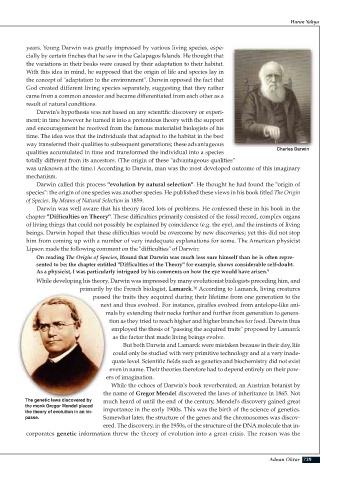
                                                                                                                             Charles Darwin
             qualities accumulated in time and transformed the individual into a species
             totally different from its ancestors. (The origin of these "advantageous qualities"
             was unknown at the time.) According to Darwin, man was the most developed outcome of this imaginary

             mechanism.
                 Darwin called this process "evolution by natural selection". He thought he had found the "origin of
             species": the origin of one species was another species. He published these views in his book titled The Origin

             of Species, By Means of Natural Selection in 1859.
                 Darwin was well aware that his theory faced lots of problems. He confessed these in his book in the
             chapter "Difficulties on Theory". These difficulties primarily consisted of the fossil record, complex organs
             of living things that could not possibly be explained by coincidence (e.g. the eye), and the instincts of living
             beings. Darwin hoped that these difficulties would be overcome by new discoveries; yet this did not stop

             him from coming up with a number of very inadequate explanations for some. The American physicist
             Lipson made the following comment on the "difficulties" of Darwin:
                 On reading The Origin of Species, Ifound that Darwin was much less sure himself than he is often repre-
                 sented to be; the chapter entitled "Difficulties of the Theory" for example, shows considerable self-doubt.
                 As a physicist, I was particularly intrigued by his comments on how the eye would have arisen.          9

                 While developing his theory, Darwin was impressed by many evolutionist biologists preceding him, and
                                     primarily by the French biologist, Lamarck. According to Lamarck, living creatures
                                                                                        10
                                           passed the traits they acquired during their lifetime from one generation to the

                                              next and thus evolved. For instance, giraffes evolved from antelope-like ani-
                                                mals by extending their necks further and further from generation to genera-
                                                  tion as they tried to reach higher and higher branches for food. Darwin thus
                                                   employed the thesis of "passing the acquired traits" proposed by Lamarck

                                                    as the factor that made living beings evolve.
                                                        But both Darwin and Lamarck were mistaken because in their day, life
                                                    could only be studied with very primitive technology and at a very inade-
                                                   quate level. Scientific fields such as genetics and biochemistry did not exist

                                                  even in name. Their theories therefore had to depend entirely on their pow-
                                                 ers of imagination.
                                                   While the echoes of Darwin's book reverberated, an Austrian botanist by
                                               the name of Gregor Mendel discovered the laws of inheritance in 1865. Not
            The genetic laws discovered by     much heard of until the end of the century, Mendel's discovery gained great
            the monk Gregor Mendel placed
            the theory of evolution in an im-  importance in the early 1900s. This was the birth of the science of genetics.
            passe.                             Somewhat later, the structure of the genes and the chromosomes was discov-
                                               ered. The discovery, in the 1950s, of the structure of the DNA molecule that in-

             corporates genetic information threw the theory of evolution into a great crisis. The reason was the


                                                                                                                          Adnan Oktar    739

