


Page 744 - Atlas of Creation Volume 1
P. 744
Trial and Error: Punctuated Equilibrium


                       Most of the scientists who believe in evolution accept the neo-Darwinist theory of slow, gradual evolution.
                  In recent decades, however, a different model has been proposed. Called "punctuated equilibrium", this model
                  maintains that living species came about not through a series of small changes, as Darwin had maintained, but
                  by sudden, large ones.

                       The first vociferous defenders of this notion appeared at the beginning of the 1970s. Two American paleon-
                  tologists, Niles Eldredge and Stephen Jay Gould, were well aware that the claims of the neo-Darwinist theory
                  were absolutely refuted by the fossil record. Fossils proved that living organisms did not originate by gradual

                  evolution, but appeared suddenly and fully-formed. Neo-Darwinists were living with the fond hope-they still
                  do-that the lost transitional forms would one day be found. Realising that this hope was groundless, Eldredge
                  and Gould were nevertheless unable to abandon their evolutionary dogma, so they put forward a new model:
                  punctuated equilibrium. This is the claim that evolution did not take place as a result of minor variations but
                  rather in sudden and great changes.

                       This model was nothing but a model for fantasies. For instance, European paleontologist O.H. Shindewolf,
                  who led the way for Eldredge and Gould, claimed that the first bird came out of a reptile egg, as a "gross muta-
                                                                                                                12
                  tion", that is, as a result of a huge "accident" that took place in the genetic structure. According to the same the-
                  ory, some land-dwelling animals could have turned into giant whales having undergone a sudden and
                  comprehensive transformation. These claims, totally contradicting all the rules of genetics, biophysics, and bio-
                  chemistry are as scientific as the fairy tales about frogs turning into princes! Nevertheless, being distressed by
                  the crisis that the neo-Darwinist assertion was in, some evolutionist paleontologists embraced this theory,
                  which had the distinction of being even more bizarre than neo-Darwinism itself.

                       The only purpose of this model was to provide an explanation of the gaps in the fossil-record that the neo-
                  Darwinist model could not explain. However, it is hardly rational to attempt to explain the fossil gap in the
                  evolution of birds with a claim that "a bird popped all of a sudden out of a reptile egg", because by the evolu-

                  tionists' own admission, the evolution of a species to another species requires a great and advantageous change
                  in genetic information. However, no mutation whatsoever improves the genetic information or adds new in-
                  formation to it. Mutations only derange genetic information. Thus the "gross mutations" imagined by the punc-
                  tuated equilibrium model would only cause "gross", that is "great", reductions and impairments in the genetic
                  information.

                       Moreover, the model of "punctuated equilibrium" collapses from the very first step by its inability to ad-
                  dress the question of the origin of life, which is also the question that refutes the neo-Darwinist model from the
                  outset. Since not even a single protein can have originated by chance, the debate over whether organisms made

                  up of trillions of those proteins have undergone a "punctuated" or "gradual" evolution is senseless.
                       In spite of this, the model that comes to mind when "evolution" is at issue today is still neo-Darwinism. In
                  the chapters that follow, we will first examine two imaginary mechanisms of the neo-Darwinist model and then
                  look at the fossil record to test this model. After that, we will dwell upon the question of the origin of life, which
                  invalidates both the neo-Darwinist model and all other evolutionist models such as "evolution by leaps".

                       Before doing so, it may be useful to remind the reader that the reality we will be confronting at every stage
                  is that the evolutionary scenario is a fairy-tale, a great deceit that is totally at variance with the real world. It is
                                                                                                    a scenario that has been used to de-

                                                                                                    ceive the world for 140 years. Thanks
                                                                                                    to the latest scientific discoveries, its
                                                                                                    continued defence has at last become
                                                                                                    impossible.


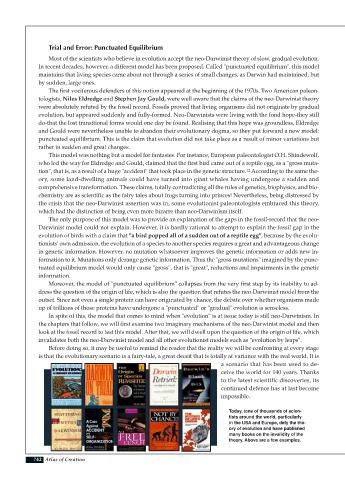
                                                                                                        Today, tens of thousands of scien-
                                                                                                        tists around the world, particularly
                                                                                                        in the USA and Europe, defy the the-
                                                                                                        ory of evolution and have published
                                                                                                        many books on the invalidity of the
                                                                                                        theory. Above are a few examples.


                742 Atlas of Creation

